
Your cart is empty.
Keep shopping
Forward Deployed Engineering: Build and Lead AI Teams
Role Play
New
627 students
Forward Deployed Engineering: Build and Lead AI Teams
Master FDE roles, AI discovery, architecture, secure deployment, productization, leadership, and business impact.
Created byArjun Vaid, School of AI
Last updated 9/2026
English
English [Auto],
What you'll learn
- Lead an enterprise AI deployment from customer discovery through architecture, production, adoption, and measurable business impact.
- Evaluate customer workflows, AI opportunities, data readiness, constraints, stakeholders, and value hypotheses before committing to a solution.
- Design production AI architectures using models, RAG, agents, APIs, enterprise integrations, evaluations, guardrails, and human approval.
- Build secure and reliable AI deployment plans covering identity, privacy, observability, SLOs, release controls, rollback, and production readiness.
- Manage complex customer deployments using milestones, decision rights, risk management, escalation, go-live planning, and operational handoffs.
- Turn successful customer deployments into reusable product capabilities while measuring adoption, ROI, business outcomes, and organizational scale.
Explore related topics
Coding Exercises
This course includes our updated coding exercises so you can practice your skills as you learn.
See a demo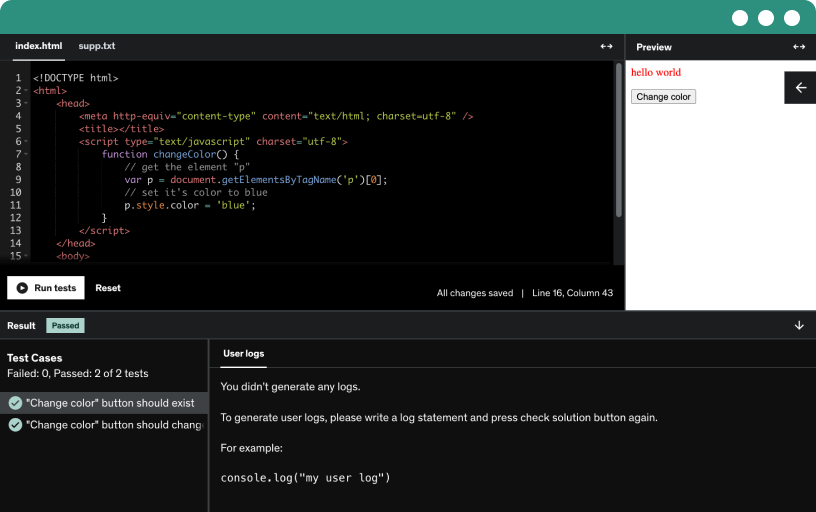
Course content
13 sections • 146 lectures • 12h 14m total length
Requirements
- A basic understanding of software systems, APIs, cloud applications, or enterprise technology is helpful.
- Familiarity with AI or generative AI concepts is useful, but deep machine learning expertise is not required.
- No prior Forward Deployed Engineer title or customer deployment experience is required.
Description
This course contains the use of artificial intelligence.
Forward Deployed Engineering sits at the intersection of software engineering, AI architecture, customer delivery, product development, and technical leadership. This course teaches you how forward deployed teams take complex enterprise problems from discovery through architecture, implementation, production deployment, adoption, and measurable business impact.
Learn How to Build and Lead Enterprise AI Deployments from Customer Problem to Production
You will learn how Forward Deployed Engineers, Forward Deployed Software Engineers, AI FDEs, architects, deployment strategists, platform engineers, security engineers, product managers, technical deployment leads, and FDE leaders work together on real customer deployments.
The course begins with the foundations of Forward Deployed Engineering and the different roles and career paths within an FDE organization. You will learn how to enter a customer environment, discover operational problems, identify stakeholders, evaluate whether AI is appropriate, assess data and integration readiness, and turn customer needs into measurable outcomes.
You will then move into AI solution architecture and technical delivery. You will learn how to separate deterministic software from probabilistic AI, choose between RAG, agents, automation, and traditional software, design enterprise integrations, establish evaluation criteria, and incorporate human approval where AI decisions require oversight.
Production readiness is treated as a core engineering responsibility. You will work with AI evaluations, release gates, security controls, identity and permissions, privacy requirements, prompt-injection risks, observability, reliability, latency, cost controls, rollback procedures, and production-readiness reviews.
The course also develops the leadership skills required to run complex deployments. You will learn how to define milestones, decision rights, dependencies, delivery workstreams, risk registers, escalation paths, go-live criteria, hypercare, and operational handoffs while coordinating customer and internal engineering teams.
Beyond deployment, you will learn how to measure adoption, ROI, workflow improvement, customer outcomes, and product signals. You will examine how successful customer work can become reusable integrations, reference architectures, evaluation frameworks, security patterns, and scalable product capabilities instead of permanent one-off customizations.
Hands-on labs, coding exercises, quizzes, role-play scenarios, and an end-to-end capstone give you opportunities to apply these concepts. Throughout the course, you will work with an Enterprise AI Claims Assistant case study that connects discovery, architecture, evaluation, security, deployment, productization, organizational design, and business outcomes.
By the end of the course, you will have a practical framework for contributing to, designing, leading, and scaling forward deployed AI engagements—and for explaining those skills in architecture discussions, customer situations, leadership roles, and FDE interviews.
Who this course is for:
- Software engineers and AI engineers who want to move into customer-facing Forward Deployed Engineering roles.
- Solutions architects, technical leads, and platform engineers responsible for designing and deploying enterprise AI systems.
- Engineering managers, FDE managers, and technical leaders who need to build, staff, and scale forward deployed teams.
- Technical consultants, implementation engineers, and deployment professionals who want stronger engineering, architecture, and AI delivery skills.
- Product, architecture, and delivery leaders who turn customer AI deployments into measurable outcomes and reusable product capabilities.