Je winkelwagentje is leeg.
Verder winkelen

Lesgeven op Udemy
Bereik wereldwijd miljoenen mensen door optimaal gebruik te maken van je kennis.
Meer informatieSQL for Beginners, Managers, Marketing: Learn SQL
Score 4,4 van de 54,4(386 scores)
2.456 studenten
SQL for Beginners, Managers, Marketing: Learn SQL
Learn SQL for Data Analytics. Database + SQL Concepts applicable to MySQL, PostgreSQL, Oracle, and Microsoft SQL Server
Gemaakt doorFaisal Memon (EmbarkX), Phil Ebiner, Video School, EmbarkX Official
Laatst bijgewerkt: 1-2026
Engels
Wat je leert
- Learn SQL for data analysis
- Write SQL queries on their own confidently
- Get a job or promotion by understanding SQL
- Help Data Analysts, Marketers, Product Managers, or any non-tech person learn SQL and analyze data on your own
- Apply your skills to Databases like MySQL, PostgreSQL, Oracle, and Microsoft SQL Server
- Compile data (Data Analytics) into comprehensive data reports for use in decision-making
- Gain hands-on experience in using SQL for real-world data analytics scenarios to influence business decisions
- Use SQL to track and understand user behavior and engagement, crucial for product development and marketing strategy
- Group and segment data using SQL to gain deeper insights
- Create and analyze funnels, measuring the effectiveness of marketing campaigns using advanced SQL
- Calculate crucial revenue metrics using SQL like ARR, MRR, and ARPU
Verwante onderwerpen verkennen
Codeeroefeningen
Deze cursus bevat onze bijgewerkte codeeroefeningen, zodat je je vaardigheden kunt oefenen terwijl je leert.
Bekijk een demo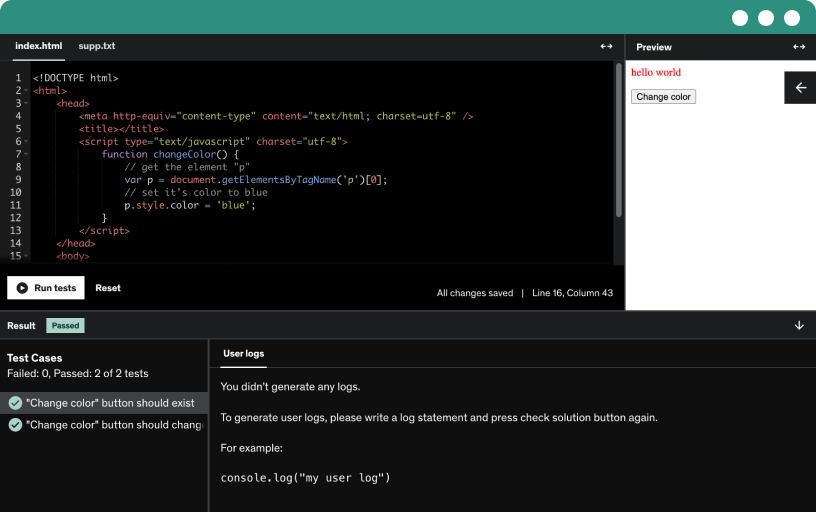
Cursusinhoud
10 secties • 76 colleges • Totale lengte van 6u 0m
- Introduction to our SQL for Beginners Course3:11
**Practical SQL for Beginners, Product Managers, Marketing**
Welcome to our Practical SQL for Beginners, Product Managers, and Marketing course! We're thrilled to have you join us on this exciting journey to master SQL. Feisal, our lead instructor, and the entire team are here to guide you through this enriching learning experience.
**Key Learning Objectives:**
1. **Course Introduction:** Get acquainted with the course and our enthusiastic instructor, Feisal. Discover the benefits of enrolling in our comprehensive SQL course tailored for beginners, product managers, and marketing professionals.
2. **Application-Centric Learning:** Dive into SQL concepts using real-world scenarios within the hypothetical ride startup, Hop Ride. Engage with the material by exploring how SQL is practically used in different application scenarios.
3. **User-Friendly Learning Environment:** Learn with ease using Repl.it, an online, browser-based coding editor. No complex software needed. Faisal ensures a non-technical background won't hinder your progress.
4. **Accessible Resources:** Access downloadable resources and sample data to enhance your learning. These materials will support your practical understanding of SQL concepts.
5. **Learning Optimization Tips:**
- Set Learning Reminders: Customize learning reminders through the mobile app to maintain consistency and motivation.
- Effective Note-Taking: Learn the importance of note-taking and how it aids retention. Utilize digital or physical notes for reference.
- Dual-Screen Advantage: Optimize your learning by using dual screens for video lessons and practicing coding simultaneously.
6. **Hands-On Practice:** Immerse yourself in hands-on, practical examples. Write code as you learn to gain real-world experience with SQL concepts.
7. **Claim Your Certificate:** Upon completing the course, download a certificate of completion. Showcase it on your resume, LinkedIn profile, or in your pursuit of career advancements.
8. **Q&A Support:** Utilize the Q&A forum on your course dashboard whenever you need assistance. Feisal is committed to addressing your questions and concerns throughout your learning journey.
Enroll today to enhance your SQL skills, advance your career, and confidently navigate databases for improved decision-making. We're excited to empower you with practical SQL knowledge. Let's embark on this educational adventure together!
**Related Keywords and Keyphrases:**
- SQL basics
- Practical SQL learning
- SQL for beginners
- SQL for product managers
- SQL for marketing professionals
- Repl.it coding editor
- Application-centric SQL
- Hands-on SQL practice
- SQL certificate of completion
- Learning optimization tips
- Dual-screen learning
- Q&A support
- SQL career advancement
- SQL skills enhancement
- SQL knowledge enrichment
- Online SQL course
- SQL tutorial
- SQL for non-technical background
- SQL database management
- SQL decision-making
- Understanding Databases and Tables | SQL Course5:16
Welcome to your comprehensive class on databases and tables. In this lesson, we'll dive into the foundational concepts that underpin database management.
Imagine a room filled with countless files and documents. You need an efficient system to keep track of them. This is where databases come in – your information superheroes. Databases enable you to store, organize, and manage vast amounts of data effectively.
A database is a structured collection of data equipped with powerful tools for retrieval and management. Think of it as your trusted tool for finding and storing information neatly. A bookish definition states that a database is a structured repository that facilitates efficient data organization and retrieval.
Within databases, tables take center stage. A database table is a structured arrangement of data that's organized in rows and columns. Rows represent individual instances, while columns hold specific pieces of information. Visualize it like an Excel sheet, where each row holds data for a particular entity, and columns hold attributes about that entity.
Relational databases take this concept further. They're structured to store data in rows and columns, enhancing organization and accessibility. Tables are integral to relational databases, ensuring information is structured and easily queried.
Let's grasp this with an example. Imagine a car rental company's database. The "Rentals" table stores data on car make, model, rental period, and more, with each row representing a distinct rental instance.
Tables simplify data management, providing a structured format for storage, modification, and retrieval. They empower data analysis and decision-making, giving insights into your information landscape.
So, to recap, databases and tables are your data's best friends, providing structured organization and streamlined accessibility. Hopefully, this lecture has clarified their significance. Stay tuned for more enlightening lessons!
- Overview of SQL and Its Importance4:14
Welcome to the introduction of SQL and its vital significance. Let's delve into the core concepts that shape SQL and its importance.
SQL, or Structured Query Language, is a specialized language used for the management, manipulation, and querying of relational databases. Imagine you have a relational database with tables storing data. SQL serves as the language that enables communication and interaction with these tables.
SQL offers an array of capabilities:
1. **Data Management and Manipulation:** You can insert, update, and delete records in the database, along with modifying the database's structure. Operations like creating, altering, or dropping tables and columns are facilitated through SQL.
2. **Data Analysis and Reporting:** SQL empowers data analysis, enabling complex tasks like filtering, sorting, aggregation, and generating insights for informed decision-making.
3. **Joining Data:** SQL facilitates the combination of data from multiple tables through joins, aiding in comprehensive analysis and reporting.
Now, let's address the question: Why should you learn SQL?
- For Product Managers, SQL becomes a powerful tool to analyze user behavior, evaluate feature performance, and make data-driven product enhancement decisions.
- Marketers can leverage SQL to segment users, track marketing campaigns, and gauge the effectiveness of their efforts, leading to optimized strategies.
- Non-technical professionals across various roles, including analysts, project managers, and operations professionals, can benefit from SQL's versatility when working with data.
Learning SQL offers advantages such as:
1. **Reduced Dependency:** By acquiring SQL skills, you can reduce reliance on others for data analysis and become more self-sufficient.
2. **Independence:** You can analyze data, perform marketing campaign assessments, and handle data-related tasks without relying heavily on specialized team members.
In essence, SQL serves as the language that bridges the gap between you and databases, enabling you to interact with data and glean insights independently. It's an essential skill for professionals across domains who work with data-driven decision-making.
So, to sum it up, SQL stands for Structured Query Language, a versatile tool for communicating with databases and tables. Mastering SQL empowers you to analyze, manage, and manipulate data effectively. It's a must-have skill in today's data-centric landscape.
Thank you for joining this class, and I look forward to our upcoming sessions.
- What are the Primary Keys? | SQL Course5:01
Let's delve into the concept of primary keys, a vital component of relational databases.
In the world of tables and databases, primary keys play a significant role. Each table has one or more columns designated as a primary key. The primary key is a crucial concept that enables the unique identification of each record in the table and ensures data consistency.
To put it simply, a primary key is a unique identifier for each row in a table. It serves the purpose of linking related data between tables, fostering efficient data management.
Consider a table storing user information like name, city, and state. Without a primary key, it's challenging to uniquely identify customers. For instance, if two "Johns" reside in the same city and state, differentiation becomes problematic.
Enter the customer ID, which functions as the primary key. Just as companies assign unique employee IDs, the customer ID uniquely distinguishes each customer's record.
In another scenario, let's examine the database of a car rental company. The "Rental ID" column serves as the primary key, ensuring distinct identification of each rental record.
Key characteristics of primary keys:
1. **Unique:** Each record must have a distinct primary key value, preventing duplicates.
2. **Non-Null:** Primary key values cannot be missing or empty, ensuring data completeness.
3. **Immutable:** Once assigned, primary key values remain constant, ensuring data integrity.
In essence, a primary key is a unique identifier that enables the precise identification of records in a table. It maintains data integrity, prevents duplicates, and enhances data management.
Mastering primary keys is essential for anyone working with databases and tables, as they form the cornerstone of efficient data organization and retrieval.
Thank you for engaging with this lecture on primary keys, and I eagerly await our upcoming sessions.
- NULLs in Table | SQL Course2:15
Let's delve into the concept of "nulls" in tables, a significant aspect of data representation.
In the realm of tables, "null" serves as a distinct marker indicating the absence of a value. Unlike an empty string, zero, or any default value, null is a special marker that represents an unknown, missing, or inapplicable value within a table.
The importance of null lies in its ability to provide flexibility in data storage. It aids in maintaining data integrity and assists in distinguishing between unknown and not applicable values. Null values are especially useful when handling situations where data is incomplete or unavailable.
For instance, consider an "employee" table. Jane Doe's entry includes a null value for the phone number, indicating its absence. On the other hand, John Smith's entry features a phone number, signifying its presence. Here, null signifies the absence of a value, specifically Jane's phone number.
When working with null values, caution is advised during calculations and comparisons. SQL offers built-in functions like "is null," "is not null," and "coalesce" to handle null values efficiently.
In summary, null is a fundamental concept in tables, indicating the absence or inapplicability of a value. Understanding how null works and how it's represented in databases is crucial when working with data.
I trust this overview clarifies the concept of nulls in SQL. I look forward to our next session together.
Thank you.
- A Quick Note for You0:38
- Introduction to Replit | SQL Course4:25
Welcome to this class! In this session, we'll be discussing an introduction to Replit, a powerful online platform for SQL and various other programming languages.
Replit is an online Integrated Development Environment (IDE) that allows users to write, run, and share code across a range of programming languages, including SQL. This user-friendly web-based environment is an excellent choice for learners, especially non-technical ones, who want to practice SQL without the need for setting up local environments or installing software on their systems. With Replit, you can directly start coding in your browser without any hassle.
Key features of Replit include:
1. **Browser-Based:** No need to install anything; just open your browser and start coding.
2. **Support for Multiple Languages:** Replit supports SQL and more than 50 other programming languages.
3. **Collaboration:** You can collaborate with team members and easily share your code with others.
4. **Version Control:** Replit includes a version control system, allowing you to track changes and revert to previous versions if needed.
5. **Integrated Database:** Replit provides an integrated database that enables you to execute queries and explore results.
To get started, you can visit the Replit website (replit.com) and sign up for a free account. When you land on the website, you'll notice various features highlighted, such as the ability to code fast with AI, build projects in any programming language without setup, and deploy projects instantly. Replit also offers a mobile app for coding on the go.
To create a Replit account, you can sign up using your Google or GitHub account, or you can use your email address to create an account. After signing up, you'll receive an email verification request to complete the account creation process.
So, head over to Replit, create an account, and explore the platform's features. This marks the end of this class, and I'll be seeing you all soon for the next session.
Thank you!
- Getting Started | SQL Course7:06
Welcome back! I hope you had the opportunity to create your Replit account. During the sign-up process, Replit might ask for additional information such as your role and purpose for using the platform. Please note that the onboarding experience may vary, but the core functionality remains consistent.
Now, let's take a closer look at the Replit dashboard:
1. **Creating a Repl:** At the top left corner, there's an option to "Create a Repl." Clicking this opens a popup where you can select a template. Choose the "SQL" template to start working with SQL queries.
2. **Title:** You can give your Repl a title. The title can be customized to reflect the purpose of your project. You'll see that the platform generates a default title, but you can change it to something more relevant, like "SQL Learnings."
3. **Read Eval Print Loop (REPL):** Replit stands for "Read Eval Print Loop." This term refers to an interactive programming environment that allows you to run, write, and debug code. Repl.it is essentially an online platform for running REPLs.
4. **Tutorial:** Replit provides an interactive tutorial to familiarize you with the different components of the platform, including the code editor, console, and collaboration features.
5. **Code Editor:** The code editor is where you write your SQL queries. It supports syntax highlighting, which means that keywords and elements of your code are color-coded for better readability.
6. **Console:** The console is where you'll see the output of your SQL queries. When you run a query, the results will be displayed here.
7. **Collaboration:** Replit allows collaboration, similar to Google Docs. You can invite others to your Repl and work together in real time.
8. **File Management:** You can create multiple files within your project, and the sidebar provides options for managing files and accessing tools like packages, debugger, and more.
9. **Running Code:** The "Run" button at the top allows you to execute your SQL code and view the output in the console.
10. **Forking a Repl:** In the Replit dashboard, you can explore other Repls. If you come across a project you're interested in, you can fork it, which creates a copy of the project in your account. You can then make changes to the forked copy without affecting the original project.
Remember that Repl.it automatically saves your work as you type, eliminating the need for manual saving.
In this session, you've learned how to create a Repl, navigate the platform's features, and understand the concept of forking a project. Replit offers a convenient and user-friendly environment for practicing SQL and various other programming languages.
That's all for this class! I look forward to our next session. Thank you!
- Setting up things | SQL Course6:05
**Setting Up for Practical SQL Learning**
Welcome to the setup phase of our Practical SQL for Beginners, Product Managers, and Marketing course. In this video, we'll guide you through the process of setting up your learning environment on Replit.
**Key Learning Objectives:**
1. **Replit Navigation:** Learn how to navigate within Replit. Log in to your Replit account and locate your repl under the "Recent Repls" section on the dashboard. Alternatively, use the "My Repl" hover option or click the "My Repl" icon to access your created Repl.
2. **History Tracking:** Understand how to utilize the history feature. This feature allows you to review changes made to your code over time, providing an effective way to undo changes and track your progress.
3. **Writing Your First Query:** Witness a basic SQL query example that displays "Hello, world." Learn how to run the query and observe the output. Note that the code is being written in "main.sql" by default.
4. **Interface Customization:** Explore interface options to maximize your coding space. Hide the file explorer sidebar to create more room for code writing. Switch between home and specific file views effortlessly.
5. **Setup with Sample Data:** Discover how to set up the learning environment by importing initial data into your Repl. Access the provided text file containing SQL commands to create and populate a user table.
6. **Hands-On Learning:** Gain an understanding of the application-centric approach. Utilize sample data from the hypothetical ride startup, "Hop Ride," as we work through real-world scenarios using SQL queries.
7. **Importance of Test Data:** Grasp the significance of test data. This data allows you to practice and experiment with SQL queries, enabling hands-on learning.
Upon completing the setup process, you'll be ready to dive into practical SQL learning. We're excited to accompany you on this enlightening journey as you become proficient in SQL concepts and applications.
**Related Keywords and Keyphrases:**
- Replit setup for SQL learning
- Navigating Replit for beginners
- History tracking in coding
- Running SQL queries on Replit
- Interface customization for coding
- Setting up SQL learning environment
- Sample data for SQL practice
- Application-centric SQL learning
- Hands-on SQL practice with test data
- SQL query examples for beginners
- SQL commands for creating tables
- "Hop Ride" startup data
- Practical SQL applications
- SQL learning environment setup
- Replit interface optimization
- Hands-on coding with SQL
- SQL learning with sample data
- SQL data manipulation practice
- SQL query output observation
- Basic SQL queries (SELECT, FROM, WHERE) | SQL Course7:57
**Basic SQL Queries: SELECT, FROM, and WHERE**
In this class, we'll delve into the basics of SQL and start crafting simple SQL queries using the SELECT, FROM, and WHERE keywords. These keywords are fundamental for creating queries that retrieve specific data from a database table.
**Key Learning Points:**
1. **Anatomy of SQL Query:** Understand the essential components of an SQL query: SELECT, FROM, and WHERE. These keywords form the foundation for querying data.
2. **SELECT Keyword:** The SELECT keyword specifies which columns you want to retrieve from the database table. You can select individual columns or use the wildcard (*) to fetch all columns.
3. **FROM Keyword:** The FROM keyword specifies the table from which you want to fetch data. In databases with multiple tables, this keyword indicates which table to access.
4. **WHERE Clause:** The WHERE clause is used to filter and retrieve specific rows that match a given condition. It allows you to narrow down your query results to meet specific criteria.
**Step-by-Step Explanation:**
- Start by understanding the basic structure of an SQL query: SELECT, FROM, and WHERE.
- In Replit, use the "replit-specific" syntax to load the data file that contains the table you want to query. This is done using the `.read` command followed by the filename.
- Write your first query to retrieve specific columns from the loaded table. For example, if the table is named "users," you can select columns like "user_id," "first_name," and "last_name" using the SELECT keyword.
- To improve the readability of the query output, use the `headers.on` command to enable column headers and `mode.column` to format the output in column mode.
- Experiment with various columns and data output options to familiarize yourself with the query structure.
- Introduce the WHERE clause to filter query results based on specific conditions. For example, retrieve users from a specific city, such as "New York."
**Key Takeaways:**
- SELECT specifies which columns to retrieve.
- FROM indicates the table from which to fetch data.
- WHERE filters data based on specified conditions.
- Loading data and enabling formatting are necessary housekeeping steps in Replit.
Mastering these basic SQL concepts is the foundation for effectively querying and analyzing data in databases. These fundamental principles will be the building blocks as you progress to more complex queries and data manipulation tasks.
- Filtering users based on City | SQL Basic Queries
- Comments | SQL Course3:41
**Understanding Comments in SQL**
In this class, we'll explore the concept of comments in SQL, which are essential for providing explanations, context, and notes within your code. Comments are not executed as part of the SQL query; instead, they serve as annotations to make your code more understandable and maintainable.
**Key Concepts:**
1. **What are Comments:** Comments are brief explanations or notes added to your SQL code. They help make your code more comprehensible for you and your team members, providing insights into the purpose and functionality of specific parts of the code.
2. **Single-Line Comments:** Single-line comments are used for short explanations that apply to a single line of code. You create single-line comments in SQL by using two hyphens (--) followed by your comment text. Single-line comments are highlighted in a different color and are ideal for quick notes.
3. **Multi-Line Comments:** Multi-line comments are used when you need to provide more detailed explanations that span multiple lines of code. You can use the single-line comment syntax to create multi-line comments by duplicating the comment syntax on each line. Alternatively, you can enclose your comment text between `/*` and `*/` to explicitly create a multi-line comment block.
**Advantages of Using Comments:**
- **Clarity and Readability:** Comments make your code more readable by explaining the purpose and logic behind each part.
- **Context:** Comments provide context for complex or intricate sections of code, making it easier for you and others to understand the logic.
- **Notes for Future:** By adding comments, you can leave notes to yourself or your team members about the rationale behind certain decisions or steps.
**Example Demonstration:**
- Use the `--` syntax to create single-line comments, and observe how the comment text is highlighted differently from the actual code.
- Understand that you can convert single-line comments into multi-line comments by repeating the comment syntax on multiple lines.
- Alternatively, create explicit multi-line comments using the `/*` and `*/` syntax. This is especially useful for more detailed explanations that span several lines.
- Recognize the importance of using comments for maintaining your code's readability and context, especially when dealing with complex queries or analysis tasks.
By integrating comments into your SQL code, you contribute to creating well-documented and easily understandable scripts, enhancing collaboration and efficient problem-solving among team members.
- Section Summary | SQL Course5:59
**Practical SQL for Beginners, Product Managers, and Marketing Professionals**
Welcome to an engaging lecture where we'll distill the key takeaways from this section on Practical SQL for Beginners, Product Managers, and Marketing Professionals.
In this segment, we delved into the foundational aspects of databases and SQL, empowering you to efficiently handle data for better insights. We explored the essence of a database as a structured reservoir for information, meticulously organized to facilitate effective retrieval and management.
Moving forward, we uncovered the significance of tables – reminiscent of spreadsheets – that house data in an organized structure of rows and columns. With this visual representation, we grasped the interplay of data arrangement within these tables, emphasizing both rows' information and columns' distinct attributes.
A crucial insight was the concept of a relational database. This paradigm, frequently invoked in the realm of data analysis, hinges on storing data in rows and columns, thereby establishing relationships that underpin data-driven insights.
Our foray into SQL, the cornerstone of database interaction, furnished the necessary skills for communicating with data repositories. We observed how SQL's structured query language serves as a conduit to access, filter, and manipulate data in databases, aligning perfectly with the needs of product managers and marketing professionals seeking to harness data for strategic decision-making.
Crucially, the notion of a primary key surfaced as a lynchpin for uniquely identifying individual entries within a table. This key serves as a linchpin for linking related data across tables, enabling a seamless synergy between datasets.
Addressing the reality of missing data, we discovered the apt representation using NULL, acting as a placeholder for absent values. This practice ensures the integrity of data analysis and strategic decisions.
An introduction to Replit, an intuitive online coding environment, democratized coding for learners, obviating the complexity of software installation and configuration. A boon for beginners seeking an expedited journey into the realm of coding.
The anatomy of a SQL query unfolded as we analyzed the three pivotal components: SELECT, FROM, and WHERE. These elements, though basic, paved the way for crafting powerful queries for retrieving precise information from tables.
Concluding this segment, we deciphered the significance of comments in SQL – a non-executable code feature that enhances code documentation and readability. This paves the way for clear communication within collaborative projects.
As you wrap up this section, equipped with practical skills in SQL and database management, you're poised to traverse the dynamic landscapes of product management and marketing with data-driven proficiency.
**Key Learning Objectives:**
- Grasp the essence of databases as structured data repositories.
- Comprehend the role of tables in organizing data with rows and columns.
- Understand the concept of a relational database and its relevance.
- Harness SQL for effective communication and manipulation of data.
- Utilize primary keys to establish data relationships.
- Learn techniques to handle missing data using NULL.
- Explore Replit as an accessible coding environment.
- Master the anatomy of a SQL query.
- Employ comments for enhanced code documentation and readability.
**Keywords and Keyphrases:**
- Practical SQL for Beginners
- Product Managers
- Marketing Professionals
- Database Management
- Structured Query Language
- Relational Database
- Primary Key
- Missing Data Handling
- Replit Online Coding Environment
- SQL Query Anatomy
- Comments in SQL
- Data Retrieval
- Data Manipulation
- Data Relationships
- Data Integrity
- Coding for Beginners
- Strategic Decision-making
- Database Structure
- Data Analysis Techniques
- Section Introduction: Data Analysis with SQL2:15
**Mastering Basic Data Analysis with SQL: Practical Techniques for Data Enthusiasts**
Welcome to an exciting class where we're about to embark on a journey through the world of SQL, uncovering foundational techniques that empower you to perform basic data analysis. In this section, you'll gain invaluable skills in writing fundamental queries and harnessing SQL's power to extract insights from your data.
Our exploration commences with an overview of diverse data types within SQL. From numbers to strings, characters to dates, we'll delve into the intricacies of working with these data types, equipping you with the versatility to store and manipulate information effectively.
Ever wondered how to tally the number of rows within your result set? Our tutorial will unveil the technique of row counting, an essential skill when you need to quantify specific results. Imagine determining the number of users in the United States using your ridesharing app – this technique becomes indispensable.
Clear and concise outputs are essential for meaningful analysis and reporting. We'll guide you through optimizing column names in your outputs, enhancing the readability and utility of your findings.
Operators are the backbone of SQL, facilitating dynamic data retrieval. Our comprehensive overview of SQL operators will empower you to perform nuanced data selection based on diverse criteria, aligning perfectly with your analytical needs.
To ground these techniques in real-world application, we'll introduce you to our hypothetical startup, "Hop Ride." Through engaging scenarios, you'll witness the practical implications of SQL concepts, solidifying your understanding.
By the culmination of this section, you'll possess the ability to conduct basic data analysis using SQL. Your newfound skills will empower you to navigate through data, extract insights, and drive informed decisions.
**Key Learning Objectives:**
- Gain proficiency in writing basic SQL queries.
- Understand and manipulate various SQL data types.
- Master the art of row counting for result analysis.
- Enhance output readability through optimized column names.
- Utilize SQL operators for dynamic data retrieval.
- Apply SQL concepts to practical scenarios within a startup environment.
**Keywords and Keyphrases:**
- Basic Data Analysis
- SQL Techniques
- SQL Data Types
- Row Counting
- Output Optimization
- SQL Operators
- Practical Application
- Startups and Data Analysis
- Data Insights
- Informed Decision-making
- SQL Query Writing
- Analytical Skills
- Data Manipulation
- Real-world Scenarios
- SQL Learning
- Data Exploration
- Startup Environment
- Data Enthusiasts
- SQL Fundamentals
- Getting users from a city on a particular date | SQL Course8:01
**Filtering Data: SQL AND Clause Explained**
Welcome to this informative lesson where we delve into the powerful world of SQL's AND clause, an essential tool for refining your data queries. By the end of this session, you'll be equipped to extract precise datasets based on multiple conditions.
Let's begin by addressing a common query: how to retrieve users from a specific city on a particular date? We'll navigate through the steps of constructing this query, unveiling the capabilities of the SQL AND clause.
Imagine you have a table with user information, including their registration city and date. Using the AND clause, we can filter data based on both city and registration date simultaneously. By employing the logical AND keyword, we ensure that records must satisfy both conditions to be included in the output.
During our journey, we encounter SQL's inherent functions. For instance, if your data includes date-time formats, extracting the date can be achieved through the DATE function. We demonstrate how this function simplifies the process and ensures accurate comparisons.
As we delve into the details, remember that SQL keywords like AND are inbuilt and predefined within the language. They serve as essential tools for efficient data manipulation.
Our goal is to empower you to master SQL's AND clause for multifaceted data queries. Whether you're filtering users by city and date, or addressing more complex scenarios, this knowledge will be pivotal to obtaining precise and relevant results.
**Key Learning Points:**
- Understanding SQL's AND clause and its significance.
- Crafting queries with multiple conditions using the AND keyword.
- Utilizing the DATE function to extract dates from date-time formats.
- Navigating SQL's inbuilt keywords and functions for data manipulation.
**Keywords and Keyphrases:**
- SQL AND Clause
- Data Filtering
- Multiple Conditions
- Logical AND Keyword
- DATE Function
- Data Extraction
- Inbuilt Keywords
- Efficient Querying
- Precise Results
- Data Manipulation
- SQL Functions
- Query Optimization
- Filtering Chicago's Data
- Data Types | SQL Course8:08
**Understanding SQL Data Types: A Crucial Step in Database Management**
Welcome to a crucial lesson in our online course, "Practical SQL for Beginners, Product Managers, and Marketers." Today, we dive deep into the realm of SQL data types, a foundational concept in effective database management. This knowledge empowers you to make informed decisions about data storage, analysis, and manipulation.
Picture this: you're handling a diverse array of data, and knowing the right data type is like fitting puzzle pieces into the right slots. We explore common data types you'll encounter while working with SQL queries, such as integers, floats, text, date-time values, and booleans. These data types serve as the building blocks for structuring your database.
As we journey through the diverse world of data types, we take you through their definitions, applications, and even provide real-world examples. Whether it's integers for precise numeric values, floats for measurements, text for user names and product descriptions, or booleans for yes-or-no questions, understanding data types ensures accuracy and consistency.
But it doesn't end there. We unravel the intricacies of data type sizes, crucial for optimal storage. The space allocated for each column is carefully managed based on the data type. This efficiency translates to faster query execution, enhancing the performance of your database.
Imagine being equipped to design a database that's not only accurate but also efficient. Data types play a pivotal role in making this a reality. Our practical examples, ranging from car rental data to user information, highlight the strategic selection of data types for various columns.
Data accuracy, storage efficiency, and query performance are the trifecta of benefits brought by proper data type usage. A column defined as an integer will accept only whole numbers, ensuring data integrity. On the storage front, efficient allocation based on data types optimizes space. Query performance gets a boost as the database adapts its execution plan to the data types.
As we wrap up this enlightening session, keep in mind that the specifics of data types might vary across different databases, but the underlying concept remains consistent. Armed with this knowledge, you're now prepared to embark on a journey of well-structured and efficiently managed databases.
**Key Learning Objectives:**
- Grasp the significance of SQL data types in database management.
- Understand the different types of data, including integers, floats, text, date-time values, and booleans.
- Learn how data types impact data accuracy, storage efficiency, and query performance.
- Apply data types strategically to design efficient and accurate databases.
**Relevant Keywords and Keyphrases:**
- SQL Data Types
- Database Management
- Practical SQL
- Data Accuracy
- Storage Efficiency
- Query Performance
- Structuring Databases
- Integer Data Type
- Float Data Type
- Text Data Type
- Date-Time Data Type
- Boolean Data Type
- Efficient Data Storage
- Real-World Examples
- Data Type Sizes
- Database Design
- Online Course
- Practical Database Management
**Related Keywords and Keyphrases:**
- Database structure
- SQL queries
- Data integrity
- Data manipulation
- Database optimization
- SQL fundamentals
- Database design principles
- Data precision
- SQL data types explained
- Query optimization
- Efficient data management
- Structured query language
- SQL for beginners
- Database organization
- Data storage techniques
- Counting the users | SQL Course6:09
**Unlocking Data Insights: Counting Records in SQL for Effective Analysis**
Welcome back to your journey in mastering Practical SQL for Beginners, Product Managers, and Marketers. In this lesson, we delve into the transformative world of counting records, a crucial technique that arms you with potent data analysis tools.
We kick off by spotlighting the foundational concept of counting records in SQL. This pivotal skill allows you to explore user data in depth, revealing insights critical for product optimization and strategic marketing decisions.
Our tutorial commences by demonstrating how to pinpoint users who satisfy specific criteria. Imagine identifying individuals residing in New York City and registering on precise dates—a powerful technique for laser-focused audience targeting. These filtered results provide actionable insights, enhancing decision-making processes.
Diving deeper, we explore the mechanics of SQL queries that extract records meeting your criteria. We demystify the role of the 'WHERE' clause in filtering data, ensuring precision in your results.
Yet, we're not content with merely listing users. Our focus shifts to harnessing the COUNT function's potential. This function serves as your dynamic tally system, promptly quantifying records without manual enumeration. Rather than tallying rows one by one—a daunting task for large datasets—the COUNT function delivers swift results, saving time and bolstering accuracy.
Delving into syntax, we illustrate how to count specific column values. However, beware the nulls! Our tutorial clarifies how COUNT tallies non-null values, excluding nulls from your count.
What if we seek an overall count of records? Behold the power of an asterisk (*), replacing the column name. This approach unveils the total record count, a pivotal figure for holistic data evaluation.
To embed these concepts in real-world scenarios, we spotlight communication campaigns. Imagine gauging email campaign viability by tallying users with email IDs against the total. This technique aids campaign optimization, ensuring targeted outreach.
Concluding the lesson, we emphasize the versatility of COUNT. It's not just about numbers; it's about actionable insights. Whether you're a product manager refining strategies or a marketer shaping audience outreach, COUNT serves as your data analysis ally.
**Key Learning Objectives:**
- Grasp the foundational concept of counting records using the COUNT function.
- Understand the power of WHERE clauses in SQL queries for precision.
- Master COUNT's capability to quantify records swiftly and accurately.
- Differentiate between counting non-null values and total records using an asterisk (*).
- Apply COUNT to optimize communication campaigns and strategic decision-making.
**Keywords and Keyphrases:**
- Practical SQL for Beginners
- Product Managers and Marketers
- Counting Records in SQL
- WHERE Clause in SQL
- Data Analysis Techniques
- Precision Data Filtering
- SQL COUNT Function
- Efficient Record Tallying
- Counting Non-Null Values
- Total Record Count
- Decision-Driven Insights
- Communication Campaign Optimization
**Related Keywords and Keyphrases:**
- SQL Querying Skills
- Database Query Techniques
- Targeted Audience Outreach
- SQL for Marketing Analysis
- Strategic Decision-Making
- Audience Targeting Strategies
- Practical Data Manipulation
- SQL WHERE Clause Explained
- Data-Driven Marketing
- Record Count in SQL
- SQL Query Optimization
- SQL COUNT Function Examples
- Effective Data Analysis Techniques
- Practical SQL Applications
**List of Related Keywords and Keyphrases:**
- SQL Data Filtering
- Record Count Tutorial
- SQL Data Analysis
- Product Optimization
- Marketing Insights
- Data-Driven Decision-Making
- SQL WHERE Clause Usage
- Efficient Data Manipulation
- SQL Record Tally Techniques
- Campaign Strategy Optimization
- Audience Targeting in SQL
- Practical SQL Skills
- Strategic Data Analysis
- Counting Data Records
- SQL Query Best Practices
- Marketing Data Analysis
- SQL COUNT Syntax
- Data Insights for Marketers
- Practical SQL Applications
- Counting Los Angeles Residents
- Giving output column pretty names | SQL Course3:52
**Enhance Output Clarity: Using Column Aliases for Informative Results**
Welcome to another insightful class on SQL. In this session, we'll explore a vital technique—assigning meaningful names to output columns—helping you make sense of query results efficiently.
When executing queries, it's essential that your output columns bear clear and descriptive names. While counting user IDs or records, the formulaic column names may lack user-friendliness.
This is where column aliases come into play. These aliases enable you to provide user-friendly names to output columns, enhancing comprehension. In SQLite, you use the "AS" keyword followed by the desired alias name.
For instance, replacing the complex name "count(user_id)" with a concise alias like "num_users" is achieved using "AS num_users." Running this query now yields results displaying the user-friendly alias.
Remember, column aliases should be concise yet descriptive. While longer aliases are fine, excessively long names should be avoided.
But what if you desire spaces in your alias? Using spaces directly results in errors. To resolve this, enclose the alias in double quotes. For instance, "count(users)" as "count of users" is achieved through double quotes.
This strategy is especially valuable when dealing with complex queries generating multiple columns. By assigning well-thought-out aliases, you craft more informative output for comprehensive reports.
For instance, attempting "count users" directly results in an error due to the space. To solve this, wrap the alias in double quotes: "count users" becomes "count users."
Keep in mind that while double quotes are not always necessary, they're crucial for special characters or spaces. This ensures accurate interpretation by SQLite.
Incorporating this knowledge, you can assign insightful aliases, such as "count of total users" and "users with phone." This practice enhances query result clarity and facilitates better understanding of data operations.
In conclusion, column aliases are an essential tool for enhancing query output readability. Employ them to create descriptive, informative, and well-structured results that amplify your data analysis prowess.
**Key Learning Objectives:**
- Grasp the significance of column aliases in presenting query results.
- Understand the "AS" keyword for assigning aliases in SQLite.
- Learn to create concise and descriptive aliases for output columns.
- Utilize double quotes for aliases with spaces or special characters.
- Apply column aliases to improve the clarity of complex query output.
**Keywords and Keyphrases:**
- SQL Column Aliases
- Descriptive Output Names
- SQLite "AS" Keyword
- User-Friendly Query Results
- Meaningful Column Labels
- Query Result Enhancement
- Informative Output Columns
- Clarifying Query Output
- Data Analysis Precision
- SQL Output Customization
**Related Keywords and Keyphrases:**
- Data Presentation in SQL
- Query Output Clarity
- SQL Result Labeling
- Output Column Customization
- User-Friendly Querying
- Enhanced Query Result Visibility
- Column Naming Strategies
- Informative Data Display
- SQL Output Formatting
- Query Output Enhancement
**List of Related Keywords and Keyphrases:**
- SQL Query Output Aliases
- Output Column Labeling
- SQLite Output Customization
- Informative Query Results
- Query Result Readability
- Descriptive Result Columns
- User-Friendly Data Display
- Query Output Formatting
- SQL Alias Usage
- Output Column Clarity
- SQL Result Presentation
- Column Labeling Techniques
- Query Result Interpretation
- SQL Data Analysis Enhancements
- User Information Extraction
- Operators | SQL Course5:10
**Mastering SQL Operators: A Comprehensive Guide**
Greetings, learners!
In today's class, we're delving into the realm of SQL operators—a fundamental topic crucial for any budding data enthusiast. Operators are the gears that drive data manipulations, and we'll unravel their different types and applications.
Our journey begins with comparison operators. These gems facilitate comparisons between values, helping us filter and analyze data effectively. We've already witnessed the equal to, not equal to, greater than, less than, greater than or equal to, and less than or equal to operators in action.
Next up are arithmetic operators. These versatile tools enable mathematical calculations within queries. Whether it's addition, subtraction, multiplication, division, or modulo operations, these operators play a pivotal role in computing new values from existing data.
Imagine you're working on a ride-sharing app, calculating total earnings for drivers. You'd use arithmetic operators to sum up ride fares and tips, obtaining the total earnings effortlessly.
And then, there are logical operators. These logical wizards combine Boolean expressions, helping us craft intricate conditions for data filtering. The "AND," "OR," and "NOT" operators allow us to piece together multiple conditions, ensuring a precise data subset.
Imagine analyzing a dataset of rides—combining conditions like ride fare and tip amount to evaluate rides yielding high earnings.
Our class table showcases these operators in action. The comparison operators evaluate attributes like city and registration date. Logical operators, like the "AND" operator, merge these conditions for precise data extraction.
As you embark on your SQL journey, understanding these operators is paramount. They form the foundation of data manipulation, shaping how you query and analyze information. Whether crafting complex filtering criteria or performing simple calculations, these operators are your trusty companions.
So, equip yourself with this operator knowledge. It's an invaluable toolset to transform raw data into actionable insights, and you'll be employing these operators extensively on your data-driven adventures.
**Key Learning Objectives:**
- Grasp the significance of SQL operators in data manipulation.
- Recognize the diverse categories of operators: comparison, arithmetic, and logical.
- Understand how comparison operators aid data filtering.
- Explore arithmetic operators' role in mathematical calculations.
- Learn how logical operators create intricate filtering conditions.
- Apply operators to craft queries that uncover valuable insights.
**Keywords and Keyphrases:**
- SQL Operators Overview
- Comparison Operators
- Arithmetic Operators
- Logical Operators
- Data Filtering Techniques
- Mathematical Calculations in SQL
- Crafting Complex Conditions
- Querying Data Insights
- Data Manipulation Fundamentals
- Operator Applications in SQL
**Related Keywords and Keyphrases:**
- Data Filtering with SQL Operators
- SQL Arithmetic Calculations
- Logical Condition Crafting
- SQL Data Manipulation Essentials
- Comparison in SQL Queries
- Operator Utilization in SQL
- Mathematical Operations in SQL
- Query Data Precision
- SQL Operator Types
- Crafting Precise SQL Conditions
**List of Related Keywords and Keyphrases:**
- SQL Data Filtering Tools
- SQL Operator Diversity
- Arithmetic Computations in SQL
- Logical Expressions in SQL
- Comprehensive SQL Operators
- Operator-Based Data Extraction
- SQL Data Analysis Techniques
- Logical Filtering in SQL
- SQL Comparison Precision
- Operator Mastery in SQL
- Comparison Operators in Action | SQL Course4:59
**Harnessing the Power of Comparison Operators in SQL**
Greetings, eager learners!
Today, we're embarking on an exciting journey into the realm of comparison operators in SQL. These operators are the gears that drive the precision of data filtering and analysis, allowing us to uncover valuable insights from raw data.
Let's start by familiarizing ourselves with the diverse comparison operators at our disposal. We have the trustworthy "equal to," "not equal to," "greater than," "less than," "greater than or equal to," and "less than or equal to." Additionally, the "not equal to" operator can also be represented as "<>."
Let's put these operators into action! Imagine we're managing a ride-sharing app, and we're tasked with extracting data about users who joined after a certain date. We're using the "greater than" operator to filter registrations after January 1, 2023. Our SQL query skillfully incorporates these operators to fetch the desired dataset.
Next, let's dive into another example. Suppose we're searching for users with a specific first name—let's say "John." By utilizing the "equal to" operator, we craft a query that precisely retrieves users matching the criteria.
But what if we want to exclude users named "John"? The "not equal to" operator comes to our rescue. Whether you're including or excluding specific attributes, these operators allow you to fine-tune your results.
Moreover, let's explore the difference between the "greater than" and "greater than or equal to" operators. The former retrieves results after a certain date, excluding the date itself. On the other hand, the latter includes the specified date in the results. These subtle distinctions empower us to tailor our queries to specific needs.
Comparison operators are the backbone of data analysis in SQL. They enable us to slice and dice data based on conditions, providing insights for strategic decision-making. Whether you're analyzing campaign results within a certain time frame or evaluating user behaviors, comparison operators are your go-to tools.
As you embark on your SQL journey, remember that comparison operators play a pivotal role in shaping how you extract meaningful insights from datasets. They're the bridges connecting raw data to valuable information. So, embrace these operators, and you'll navigate the realm of data analysis with confidence.
**Key Learning Objectives:**
- Grasp the significance of comparison operators in SQL data analysis.
- Familiarize yourself with diverse comparison operators: equal to, not equal to, greater than, less than, greater than or equal to, and less than or equal to.
- Apply comparison operators in SQL queries to filter and analyze data.
- Explore real-world scenarios where comparison operators are essential.
- Understand the subtle distinctions between different comparison operators.
- Learn how to craft precise queries using comparison operators.
- Recognize the power of data-driven insights enabled by comparison operators.
**Keywords and Keyphrases:**
- SQL Comparison Operators Mastery
- Precision Data Filtering with SQL
- Crafting Precise SQL Queries
- Equal To Operator in SQL
- Not Equal To Operator in SQL
- Greater Than Operator in SQL
- Less Than Operator in SQL
- Filtering Data with SQL Operators
- SQL Data Analysis Techniques
- Real-World Data Scenarios with SQL
- Data-Driven Insights with SQL
**Related Keywords and Keyphrases:**
- SQL Operator Applications
- SQL Operator Types
- Data Analysis with SQL
- Data Filtering Techniques
- Crafting SQL Queries
- Precision Data Analysis
- SQL Comparison Mastery
- Data Insight Generation
- SQL Query Crafting Techniques
- SQL Data Manipulation Skills
**List of Related Keywords and Keyphrases:**
- SQL Operator Expertise
- SQL Data Filtering Precision
- Crafting Effective SQL Queries
- SQL Data Analysis Strategies
- Mastering SQL Operators
- Precise Data Filtering with SQL
- SQL Insight Generation Techniques
- Data Filtering Excellence in SQL
- SQL Query Crafting Mastery
- Effective Data Analysis with SQL
- High-Value Discoveries
- Excluding a particular city | SQL Course1:37
**Excluding Records with SQL's Not Equal To Operator**
Hello, knowledge seekers!
Today, we're delving into the intriguing realm of excluding records from query results using SQL's "not equal to" operator. This powerful operator enables us to filter data by excluding specific values, allowing us to refine our search and obtain more precise results.
Imagine you're tasked with discovering a list of users who reside anywhere but New York. To achieve this, we'll harness the might of the "not equal to" operator. In our SQL query, we use the "select" statement to gather data from the "users" table. Our condition lies in the "where" clause, where we specify that we want to exclude records where the "city" column is equal to "New York." This way, we're left with only the records that don't match the condition.
Running this query unveils a result set free from any mentions of New York. Even if the initial record had New York as the city, it is now conspicuously absent from our results.
This operation showcases the "not equal to" operator—a vital component of comparison operators. By using this operator in the "where" clause, you're telling SQL to filter out records that match the condition you specify. In essence, it's like saying, "Show me everything except this."
Moreover, don't forget that the "not equal to" operator can be employed in various situations, whether you're working with numbers, dates, or text. It's your go-to tool for creating exclusionary filters that fine-tune your query results.
So there you have it—an introduction to the "not equal to" operator's prowess in excluding records. By wielding this operator effectively, you're empowered to unearth precisely the data you need without the clutter of unwanted information.
**Key Learning Objectives:**
- Grasp the functionality of SQL's "not equal to" operator.
- Learn how to exclude specific records from query results using the "not equal to" operator.
- Understand how to use the "not equal to" operator in the "where" clause.
- Discover the power of comparison operators in refining query results.
- Explore real-world scenarios where excluding records is beneficial.
- Recognize the flexibility of the "not equal to" operator in various data types.
- Gain the skill to craft SQL queries with exclusionary filters.
**Keywords and Keyphrases:**
- Excluding Records with SQL
- Filtering Data with "Not Equal To" Operator
- SQL Query Refinement Techniques
- Using "Not Equal To" Operator in SQL
- Precision Data Exclusion with SQL
- SQL Query Result Exclusion Strategies
- Data Refinement using SQL Operators
- SQL Query Crafting with Exclusion
- Fine-Tuning SQL Query Results
- Exclusionary Filters in SQL Queries
**Related Keywords and Keyphrases:**
- SQL "Not Equal To" Operator Mastery
- Crafting SQL Queries with Precision
- SQL Data Refinement Techniques
- SQL Query Result Exclusion
- SQL Query Refinement Mastery
- Exclusion Filters in SQL
- SQL Query Precision Techniques
- Refining SQL Query Results
- Exclusionary SQL Operators
- Crafting SQL Queries with Filters
**List of Related Keywords and Keyphrases:**
- SQL Exclusion Mastery
- Precision Data Refinement with SQL
- Crafting Effective SQL Queries
- SQL Query Result Exclusion Strategies
- SQL Operator Proficiency
- Exclusionary SQL Techniques
- Data Refinement Excellence with SQL
- SQL Query Crafting Mastery
- SQL Query Refinement Skills
- Effective Data Refinement with SQL
- Skipping a Day
- Getting Users From City with name | SQL Course1:57
**Logical Operators in Action**
Hello there, knowledge enthusiasts!
Today, we're diving into the world of logical operators in SQL, where the magic of combining conditions comes to life. Logical operators enable us to create complex queries by harmoniously merging multiple conditions, allowing us to extract highly specific data from our database.
Imagine you're on a quest to find users residing in the city of Los Angeles with the last name "Smith." To conquer this challenge, we'll enlist the assistance of the "and" operator. This operator is your trusty sidekick for joining two or more conditions seamlessly.
Let's craft a query that orchestrates this harmonious union. Our SQL adventure begins with the "select" statement to gather data from the "users" table. The "where" clause serves as our realm of conditions, where we embark on two journeys concurrently.
First, we venture into the realm of "city," where we compare each record's "city" column with the majestic city of Los Angeles. Our "and" operator then becomes the bridge that seamlessly guides us to the next journey. Here, we delve into the "last name" realm, where we compare the "last name" column with the enigmatic name "Smith."
Now, as we execute this query, the SQL sorcery commences. The result set reveals that no user hailing from the city of Los Angeles bears the surname "Smith." Our query stands true to its logic, displaying an empty result set.
The true power of the "and" operator shines when both conditions within the query align. This operator demands that all conditions linked by it must hold true for a record to join the result set. In other words, it's akin to saying, "Yes, I want records where both these conditions are met."
By embracing the "and" operator, you gain mastery over combining conditions, shaping intricate queries that yield precise results. Whether you're filtering users, products, or any other dataset, logical operators like "and" provide the tools to uncover the specific information you seek.
So, there you have it—the "and" operator in all its logical glory. With this operator by your side, you possess the means to weave intricate queries that fuse multiple conditions, guiding you toward discovering the data treasures hidden within your database.
**Key Learning Objectives:**
- Understand the role and significance of logical operators in SQL.
- Learn how to use the "and" operator to combine conditions within a query.
- Master the art of creating complex queries by harmoniously merging conditions.
- Discover how the "and" operator influences query results.
- Explore real-world scenarios where logical operators play a pivotal role.
- Recognize the importance of using logical operators to craft precise queries.
- Gain the skill to wield logical operators effectively for data extraction.
- Learn how to link multiple conditions using the "and" operator.
- Discover the logical prowess of the "and" operator in SQL queries.
**Keywords and Keyphrases:**
- Logical Operators in SQL
- Using "And" Operator in Queries
- Crafting Complex Queries with Logic
- Data Extraction with Logical Operators
- SQL Query Precision Techniques
- Creating Precise Queries with Logical Operators
- Mastering SQL's Logical Operators
- SQL Query Crafting with "And" Operator
- Realizing Logical Operator Power in SQL
- Using "And" Operator for Complex Conditions
**Related Keywords and Keyphrases:**
- Mastering SQL's Logical Prowess
- Crafting Complex SQL Queries
- Data Extraction Excellence with SQL
- Precision Query Construction with Logic
- SQL Logical Operator Mastery
- Crafting Intricate Queries in SQL
- Logical Operator Expertise in SQL
- SQL Query Precision Mastery
- Complex SQL Query Creation
- Effective Data Extraction with SQL
- The Experienced Bachelors
- Getting users who live in any of the cities | SQL Course2:23
**Unveiling the Power of the "OR" Operator in SQL**
Ahoy, fellow learners!
Today, we're delving into the mystical realm of the "OR" operator in SQL, where the magic of choice and inclusivity reigns supreme. Our adventure begins with a scenario—a quest to gather a group of users who dwell in the captivating cities of San Francisco and San Diego. Picture yourself as the data voyager entrusted with this task. To achieve this feat, we'll harness the prowess of the "OR" operator.
As we embark on this quest, we're armed with the sacred "select" incantation, drawing forth data from the revered "users" table. Our journey takes us to the mystical "where" domain, where the enchanting "OR" operator awaits. The "OR" operator stands as the gatekeeper of inclusivity, allowing data to pass through if either of the conditions it guards holds true.
Our tale unfolds as we craft the query incantation. The initial condition presents itself: a search for users dwelling in the city of San Francisco. The "OR" operator now emerges, ushering in the second condition—a quest for those residing in the alluring city of San Diego. The "OR" operator symbolizes choice, inviting either condition to stand as the key to unlock the gates of data.
With a flourish, the query is cast into the realm of databases. Alas, the results materialize before us, revealing the users who grace the cities of San Francisco and San Diego. The "OR" operator's magic has worked its charm, summoning users from either city to join the ranks of the result set.
The "OR" operator is the embodiment of inclusivity, welcoming records that satisfy either of the conditions it guards. Think of it as an open doorway—one that admits those who fulfill even a single condition.
Armed with this newfound knowledge, you're equipped to construct queries that embrace choice, casting a wider net to capture diverse data points. The "OR" operator is your guide in tailoring queries to your precise needs, ensuring no valuable insights escape your grasp.
So there you have it—the triumphant "OR" operator in SQL's grand saga. With this operator in your arsenal, you can craft queries that showcase the power of choice, extracting data that spans across multiple conditions. As you explore the world of SQL, remember the "OR" operator's gift of inclusivity—a powerful tool in your quest to unearth data's hidden gems.
**Key Learning Objectives:**
- Embrace the significance of the "OR" operator in SQL.
- Discover how the "OR" operator offers choice and inclusivity.
- Learn to craft queries with multiple inclusive conditions.
- Gain insight into the role of the "OR" operator in shaping query results.
- Recognize the power of the "OR" operator in diverse data extraction.
- Explore real-world scenarios where the "OR" operator excels.
- Uncover the potential of the "OR" operator in tailored queries.
- Master the art of combining conditions using the "OR" operator.
- Use the "OR" operator to include diverse data subsets.
- Navigate SQL's landscape with the "OR" operator's guidance.
**Keywords and Keyphrases:**
- The Power of "OR" Operator
- Choice and Inclusivity in SQL
- Crafting Queries with "OR" Operator
- Inclusive Data Extraction with "OR"
- The Magic of SQL's "OR" Operator
- SQL Mastery: Embracing "OR" Operator
- Inclusive Query Creation with "OR"
- Unveiling "OR" Operator's Role
- Exploring Data Diversity with "OR"
- SQL Query Mastery with "OR" Operator
**Related Keywords and Keyphrases:**
- SQL's Inclusive Operator
- Data Extraction with "OR" Operator
- Mastering SQL's "OR" Operator
- Crafting Inclusive Queries with SQL
- Inclusive Query Tailoring with "OR"
- Navigating SQL's Inclusivity
- Embracing Diversity with "OR" Operator
- Harnessing "OR" Operator's Potential
- Inclusivity-Infused SQL Query Mastery
- SQL Query Diversity with "OR" Operator
- Varied Employee Retrieval
- Excluding a particular city (Another way) | SQL Course3:33
**Harnessing the Power of the "NOT" Operator in SQL**
Greetings, eager learners!
Today, we set forth on a journey to uncover the secrets of the enigmatic "NOT" operator in SQL—a tool of reversal and negation. Imagine you're a seeker of truth in the realm of data, tasked with summoning users who reside anywhere but the illustrious city of New York. Fear not, for the "NOT" operator shall be your guide.
Our voyage begins with the familiar "select" invocation, beckoning data forth from the revered "users" table. A noble goal lies ahead: to assemble a roster of users exempt from the enchanting city of New York. Two paths lie before us—one paved with the "not equal to" comparison operator, and the other with the "NOT" logical operator.
The first path finds us wielding the "not equal to" operator, stating our quest as a condition: to select all users not residing in New York. The query is cast, and behold, the result manifests—a list of users hailing from cities other than New York.
But there exists another way—a path illuminated by the "NOT" logical operator. This operator is a master of reversal, capable of negating any condition. We take the query we crafted earlier and introduce the "NOT" operator before the condition, infusing it with the essence of negation. With a flourish, the query is cast again, and the result appears. This time, users from the enchanting city of New York are excluded, leaving a diverse array of cities in their wake.
Behold, the "NOT" operator in all its glory! With this operator, you have the power to reverse, to negate, and to transform conditions. The "NOT" operator stands as a sentinel of alteration, allowing you to shape queries with precision and finesse.
Armed with this knowledge, you possess a versatile tool—one that can craft queries that exclude, reverse, and negate. The "NOT" operator is your gateway to the realm of data manipulation, a key to unlocking the potential of your queries.
As you continue your journey through the landscapes of SQL, remember the "NOT" operator's capacity to invert conditions and reshape data to your desires. With the "NOT" operator by your side, you'll navigate the intricate world of SQL with newfound prowess.
**Key Learning Objectives:**
- Uncover the magic of the "NOT" operator in SQL.
- Explore how the "NOT" operator reverses conditions.
- Learn to exclude specific conditions with the "NOT" operator.
- Gain insight into the "NOT" logical operator's role.
- Discover the power of negation in SQL queries.
- Recognize the impact of the "NOT" operator on data extraction.
- Create versatile queries with the "NOT" operator's guidance.
- Explore real-world scenarios where the "NOT" operator excels.
- Harness the potential of the "NOT" operator in tailored queries.
- Master the art of negating conditions using the "NOT" operator.
- Use the "NOT" operator for data filtering and manipulation.
- Dive into SQL's landscape with the "NOT" operator's prowess.
**Keywords and Keyphrases:**
- Unleashing the "NOT" Operator
- SQL's Negation Master: "NOT" Operator
- Reshaping Data with "NOT" Operator
- Harnessing Negation in SQL
- Creating Exclusion Queries with "NOT"
- The Magic of SQL's "NOT" Operator
- SQL Mastery: Navigating with "NOT" Operator
- Negation-Infused SQL Query Mastery
- Crafting Queries with "NOT" Operator
- SQL Query Manipulation with "NOT"
- Altering Data with SQL's "NOT" Operator
- Mastering Data Negation with "NOT"
**Related Keywords and Keyphrases:**
- SQL's Reversal Operator
- Data Manipulation with "NOT" Operator
- Mastering SQL's "NOT" Operator
- Crafting Inverted Queries with SQL
- Data Transformation using "NOT" Operator
- Navigating SQL with "NOT" Operator
- Negation Magic: SQL Query Mastery
- Harnessing the "NOT" Operator's Power
- SQL Query Alteration with "NOT"
- Inverting Conditions with SQL's "NOT" Operator
- Non-Doctorate Applicants
- Challenge: Segmenting users for sending emails | SQL Course6:40
**Mastering the Art of Concatenation in SQL**
Welcome, curious minds, to a journey of discovery in the realm of SQL concatenation—a technique that empowers us to blend and unite data into harmonious strings. Picture yourself as an alchemist, conjuring the "full name" elixir from the twin ingredients of "first name" and "last name." As we delve into the magical world of the concatenation operator, prepare to be enchanted by the symphony of data fusion.
Our story begins with a noble quest: to craft personalized emails for our beloved users at Homepride, the illustrious ride-sharing startup. Our task? To weave together the delicate fabric of users' full names and email addresses. Enter the "select" invocation, and behold the grand tapestry of user data before us.
The challenge lies in merging the separate threads of "first name" and "last name" into a single, cohesive "full name." Fear not, for the concatenation operator is our wand of transformation. Behold its power as we summon the "full name" by combining "first name," a space, and "last name." With each magical utterance of the concatenation operator (symbolized by two pipe symbols ||), the strings unite, forming a harmonious chorus of full names.
To imbue our creation with a fitting moniker, we employ the "as" keyword, bestowing upon it the name "full name." And lo, the query yields the desired output—an enchanting tableau of full names and corresponding email addresses.
Yet, the magic does not end there. The "where" clause, our guiding compass, directs our journey to a specific city—New York. Our incantation invokes a result set containing only those users residing within the chosen city.
With our newfound knowledge, we possess the ability to craft personalized emails for users in New York, fostering connections through the power of personalized communication. Armed with the concatenation operator, you are equipped to weave data strands into intricate tapestries, unlocking hidden potential within your SQL queries.
**Key Learning Objectives:**
- Unveil the art of concatenation in SQL queries.
- Explore how the concatenation operator merges strings.
- Learn to combine columns into cohesive strings.
- Discover the power of the "as" keyword for aliasing.
- Grasp the role of the "select" statement in data extraction.
- Master the technique of creating full names from "first name" and "last name."
- Understand the significance of the "where" clause for data filtering.
- Learn to extract and combine data for personalized communication.
- Gain insights into using SQL for targeted email campaigns.
- Harness the power of data fusion with the concatenation operator.
- Explore real-world scenarios where concatenation shines.
- Unleash the potential of the concatenation operator for diverse applications.
**Keywords and Keyphrases:**
- SQL Data Fusion: The Concatenation Operator
- Mastering SQL Concatenation for Beginners
- Creating Full Names with SQL's Concatenation
- Blending Data with the Concatenation Operator
- SQL's Concatenation Magic: Full Name Generation
- From Two to One: SQL Concatenation Technique
- Personalized Emails with SQL's Concatenation
- SQL's Concatenation Operator for Data Blending
- Unlocking SQL's Concatenation Potential
- Weaving Strings with SQL's Concatenation
- The Art of Concatenating SQL Strings
- Concatenation Mastery: SQL's Data Fusion Tool
**Related Keywords and Keyphrases:**
- SQL Data Transformation with Concatenation
- Mastering SQL's Concatenation Operator
- The Magic of SQL's Concatenation Technique
- Crafting Strings with SQL's Concatenation
- Blending Columns using SQL's Concatenation
- SQL's Concatenation Wizardry: Full Name Crafting
- Tailoring SQL Queries with Concatenation
- Creating Cohesive Data Strings with SQL
- SQL's Concatenation for Personalization
- Harnessing Concatenation in SQL Queries
- Data Unification with SQL's Concatenation Operator
- Mastering Data Fusion in SQL Using Concatenation
- Challenges: Let’s get some hands on Practice | SQL Course17:13
In this video lesson, you'll delve into the practical application of SQL queries using a simulated database related to a ridesharing company. This challenge-filled session is aimed at strengthening your understanding of various SQL operators and concepts.
The video begins with the instructor setting up the environment using a SQL file. You'll learn how to create a new Repl, paste code, and organize files effectively. The instructor emphasizes simplicity in data structure, starting with a single table and then moving on to multiple tables.
A set of queries is provided for you to attempt. These queries focus on different aspects such as filtering, calculations, and logical operations. The instructor walks you through each query, demonstrating the use of various SQL operators:
1. You'll filter rides with a fare amount greater than 20.
2. Users registered before a specific date will be identified.
3. The total fare amount for all rides is calculated using addition.
4. Calculating the average fare amount per mile involves division.
5. The remainder of fare amount divided by 5 is found using the modulo operator.
6. Rides with pickup locations in Central Park or Times Square are selected.
7. Users registered before a specific date and from New York are identified using logical "AND."
The instructor encourages you to practice, even if some queries seem complex. The emphasis is on hands-on learning and attempting the challenges yourself, gaining familiarity with SQL syntax and operators. Mistakes are part of the learning process.
By the end of the lesson, you'll have gained practical experience in writing SQL queries with various operators and will be better equipped to tackle real-world scenarios involving database manipulation and analysis.
- Data Analysis with SQL Section Summary4:29
**Mastering SQL Basics: Data Types, Operators, and Logical Expressions**
Welcome to this comprehensive class where we delve into the fundamental concepts of SQL, equipping you with the skills needed for effective data analysis using ChatGPT and other AI tools. In this video lesson, we'll summarize the key takeaways from this section to give you a clear understanding of what you've learned.
We kick off by exploring data types – a crucial aspect of database management. Learn how to choose the right data type for various scenarios, including integer, float, text, date-time, and boolean, ensuring your database stores information accurately.
Discover how to efficiently count records in your result set and improve output clarity by employing aliases to enhance column names. Gain insight into operators, encompassing arithmetic, comparison, and logical categories. Arithmetic operators like addition, subtraction, multiplication, division, and modulo empower you to perform calculations on values, useful for creating calculated columns.
Comparison operators, such as equal to, not equal to, less than, and greater than, enable data comparison, returning true or false values. Logical operators, including and, or, and not, allow you to combine boolean expressions, making complex conditions in WHERE clauses achievable.
The learning comes alive as we apply these concepts to a hypothetical ridesharing app called "hop." Uncover the role of these principles in real-world scenarios, reinforcing your understanding.
The class also unveils strategies to use comparison operators effectively, like utilizing the greater than symbol to filter users who registered before or after specific dates. Witness logical operators in action, combining conditions for users living in certain cities or having particular last names.
To enhance your prowess, the lesson demonstrates using operators, both arithmetic and logical, to negate conditions, allowing for dynamic filtering.
Upon completing this video, you'll have the confidence to embark on basic data analysis journeys with SQL. Whether you're a beginner or seeking to refine your skills, this class empowers you to leverage SQL's power for optimal data manipulation and insights.
Start your SQL journey today and take a step closer to becoming an adept data analyst with ChatGPT and other AI tools. See you in the next lesson!
**Keywords**: SQL basics, data types, operators, logical expressions, data analysis, ChatGPT, AI tools, arithmetic operators, comparison operators, logical operators, WHERE clauses, database management, calculated columns, boolean expressions, data manipulation, data analyst.
- Section 2 Recap Quiz
- Section Introduction: Grouping and Segmenting Data with SQL0:56
**Embarking on a Journey of Data Grouping and Analysis**
Greetings, fellow seekers of knowledge! As we step into this enlightening section, allow me to provide you with a compass to navigate the rich landscape of data grouping, analysis, sorting, and result limiting in SQL. Get ready to unlock the power of data segmentation and dive into the exciting realm of data manipulation.
In this section, we will embark on a voyage through the art of grouping data. Prepare to unravel the mysteries of how to analyze your data by grouping it based on specific criteria. Whether it's aggregating sales data by region or categorizing users by their preferences, the concept of data grouping will become your guiding star.
As we journey deeper, you will learn the delicate craft of sorting data. Discover how to arrange your results in ascending or descending order, enabling you to find patterns and trends that may have remained hidden in a jumbled sea of information.
But that's not all—our adventure doesn't stop there. You will also gain mastery over result limitation. Imagine sifting through a treasure trove of data, selecting only the gems you desire. Whether it's the top 10 best-performing products or the most recent customer inquiries, result limitation empowers you to focus on what truly matters.
So buckle up, intrepid learners! As we navigate this sea of data, we will uncover the techniques that enable us to conquer complexity, analyze patterns, and extract insights with ease. Armed with the knowledge of data grouping, sorting, and result limitation, you'll be well-prepared to wield SQL as a powerful tool for data exploration and analysis.
**Key Learning Objectives:**
- Understand the significance of grouping data in SQL.
- Explore how data grouping enables efficient analysis.
- Learn techniques for segmenting data based on specific criteria.
- Grasp the art of sorting data in ascending or descending order.
- Discover the power of result limitation for focused insights.
- Learn to apply result limitation to specific scenarios.
- Explore practical applications of data grouping and analysis.
- Gain insights into enhancing data exploration using SQL.
- Unlock the potential of SQL for data-driven decision-making.
- Master the skill of revealing patterns and trends through grouping.
- Harness the power of SQL to conquer complex data sets.
- Apply data segmentation to various business contexts.
- Grasp the nuances of data analysis using SQL techniques.
- Enhance your ability to uncover hidden insights with SQL.
- Explore real-world examples of data grouping and analysis.
**Keywords and Keyphrases:**
- SQL Data Grouping and Analysis
- Mastering SQL's Grouping Techniques
- Exploring Data Segmentation in SQL
- Unveiling Hidden Patterns with SQL Grouping
- Sorting and Limiting SQL Result Sets
- Data Exploration through SQL Analysis
- Focused Insights: SQL Result Limitation
- Crafting Insights with SQL Grouping
- Enhancing Decision-Making with SQL Analysis
- SQL Techniques for Efficient Data Exploration
- Unlocking Patterns: SQL's Data Grouping Power
- Navigating Complex Data Sets with SQL
- Applying Data Segmentation in SQL Queries
- Practical SQL Applications: Grouping and Analysis
**Related Keywords and Keyphrases:**
- Mastering Data Grouping in SQL
- The Art of SQL Data Analysis
- SQL's Grouping and Segmentation Magic
- Crafting Insights with SQL's Power
- SQL Techniques for Advanced Analysis
- Grouping and Analysis in SQL Queries
- Limiting Results with SQL's Power
- Navigating Data with SQL's Tools
- Unveiling Insights with SQL Techniques
- Data Exploration using SQL's Techniques
- Applying SQL's Grouping to Business Contexts
- Enhancing SQL Analysis with Grouping
- Unleashing SQL's Power for Data Exploration
- Grouping Data | Introduction5:21
**Mastering Data Grouping: Unveiling Insights Through Transformative Analysis**
Welcome to an enlightening class on the art of grouping data! In this introductory session, we'll delve into the concept of data grouping, exploring its importance and real-world applications. Imagine having a table containing toy information – manufacturer, price, age range, and more. Now, envision the task of determining how many toys each manufacturer produces. This is where grouping comes into play.
To comprehend the process, let's break it down. We'll start by filtering the data based on the manufacturer – ABC Toys, X, Y, Z Company, and Lemon Co. This initial sorting enables us to categorize the data into manageable groups. Next, we'll count the number of toys in each group, creating a column termed "total toys." This systematic approach allows us to extract meaningful insights.
The process of grouping data involves segmenting rows based on specified columns, enhancing clarity and facilitating analysis. In our example, the group-by clause is employed to segment the data by manufacturer. To perform calculations on grouped data, we employ aggregate functions such as sum, count, average, max, and min. For instance, sum aggregates the total number of toys in each group, revealing valuable statistics.
Why is grouping essential? This technique proves invaluable when summarizing data based on distinct criteria such as product, region, or time period. Picture yourself at a ride-sharing app company aiming to assess the number of rides taken in various US cities last month. By employing grouping, you can quickly discern ride counts for New York, Washington, DC, San Jose, San Francisco, and more, leading to informed business decisions.
As we journey through this course, you'll master the transformative process of grouping data, opening doors to profound insights and enhanced decision-making. You'll harness the power of group-by clauses and aggregate functions to decipher complex data patterns.
Get ready to unlock the potential of data grouping in your analytical journey with ChatGPT and AI tools. Prepare to embark on a transformative exploration that equips you with the skills needed to make sense of intricate datasets, enabling you to uncover hidden insights and elevate your data analysis capabilities.
Enroll now and embark on your journey to becoming a skilled data analyst, proficiently utilizing data grouping for insightful analysis. See you in the next lesson!
**Keywords**: Data grouping, data analysis, group-by clause, aggregate functions, insightful analysis, ChatGPT, AI tools, transformative exploration, business decisions, data patterns, hidden insights, data analyst, analytical journey, enroll.
- Workshop Attendance Analysis | GROUP BY Clause in SQL
- Count users citywise | SQL Course2:40
**Mastering Data Grouping: Unveiling Insights Through Transformative Analysis**
Welcome to a illuminating class focused on the art of data grouping! In this introductory session, we'll dive deep into the concept of data grouping, its significance, and real-world applications. Imagine you're faced with a table containing toy details – manufacturer, price, age range, and more. Now, visualize the challenge of determining the quantity of toys produced by each manufacturer. This is precisely where data grouping takes center stage.
Let's deconstruct the process. We'll begin by filtering data based on manufacturers like ABC Toys, X, Y, Z Company, and Lemon Co. This initial sorting organizes data into manageable groups. Next, we'll tally the toys in each group, generating a column labeled "total toys." This systematic approach enables us to extract insightful conclusions.
Data grouping involves segmenting rows based on specific columns, enhancing clarity and enabling analysis. In our example, we use the group-by clause to categorize data by manufacturer. To perform calculations on grouped data, we employ aggregate functions like sum, count, average, max, and min. For instance, the sum function tallies the total toys in each group, revealing invaluable statistics.
The significance of grouping lies in its ability to summarize data based on distinct criteria, such as product, region, or time period. Imagine you're part of a ride-sharing app company aiming to evaluate the number of rides taken in various US cities last month. By leveraging grouping, you can rapidly discern ride counts for cities like New York, Washington, DC, San Jose, San Francisco, and more, empowering well-informed business choices.
As you progress through this course, you'll become proficient in the transformative art of data grouping, unlocking profound insights and improved decision-making. You'll harness the potential of group-by clauses and aggregate functions to decipher intricate data patterns.
Prepare to unleash the potential of data grouping in your analytical journey with ChatGPT and AI tools. Embark on a transformative exploration that equips you with skills to navigate complex datasets, uncover concealed insights, and elevate your data analysis capabilities.
Enroll now to embark on your path to becoming a proficient data analyst, skillfully leveraging data grouping for insightful analysis. See you in the next lesson!
**Keywords**: Data grouping, data analysis, group-by clause, aggregate functions, insightful analysis, ChatGPT, AI tools, transformative exploration, business decisions, data patterns, hidden insights, data analyst, analytical journey, enroll.
- Counting books by genre | Group By with Aggregate Functions in SQL
- Aggregation functions | SQL Course2:05
It's truly captivating to welcome you to a class dedicated to the art of data grouping! In this opening session, we'll plunge into the core of data grouping, understanding its essence, and discovering its applications in the real world. Imagine being presented with a table that details toys – including manufacturer, price, age range, and more. Picture the challenge of discerning the volume of toys produced by each manufacturer. Enter data grouping, a technique that will illuminate the path forward.
Let's break down the process: We initiate by sifting through data, grouping it by manufacturers like ABC Toys, X, Y, Z Company, and Lemon Co. This initial categorization streamlines data into coherent clusters. Following this, we aggregate the toy counts within each group, resulting in a column termed "total toys." This structured method empowers us to draw perceptive conclusions.
Data grouping involves segmenting rows based on specific columns, intensifying clarity and enabling thorough analysis. In our illustration, the group-by clause categorizes data by manufacturer. For calculations on grouped data, we harness aggregate functions like sum, count, average, max, and min. For instance, the sum function sums up total toys within each group, yielding invaluable statistical insights.
The importance of data grouping lies in its capacity to encapsulate data based on distinctive criteria – be it product, region, or time period. Imagine yourself part of a ride-sharing app company, eager to gauge the number of rides taken across various US cities the previous month. Through data grouping, you can swiftly ascertain ride counts for cities like New York, Washington, DC, San Jose, San Francisco, and more, enriching well-informed business decisions.
As you progress through this course, you'll become well-versed in the transformative technique of data grouping. Expect to unravel profound insights and refine your decision-making abilities. You'll adeptly wield group-by clauses and aggregate functions to decode intricate data patterns.
Prepare to unleash the potential of data grouping on your analytical journey, with the support of ChatGPT and AI tools. Set forth on a transformative expedition that empowers you with skills to navigate intricate datasets, unveil concealed insights, and amplify your data analysis proficiency.
Don't hesitate to enroll and set foot on the path to becoming a proficient data analyst. Master the art of leveraging data grouping for enlightening analysis. I eagerly await to see you in the forthcoming lesson!
**Keywords**: Data grouping, data analysis, group-by clause, aggregate functions, insightful analysis, ChatGPT, AI tools, transformative exploration, business decisions, data patterns, hidden insights, data analyst, analytical journey, enroll.
- Store Inventory Statistics | Aggregate Functions in SQL
- Challenge: Find the total fare amount earned by each driver | SQL Course4:44
Welcome to this class! In this lecture, we're delving into an exciting challenge. The task at hand is displayed on screen: we're required to determine the total fare earnings for each driver within a ride-sharing company. As our ride-sharing app boasts numerous registered drivers, our aim is to calculate the total fare earned by each individual driver. This information is stored in the "rides" table.
This challenge stems from a business need, and we're embracing it wholeheartedly. I encourage you to pause the video and take on this challenge yourself. If you find the solution, fantastic! If not, that's perfectly alright. The primary objective here is to gain hands-on experience, enabling you to independently construct queries.
The focus isn't solely on obtaining the correct answer; instead, it's about the valuable experience of hands-on practice. So, pause the video and give this challenge a shot!
Welcome back! I hope you've had a chance to tackle the challenge. Now, let's dive into the solution. To determine the total fare amount, we begin by using the query: "SELECT fare amount" from the "rides" table.
Adding the "driver ID" to the mix allows us to differentiate drivers who have undertaken multiple rides. With this information, we proceed to the crux: utilizing the "GROUP BY" clause. This clause groups driver IDs, and the "SUM" function aggregates fare amounts within each group. It's important to note that "SUM" is an inbuilt aggregation function that works on columns with integer values.
As a result of using "GROUP BY" and "SUM," we're presented with a grouped view of driver IDs and their respective total fare earnings. By adding an alias name, such as "total fare," the columns are now more comprehensible.
This exercise underscores the power of the "GROUP BY" clause. It's a valuable tool for segmenting data, ideal for analyzing business problems—like understanding why drivers might be leaving the platform. Insights, like total fare earnings, average fare, and driver payouts, can be derived through such analysis.
In conclusion, the "GROUP BY" clause is instrumental for grouping data based on specific columns, allowing for operations like sum, average, and count. It's an indispensable skill for those working with ChatGPT and other AI tools. The challenge we've explored holds significant value in grasping the intricacies of data manipulation. Looking forward to our next encounter!
- Analyzing driver’s data | SQL Course6:44
Welcome to this class! In this session, we're diving into the world of driver data analysis. Imagine having specific business requirements that demand three distinct datasets. These datasets comprise the minimum fare amount earned by each driver, the maximum distance traveled by each driver, and the average fare amount earned by each driver. Excitingly, all this valuable information is stored in the "rides" table.
Let's embark on writing queries to tackle each requirement. Throughout this process, we'll leverage aggregate functions to gain insights.
Starting with the first task, finding the minimum fare amount earned by each driver, we first select the fare amount from the "rides" table. To pinpoint the minimum fare amount, we use the "MIN" function. However, without proper grouping, we'd obtain the minimum across the entire dataset. That's where the "GROUP BY" clause comes in. By grouping the data based on driver ID, we successfully obtain the minimum fare amount for each driver.
Next, we delve into the quest for the maximum distance traveled by each driver. The process is analogous—select the distance from the "rides" table and apply the "MAX" function. Once more, the "GROUP BY" clause is essential to organize the results by driver ID. Now we possess the maximum distance traveled by each driver.
As for the average fare amount earned by each driver, the approach is consistent. We select the fare amount, utilize the "GROUP BY" clause to group data by driver ID, and deploy the "AVERAGE" function to calculate the average fare. The result is an understanding of the average fare earned by each driver.
Throughout these queries, you may have noted that while the "GROUP BY" clause is necessary to segment data, some aggregate functions can also be applied without it. This class underscores the versatility of the "GROUP BY" clause and the power of aggregate functions in data analysis.
Remember, validation is crucial. Cross-checking your queries with sample data helps ensure their accuracy. By mastering these techniques, you're one step closer to effectively analyzing data and deriving actionable insights. This lecture is an essential foundation for anyone navigating ChatGPT and AI tools. Looking forward to our next learning journey together!
- Sorting driver’s data | SQL Course7:27
Learn about sorting data using SQL's "ORDER BY" clause in this video lesson. As a student of the ChatGPT and AI tools course, you'll gain essential insights into efficiently organizing data for analysis.
Starting with a warm welcome, the lesson delves into the process of sorting driver-related data. The primary focus is on the "ORDER BY" clause, a powerful tool for arranging data in a specific sequence. The lesson demonstrates how to use this clause to control the order of query results effectively.
Through practical examples, the instructor showcases the process step by step. The tutorial emphasizes understanding the syntax, purpose, and benefits of the "ORDER BY" clause. The instructor explains how you can sort data in ascending or descending order, using relevant keywords like "ASC" and "DESC." Clear explanations are provided for both scenarios, helping you grasp the concept comprehensively.
Furthermore, the video underscores the importance of using column names or aliases instead of column numbers for clarity and readability. The instructor also touches upon the significance of sorting data for better analysis, readability, and trend identification.
By the end of this lesson, you'll have a solid understanding of how to utilize the "ORDER BY" clause effectively in your SQL queries. This knowledge is essential for data analysts, product managers, and anyone working with data-driven decision-making processes. Whether you're aiming to sort numeric, text, or date data, the "ORDER BY" clause is a versatile tool that empowers you to present and analyze your data with precision.
So dive into this engaging lesson, enhance your SQL skills, and gain the expertise to organize and analyze data using the "ORDER BY" clause. This tutorial is a key step in your journey to becoming a proficient user of ChatGPT and other AI tools for data manipulation and analysis.
- Student Grade Analysis | Sorting and Group By in SQL
- Getting top 3 earning drivers | SQL Course5:24
**Master SQL Result Limitation and Optimization for Data Analysis**
Welcome to an enlightening lesson on leveraging SQL's result limitation capabilities to enhance data analysis efficiency. Imagine you're working on a Ride Sharing app and need to extract the top three highest-earning drivers for analysis. But how do you efficiently extract this data while ensuring performance and usability?
Let's start with a query that provides a list of drivers ranked by their earnings. The goal is to extract the top three earners for analysis. In SQL, you can achieve this using the "LIMIT" clause, which restricts the number of returned rows.
Consider the benefits of employing the "LIMIT" clause:
- **Performance Boost:** Especially when dealing with large datasets, limiting returned rows can significantly improve query performance by reducing data processing.
- **Enhanced Usability:** For presentations like dashboards or reports, limiting output to the top results makes information more comprehensible for users.
- **Data Privacy Control:** When sharing data with external parties, using "LIMIT" ensures only a specified amount of data is disclosed.
- **Effective Testing and Debugging:** During query development, limiting results to a small set aids in verifying correctness before processing the entire dataset.
SQL's "LIMIT" clause is a versatile tool, often paired with "ORDER BY" to retrieve specific top results based on a chosen order. Importantly, it can also be used independently without "GROUP BY."
Imagine scenarios where you require limited results:
1. **Performance Improvement:** Trim processing time by handling only essential data, enhancing overall query execution.
2. **Enhanced Usability:** Displaying a manageable number of top results streamlines user experience, especially in reports or dashboards.
3. **Data Privacy Assurance:** Maintain data confidentiality by sharing a restricted subset with third parties or external systems.
4. **Testing and Debugging:** Ensure query correctness and fine-tune performance by examining a limited result set before full execution.
In conclusion, the "LIMIT" clause in SQL is a potent asset in restricting result counts. It offers performance gains, usability enhancements, data privacy controls, and testing benefits. Empower your SQL skills with this technique to streamline data analysis and make informed decisions effectively.
Unlock the potential of SQL's result limitation capabilities to elevate your data analysis prowess. See you in the next lesson!
**Keywords and Keyphrases:**
- SQL Result Limitation
- Data Analysis Efficiency
- SQL "LIMIT" Clause
- Top Earning Drivers Extraction
- Performance-Driven Queries
- Dashboards and Reports Enhancement
- Data Privacy Control
- Testing and Debugging SQL Queries
- Data Analysis Skill Development
- SQL Optimization Techniques
- Student Performance Ranking | LIMIT in SQL
- Filtering driver's data by Fare Amount | SQL Course3:32
**Master Grouped Data Filtering with SQL's Having Clause - Practical SQL for Beginners, Product Managers, Marketing**
Welcome to this insightful lesson in the Practical SQL course designed for beginners, product managers, and marketing professionals. In this session, we'll dive into an essential skill for refining your data analysis using SQL's "HAVING" clause. This knowledge is crucial for enhancing your ability to glean valuable insights from your datasets.
**Key Learning Objectives:**
1. **Understanding Grouped Data Filtering:** Gain a clear understanding of why filtering grouped data is essential and how it complements individual record filtering using the "WHERE" clause.
2. **Harnessing the Power of the "HAVING" Clause:** Explore how the "HAVING" clause becomes a versatile tool to filter and analyze aggregated data after grouping and aggregation operations.
3. **Practical Application:** Discover how to effectively use the "HAVING" clause to filter out specific group-level data based on criteria such as total fare amount in a ridesharing application.
4. **Differentiating "HAVING" and "WHERE" Clauses:** Grasp the key distinction between the "HAVING" clause, which operates on grouped and aggregated data, and the "WHERE" clause, which filters individual records.
5. **Combining Clauses for Comprehensive Analysis:** Learn the art of combining clauses such as "HAVING," "WHERE," "GROUP BY," and "ORDER BY" to create robust and tailored SQL queries.
In the presented example, you'll explore a query that identifies the top earning drivers in a ridesharing app by grouping data based on driver ID and calculating total fare amounts. You'll then employ the "HAVING" clause to filter out drivers whose total fare amount exceeds a specified threshold, refining the output to reveal precise insights.
This lesson empowers you to filter aggregated data effectively, enabling you to identify specific trends and patterns within your datasets. By the end of this session, you'll have a solid grasp of how to use the "HAVING" clause, expanding your SQL skills for data-driven decision-making.
Stay tuned for more captivating lessons that will help you unleash the full potential of SQL in your practical scenarios. Enrich your data analysis toolkit and elevate your expertise in SQL.
**Keywords and Keyphrases:**
- Practical SQL for Beginners
- SQL Data Analysis
- Grouped Data Filtering
- "HAVING" Clause
- Aggregated Data Analysis
- Ridesharing Application Analysis
- Data-Driven Decision-Making
- Data Insight Extraction
- SQL Query Optimization
- Individual Record Filtering
- "WHERE" Clause
- Comprehensive Data Analysis
- SQL Skills for Marketing
- Practical Data Analysis
- SQL Query Mastery
- Data Analytics Techniques
- SQL for Product Managers
- Data Refinement Strategies
- Data-Driven Insights
- SQL Clause Combinations
- Top-Performing Grade Levels | HAVING in SQL
- Section Summary: Grouping and Segmenting Data with SQL3:40
Let's wrap up and summarize the key takeaways from this section of the course, where we explored the concept of grouping in SQL.
At the outset, we grasped the fundamental mechanism of grouping, which involves segmenting data into distinct groups based on common attributes. This concept was elucidated using an illustrative example, demonstrating how data about toys and manufacturers could be grouped by manufacturer to obtain organized and insightful results.
We delved into various aggregate functions that facilitate the computation of summary statistics for each group. These functions include "COUNT," "AVG," "MIN," and "MAX," each serving a specific purpose in calculating data metrics like total count, average, minimum, and maximum values.
The practical application of these concepts was exhibited through sample queries. For instance, we learned how to group data related to drivers and their earnings, subsequently deriving insights such as the total fare amount for each driver. Moreover, we explored the use of column aliases to make query results more interpretable.
The course then steered toward refining grouped data through sorting. Demonstrative queries highlighted the order of data presentation, which could be either ascending or descending based on the specified attribute.
The utilization of the "LIMIT" clause was elucidated as well. By incorporating the "LIMIT" clause into queries, we can effortlessly retrieve a specific number of top records without having to load the entire dataset and filter it afterward. This optimization technique is particularly beneficial for efficiency and usability.
To encapsulate our learning, we were introduced to the "HAVING" clause, an invaluable tool for filtering grouped data. Unlike the "WHERE" clause, which operates at the individual record level, the "HAVING" clause enables us to filter out entire groups based on certain criteria. This technique can prove incredibly useful when working with aggregated data.
In conclusion, this section of the course equipped us with a solid understanding of grouping, aggregation, sorting, and filtering in SQL. These concepts form the foundation for various data analysis tasks and reporting, making them indispensable tools for any individual working with databases.
As we journey forward, the knowledge gained in this section will undoubtedly serve as a strong basis for more advanced concepts in SQL and data manipulation. The power to group, summarize, and analyze data effectively is a skill that will significantly enhance our capabilities as data professionals.
So, as we prepare to move on to the next phase of learning, remember that these concepts aren't just theoretical; they're practical tools that can empower us to extract meaningful insights from data. Stay engaged and keep building your expertise. Thank you for joining this section, and I look forward to continuing our exploration together.
- Section 3 Recap Quiz
- Section Introduction: Measuring User Behavior and Engagement with SQL1:33
**Unlock Insights into User Behavior with SQL: Engage, Analyze, and Optimize**
Hello, everyone! Welcome to this enlightening section dedicated to understanding user behavior and engagement metrics using SQL. This section is designed to empower you with advanced SQL techniques that uncover valuable insights from your data. Let's dive into what you can expect to learn and explore.
**Key Learning Objectives:**
1. **Mastering Subqueries:** Delve into the world of subqueries and learn how to leverage them to extract complex data sets and perform intricate analyses.
2. **Unveiling User Behavior:** Discover the critical user behavior and engagement metrics that play a pivotal role in understanding how your audience interacts with your product or service.
3. **Implementing Conditional Logic:** Elevate your SQL skills by mastering the art of embedding conditional logic directly into your SELECT statements. Learn how to derive insights based on column values.
4. **Navigating Foreign Keys:** Gain a solid grasp of foreign keys, a cornerstone of relational databases. Understand their significance and become proficient in working with them to establish robust data relationships.
5. **Tackling Missing Data:** Explore effective strategies to handle the challenge of missing data, often represented as NULL values in your columns. Learn how to manage and interpret these gaps in your analyses.
Throughout this engaging section, you'll dive deep into each topic, guided by expert instruction that simplifies complex concepts. Whether you're a marketer, product manager, or someone looking to harness the power of SQL, this section equips you with actionable skills to drive data-driven decision-making.
Get ready for an exciting journey of learning, exploration, and practical application. By the end of this section, you'll possess the tools to analyze user behavior, extract meaningful insights, and optimize your strategies for success.
Join us inside as we embark on this knowledge-rich adventure. Let's unlock the potential of SQL for understanding user behavior and maximizing engagement!
**Keywords and Keyphrases:**
- User Behavior Analysis
- Engagement Metrics
- Subqueries in SQL
- Advanced SQL Techniques
- Conditional Logic in SQL
- Foreign Keys in Relational Databases
- Handling Missing Data
- Data-Driven Decision-Making
- SQL Data Analysis
- User Interaction Patterns
- SQL Skill Development
- Practical SQL Applications
- SQL for Marketers
- Data Interpretation
- Data Relationship Management
- Optimizing Engagement Strategies
- Working with Subqueries | SQL Course10:23
**Unveiling Subqueries: Master the Art of Complex Data Extraction**
Welcome to an enlightening lesson on the power of subqueries in SQL. In this session, we delve into the art of using subqueries to unlock insights from complex data sets. Get ready to learn how subqueries can be your secret weapon when it comes to solving intricate data challenges.
**Key Learning Objectives:**
1. **Understanding Subqueries:** Grasp the fundamental concept of subqueries and learn how they can be seamlessly integrated within SQL statements to break down complex problems.
2. **Real-World Problem Solving:** Dive into a real-world scenario where subqueries are essential. Explore how to identify drivers who have never completed rides with fare amounts exceeding $20.
3. **Applying DISTINCT for Precision:** Explore the power of the DISTINCT keyword to ensure precision and accuracy in your query results, eliminating duplicate data.
4. **Subquery Syntax and Applications:** Gain a comprehensive understanding of where subqueries can be used within SQL statements, including the SELECT, WHERE, and other clauses.
By the end of this session, you'll have a firm grasp of subquery usage, enabling you to tackle intricate challenges and extract meaningful insights from your data. Subqueries are a powerful tool that will expand your SQL toolkit and empower you to navigate and analyze complex data sets with confidence.
Get ready to level up your SQL skills and elevate your data analysis capabilities with the magic of subqueries.
**Keywords and Keyphrases:**
- Subquery in SQL
- Complex Data Extraction
- Real-World Problem Solving
- Distinct Keyword in SQL
- SQL Syntax and Applications
- Data Analysis with Subqueries
- Data Insights Extraction
- SQL Skill Enhancement
- Precision in Query Results
- Complex Problem Solving
- Data Challenges Solution
- Advanced SQL Techniques
- Subquery Applications in SELECT and WHERE Clauses
- SQL Data Manipulation
- Expensive Products | Subqueries in SQL
- User Behaviour and Engagement Metrics to Track | SQL Course2:43
**User Behavior and Engagement Metrics: Unveiling the Insights**
Welcome to a revealing lesson on the importance of tracking user behavior and engagement metrics. In this session, we'll explore how analytics can be harnessed to gain insights into user interactions with a product, ultimately leading to improved user experiences and product enhancements.
**Key Learning Objectives:**
1. **The Power of Analytics:** Discover how analytics can provide valuable insights into user engagement, active users, time spent on a product, and user retention. These metrics offer a comprehensive view of user behavior over time.
2. **Metrics for Measuring Performance:** Dive into the essential metrics that gauge product performance, such as feature usage rate, retention rate, feature adoption, and churn rate.
3. **Understanding Feature Usage Rate:** Learn in-depth about feature usage rate, a crucial metric that measures the proportion of users who have engaged with a specific product feature during a defined timeframe.
4. **Interpreting Feature Usage Rate:** Analyze a practical example that breaks down feature usage rate. Understand how to interpret and utilize this metric to identify popular and underutilized features.
By the end of this session, you'll be equipped with the knowledge to track user behavior and engagement metrics effectively. The insights you gain will allow you to fine-tune your product, prioritize feature enhancements, and foster a better user experience. These metrics provide a window into user preferences and usage patterns, enabling you to make data-driven decisions that resonate with your audience.
Prepare to harness the power of analytics to shape your product's success and cultivate a deeper understanding of user behavior.
**Keywords and Keyphrases:**
- User Behavior and Engagement Metrics
- Analytics for Insights
- User Interaction Tracking
- Product Enhancement through Analytics
- Active Users and Time Spent Analysis
- User Retention Insights
- Measuring Product Performance
- Essential Performance Metrics
- Feature Usage Rate Definition
- Retention Rate Calculation
- Feature Adoption Metrics
- Churn Rate and User Attrition
- Understanding User Preferences
- Data-Driven Decision Making
- Enhancing User Experience
- Prioritizing Feature Enhancements
- Data-Driven Product Success
- Informed Decision Making
- Load Setup Data | SQL Course2:12
**Data Loading and Analysis: Unleashing Insights from User Activity**
Greetings and welcome to this informative session! Today, we embark on a journey to explore user activity data analysis. By the end of this lecture, you'll be well-equipped to perform analytics on a new dataset. Let's dive in and unravel the steps to load and analyze the provided dataset.
**Key Learning Objectives:**
1. **Data Loading Process:** Learn the process of loading a new dataset for analysis. Download the provided file and open it using a text editor suitable for your operating system.
2. **Dataset Components:** Familiarize yourself with the dataset's contents, including tables such as users, vehicles, drivers, rides, and the new addition—user activity.
3. **User Activity Insights:** Delve into the user activity table, which captures various actions performed by users within the app. Understand how to interpret user IDs and timestamps associated with actions like ride requests and completed rides.
4. **Preparation for Subsequent Lectures:** Equip yourself with the necessary dataset for upcoming lectures. Having this dataset ready will facilitate your journey into SQL-based analytics.
By the end of this session, you'll be ready to embark on a data-driven exploration of user activity. This dataset will serve as the foundation for performing meaningful analytics and gleaning insights to enhance your understanding of SQL concepts.
Prepare to dive deep into user activity, uncovering valuable insights that can guide strategic decisions and foster a better understanding of user behavior within the app.
**Keywords and Keyphrases:**
- Data Loading and Analysis
- Unveiling User Activity Insights
- Dataset Loading Process
- Text Editor for Dataset Viewing
- Components of the Provided Dataset
- User Activity Table Introduction
- User Activity Dataset Contents
- Interpreting User IDs and Timestamps
- Preparing for Analytics
- Foundational Data for Upcoming Lectures
- Data-Driven Exploration
- Strategic Decision-Making from Insights
- Enhancing User Behavior Understanding
- User Activity Insights and Analytics
- Calculating Feature Usage Rate | SQL Course8:29
**Calculating Retention Rate: Practical Application**
Hello and welcome, everyone! Today, we're diving into the hands-on process of calculating the retention rate. Our focus will be on a specific feature within our ride-sharing app: the ride scheduling feature. By analyzing the retention rate of this feature during the first two weeks of March, we can gain valuable insights into user engagement.
**Key Takeaways:**
1. **Defining the Retention Rate Objective:** Our goal is to determine how many users initiated and continued using the ride scheduling feature during the first week of March, and subsequently, the second week of March.
2. **Query Breakdown:** We'll break down the SQL queries step by step to understand how we're calculating the retention rate for the specified feature and time periods.
3. **Utilizing Case Statements:** Learn how to use case statements to filter and group data based on specific criteria.
4. **Distinct Users:** Understand the importance of counting distinct users to avoid double-counting in the retention rate calculation.
5. **Multiplying for Percentage:** Discover how to multiply and convert the retention rate into a percentage format.
6. **Applying Concepts:** Understand the concepts behind the queries, including distinct users, date ranges, case statements, and the arithmetic formula for calculating retention rate.
7. **Realistic Retention Rates:** Gain insight into what constitutes a good retention rate in a real-world scenario.
Through practical application and query analysis, we'll learn how to calculate the retention rate for a specific feature and timeframe. You'll be equipped with not only the technical steps but also the conceptual understanding needed to calculate retention rates effectively.
Keep in mind that retention rate serves as a critical metric for assessing user engagement and the success of a feature. With the noise and distractions present in today's digital landscape, a high retention rate is indeed a commendable achievement.
Thank you for joining this session, and get ready to dive into the world of practical retention rate calculation. Let's explore and uncover insights that drive user engagement and enhance the ride-sharing experience.
**Keywords and Keyphrases:**
- Calculating Retention Rate
- Practical Application of Retention Rate
- Feature-Specific Retention Analysis
- First and Second Week of March Analysis
- Breakdown of SQL Queries
- Case Statements for Data Filtering
- Counting Distinct Users for Accuracy
- Converting to Percentage Format
- Understanding Retention Rate Concepts
- Real-World Retention Rate Significance
- Unveiling User Engagement Insights
- Understanding Retention Rate | SQL Course4:43
Welcome to this class where we'll delve into the concept of retention rate and its significance. Retention rate is a crucial metric utilized by product managers, marketers, and organizations to gauge the proportion of users who continue using a particular feature or product over a defined period.
In essence, retention rate provides insights into user engagement and the performance of a feature. A higher retention rate signifies that users find value in the feature, whereas a lower rate indicates room for improvement. The formula to calculate retention rate involves tracking the number of users who continue using the feature at the end of the period, divided by the number of users who started using it at the beginning, and then multiplied by 100.
To illustrate, let's consider an example using a ride-sharing app called Hop Ride. Suppose a new referral feature has been introduced that enables users to refer friends and earn rewards. To evaluate its performance, we aim to compute the monthly retention rate for this feature.
Imagine that at the start of the month, 500 users began using the referral feature. By the end of the month, 350 of these users were actively utilizing the feature by making referrals. Applying the retention rate formula (350 / 500 * 100), we find that the retention rate for the referral feature in the first month is 70%.
A retention rate of 70% indicates that 70% of users who adopted the referral feature at the beginning of the month continued to use it throughout the month. Higher retention rates highlight user satisfaction and engagement, while lower rates might necessitate feature enhancements or adjustments to boost user involvement.
By monitoring retention rates across time periods and user segments, organizations can make informed decisions regarding feature optimization and marketing strategies. Understanding how to calculate retention rates using SQL is essential for product managers, marketers, and data analysts alike.
In conclusion, this class provides you with a comprehensive understanding of retention rates, empowering you to compute them using SQL. Whether you're new to the concept or aiming to refine your analytical skills, this knowledge will aid you in making data-driven decisions to enhance user engagement and feature performance. Stay tuned for more insightful classes. Thank you.
- CASE Statements: Evaluating Outputs Based on Condition | SQL Course7:10
Learn about SQL's powerful case statements in this video lesson from the course "Practical SQL for Beginners, Product Managers, Marketing." Case statements are a vital tool in SQL that allow you to execute conditional logic within a select statement. They're particularly useful for transforming data, categorizing and grouping data based on specific conditions, and performing conditional calculations or aggregations.
Key Learning Objectives:
- Understand the purpose and usage of case statements in SQL.
- Learn how to create new columns in the result set based on conditions.
- Discover how to categorize and group data using case statements.
- Gain proficiency in performing calculations and aggregations conditionally.
- Master the syntax of case statements, including the keywords "case," "when," and "end."
- Identify how to handle cases where none of the conditions match using the "else" clause.
- Gain insights into practical applications, such as categorizing e-commerce orders or ride fares.
Case statements provide flexibility and efficiency, enabling you to write conditional logic to customize your data processing. By following the syntax and utilizing keywords effectively, you can create structured and organized queries to achieve your goals seamlessly.
For those looking to delve into SQL's power and expand their data manipulation toolkit, this lesson on case statements is an essential step forward. Discover how to utilize this feature to optimize your data processing and analysis.
Keywords & Keyphrases:
- SQL case statements
- Conditional logic in SQL
- Transforming data using case statements
- Categorizing and grouping data
- Conditional calculations in SQL
- SQL syntax for case statements
- SQL case when else
- Data manipulation using case statements
- Practical SQL for beginners
- SQL for product managers
- SQL for marketing professionals
- SQL tutorial
- Data analysis in SQL
- SQL data manipulation
- E-commerce data categorization
- Data processing using SQL
- Structured query language
- Online course on SQL
- SQL learning resources
- Demand-Level Classification | CASE Statements in SQL
- Calculating Retention Rate | SQL Course11:35
Learn to Calculate Retention Rate in Your Ride-Sharing App: In this video lesson, we delve into the crucial concept of retention rate, with a focus on our ride-sharing app's ride scheduling feature during the month of March. Retention rate is a key metric to assess user engagement and gauge the success of a feature.
The video begins by explaining how to calculate retention rate hands-on. We break down the process step by step, making it accessible even to those new to the topic. The instructor explains how we'll analyze the ride scheduling feature's retention rate for the first and second weeks of March.
Using SQL queries, we determine the number of users who initiated the ride scheduling feature in the initial week and the following week. These counts are vital for the retention rate calculation. The instructor expertly demonstrates how to construct the SQL queries using SELECT, DISTINCT, and COUNT statements.
The video then guides us through combining the queries to calculate the retention rate. With the appropriate calculations and adjustments, we arrive at the final retention rate formula. It's essential to understand the arithmetic involved and why each component of the formula is necessary.
Throughout the video, the instructor emphasizes the significance of concepts like DISTINCT and the usage of CASE statements. These SQL techniques are instrumental in filtering and processing the data accurately.
As a student, you'll gain valuable insights into SQL query formulation and retention rate calculation. Understanding how to analyze user engagement and feature adoption is crucial in today's competitive tech landscape. This lesson equips you with the skills needed to assess your app's performance and make informed decisions for its improvement.
Remember, a high retention rate reflects a successful feature that retains user interest. This tutorial also highlights the importance of setting realistic expectations, as achieving a retention rate of 70-80% is generally considered excellent due to the challenges of user attention in a digital world full of distractions.
Master retention rate calculation and unlock the power of data-driven decision-making for your app's success. Explore this insightful video lesson now and enhance your knowledge of SQL analytics and user engagement assessment.
- Understanding Feature Adoption | SQL Course1:18
Understanding Feature Adoption: Feature adoption is a pivotal metric that measures the extent to which users engage with a specific feature within a product. This measure helps evaluate the effectiveness of the feature and its resonance with the user community.
Feature adoption informs strategic decision-making. By analyzing it, you can discern whether a feature warrants further investment in its development and enhancement. Moreover, it assists in deciding whether iteration is required to refine the feature or if deprecation is necessary if the feature remains underutilized.
The process of calculating feature adoption involves a simple formula: the percentage of users who have used the feature divided by the total number of users, multiplied by 100. This formula allows for the assessment of feature adoption over specific time periods, enabling the tracking of changes and trends.
Understanding feature adoption is crucial for product managers, developers, and decision-makers. It equips them with the insights needed to optimize product features, enhance user experiences, and make informed choices to align with user needs.
Incorporating feature adoption analysis into your product development strategy empowers you to create more impactful products and drive user engagement. By continuously monitoring feature adoption, you can tailor your product roadmap to meet user expectations and drive growth.
This lecture offers a succinct overview of feature adoption's significance and calculation. Armed with this knowledge, you're better equipped to make data-driven decisions and optimize your product's success.
Explore this enlightening lecture and gain valuable insights into the world of feature adoption. Strengthen your product development arsenal and enhance your ability to create products that truly resonate with your users.
- Calculating Feature Adoption | SQL Course5:54
Calculating Feature Adoption for a Ride-Sharing App:
In this informative class, you learned how to calculate feature adoption for a ride-sharing app. The example focused on a new payment feature, and you explored the process step by step.
Key Takeaways:
1. **Objective:** The goal was to determine the adoption rate of a specific feature within the app.
2. **Data Source:** User activity data, specifically events related to the new payment feature, were used.
3. **Adoption Rate Formula:** The adoption rate was calculated using the formula: (Number of Users Who Used the Feature / Total Number of Users) * 100.
4. **Steps:**
- First, you obtained the count of distinct users who had used the new payment feature.
- Next, you obtained the count of all distinct users who were active on the app.
- You then combined these values in a query to calculate the adoption rate.
5. **SQL Query Steps:**
- Retrieve the count of distinct users who used the feature: `SELECT COUNT(DISTINCT CASE WHEN activity_type = 'payment_made' THEN user_id END) FROM user_activity;`
- Retrieve the total number of distinct users: `SELECT COUNT(DISTINCT user_id) FROM user_activity;`
- Combine the above values to calculate the adoption rate: `SELECT (COUNT(DISTINCT CASE WHEN activity_type = 'payment_made' THEN user_id END) / COUNT(DISTINCT user_id)) * 100 FROM user_activity;`
6. **Note on Decimal Conversion:** To ensure accurate results, you multiplied the numerator by 1.0 to convert it to a decimal value, avoiding rounding issues.
7. **Applicability:** This approach can be applied to any feature tracked in the user activity table. Just replace the 'activity_type' filter with the relevant tag for the feature you're analyzing.
8. **Conclusion:** By following this process, you obtained an adoption rate of 16% for the new payment feature in the ride-sharing app. This data can guide decisions about the feature's future development and enhancement.
This class provided a hands-on demonstration of how to perform feature adoption calculations using SQL queries. Armed with this knowledge, you're better equipped to analyze feature adoption rates and optimize your product offerings based on user engagement.
- Understanding Churn Rate | SQL Course4:01
Understanding Churn Rate:
In this informative lecture, you delved into the concept of churn rate, a crucial metric used by companies to measure customer retention and product/service usage trends. Churn rate, also known as attrition rate, indicates the rate at which customers stop using a product or service within a specific period.
Key Points:
1. **Churn Rate Definition:** Churn rate is the proportion of customers who discontinue using a product or service within a given time frame. It's an important metric for evaluating customer satisfaction and retention.
2. **Formula:** Churn Rate = (Number of Customers Lost during the Period / Total Number of Customers at the Beginning of the Period) * 100.
3. **Example Calculation:** If you started the month with 1000 users and lost 50 by the end of the month, the churn rate would be (50 / 1000) * 100 = 5%.
4. **Application:** Churn rate is particularly relevant for subscription-based businesses, where retaining existing customers can be more cost-effective than acquiring new ones.
5. **Periodic Analysis:** Churn rate can be calculated for any time period, such as a month, quarter, year, or week, depending on the desired granularity.
6. **Interpreting Churn Rate:** High churn rates can indicate issues with customer satisfaction, service quality, or value delivery. Low churn rates generally suggest satisfied and engaged customers.
7. **Business Implications:** Various departments within a company, such as product management and marketing, can benefit from analyzing churn rate. It helps make informed decisions about improving the product, refining communication, and addressing customer needs.
8. **Customer Retention:** Tracking churn rate over time is essential for identifying trends, understanding customer behavior, and taking proactive steps to reduce churn.
9. **Actionable Insights:** Investigating the reasons behind churn can provide valuable insights into areas that need improvement, allowing businesses to adjust strategies accordingly.
10. **Product Enhancement:** Churn rate analysis guides product managers in enhancing features and experiences to meet customer expectations better.
11. **Communication Adjustment:** Marketing teams can refine communication strategies to bridge gaps between customer expectations and actual experiences.
12. **Importance of Churn Rate:** Churn rate serves as an early warning system for potential customer dissatisfaction and loss, enabling companies to take corrective actions promptly.
13. **Key Levers:** Identifying critical aspects of the product or service that impact churn is vital for effective intervention and customer retention strategies.
14. **Continuous Improvement:** The aim is to keep churn rate as low as possible, ensuring a strong customer base and sustainable growth.
In conclusion, churn rate is a vital metric that provides insights into customer satisfaction and retention. By calculating and analyzing churn rate, businesses can identify areas for improvement, enhance customer experiences, and maintain a loyal customer base. This knowledge empowers companies to make informed decisions that contribute to their long-term success.
- What are Foreign Keys and Relationships? | SQL Course7:38
Understanding Foreign Keys and Relationships:
In this class, you explored the concept of foreign keys and their role in establishing relationships between tables in a relational database. Foreign keys are critical for maintaining data accuracy, enforcing referential integrity, and optimizing query performance.
Key Points:
1. **Foreign Key Definition:** A foreign key is a column in one table that references the primary key of another table. It establishes a link between tables and creates relationships within a database.
2. **Primary Key Reminder:** The primary key is a unique identifier for records in a table, ensuring each record can be uniquely identified.
3. **Creating Relationships:** Foreign keys create relationships between tables, ensuring data consistency and accuracy.
4. **Hands-On Example:** You illustrated this concept using tables from a ride-sharing app's database.
5. **Referential Integrity:** Referential integrity ensures that data remains accurate and consistent across linked tables. Deleting a parent record with associated child records requires removing child records first.
6. **Referential Integrity Example:** You demonstrated how a user's rides are linked through foreign keys. Deleting a user with associated rides would disrupt referential integrity.
7. **Importance of Referential Integrity:** Referential integrity prevents inaccurate or orphaned data, preserving data quality and consistency.
8. **Data Validity:** Foreign keys enforce data validity by preventing the insertion of invalid or nonexistent references.
9. **Improving Performance:** Database engines utilize foreign key relationships to optimize query performance, especially in complex join operations.
10. **Purpose of Foreign Keys:** Foreign keys serve two main purposes:
- Establishing relationships between tables for data consistency and accuracy.
- Enhancing query performance by enabling the database engine to optimize joins.
11. **Exercise:** You encouraged exploring the existing foreign key relationships within the sample tables to solidify the understanding.
12. **Application:** Foreign keys are essential for ensuring accurate data representation, preventing orphaned records, and enhancing database performance.
13. **Benefits:** Using foreign keys in your database design guarantees data accuracy, maintains relationships, and supports efficient querying.
14. **Continued Learning:** A thorough understanding of foreign keys is vital for effective database design, management, and optimization.
In conclusion, grasping the concept of foreign keys and their importance in establishing relationships and maintaining data integrity is crucial for anyone working with databases. By enforcing referential integrity and optimizing query performance, foreign keys contribute significantly to the overall quality of data management systems.
- Creating reports | SQL Course14:47
In this video lesson, we explore the concept of joins and data retrieval using SQL queries. The scenario involves creating a report for a ride-sharing app with specific information. We need to extract data from multiple tables to generate the required report.
The report includes details such as ride ID, pickup and drop-off locations, fare amount, driver's first name, vehicle make, and vehicle model. To obtain this information, we employ SQL joins to connect three different tables: rides, drivers, and vehicles.
Starting with the ride table, we extract ride-related data. However, some data, such as driver's first name and vehicle information, is located in other tables. To incorporate this data, we perform joins. First, we join the rides and drivers tables using the common driver ID column. This helps us retrieve the driver's first name for each ride.
Next, we further enrich the report by joining the vehicles table using the vehicle ID column. This enables us to include vehicle make and model information in the report.
Throughout the process, we utilize table aliases to simplify and clarify the query, especially when dealing with multiple joins and duplicate column names.
By demonstrating this scenario, the video lesson illustrates the practical use of joins and the importance of linking tables based on shared keys. This concept is crucial when working with databases that contain data distributed across multiple tables, which is often the case in real-world applications.
In summary, this lesson provides valuable insights into leveraging SQL joins to retrieve data from interconnected tables, facilitating the creation of comprehensive reports by combining information from various sources effectively.
- Managing Missing Data | SQL Course7:12
**Learn to Manage Missing Data in SQL with This Comprehensive Video Lesson**
Welcome to an insightful class on effectively handling missing data in SQL. In this session, we delve into the concept of using "null" to denote missing or unknown data within tables. Null serves as a distinctive marker to signify the absence of information, and it holds a crucial role in maintaining the integrity of your data structure.
Picture a scenario where a user doesn't input their phone number during app registration. Here, the phone number column for that user would be assigned a null value, effectively representing the missing data. Throughout the lesson, we demonstrate how null values can be your allies when it comes to storing incomplete or undefined data, ensuring your table's structure remains robust.
With real-world examples, we guide you through the nuances of working with null values. You'll learn how to utilize the "is null" and "is not null" operators in SQL queries to filter and extract specific data entries. By exploring our user table, we illustrate the significance of null values and walk you through the process of applying these operators effectively.
We also shine a light on mathematical operations and comparisons involving null values. Discover how null is treated as an "unknown" in such operations, leading to a result of null itself. Armed with this knowledge, you'll gain the confidence to navigate null values and seamlessly manage them in various scenarios.
In the select clause, we unravel the power of the "if null" and "coalesce" functions. These functions empower you to replace null values with default alternatives, ensuring your queries yield more informative results. We demonstrate how to transform null values into user-friendly strings like "not applicable" or other customized substitutes.
To summarize, this video lesson equips you with the essential skills to proficiently handle null values in SQL. Whether you're filtering data in the where clause using "is null" and "is not null," or optimizing your select queries with "if null" and "coalesce," you'll be able to confidently manage and transform missing data.
Enhance your SQL expertise and become a pro at managing null values by diving into this comprehensive lesson. Gain a deeper understanding of data manipulation techniques that are invaluable in real-world applications. Enroll now and embark on a journey to master the art of working with missing data in SQL and beyond.
- Rental Transaction Report | COALESCE in SQL
- Managing Missing Data with CASE | SQL Course2:03
**Efficiently Handling Missing Data using Case Statements in SQL**
In this advanced tutorial, we explore a powerful technique for managing missing data in SQL: the utilization of case statements. If you've encountered situations where data is absent or incomplete, case statements offer an elegant solution to address these gaps effectively.
Imagine you're working with a user table that contains missing city data. Through case statements, we demonstrate how to handle this scenario seamlessly. By employing SQL's case statement within the select query, we can transform the missing city entries into more informative outputs.
Here's how it works:
- We initiate the process with a select query, highlighting the presence of missing city data.
- Next, we introduce the case statement with the syntax "case when city is null then 'any' else city end."
- Within this structure, we set up the conditions: if the city data is null, we substitute it with 'any'; otherwise, we retain the original city value.
- By executing this query, we generate a result where the missing city data is replaced with 'any.'
While the case statement may appear intricate, it offers immense flexibility to manage missing data creatively. Depending on your specific use case, you can extend the case statement to handle multiple conditions, making it a versatile tool for data manipulation.
While this tutorial primarily focuses on managing missing data with case statements, it's worth noting that SQL provides various techniques to address this issue. Understanding the diverse methods at your disposal equips you with a comprehensive toolkit to ensure data accuracy and integrity.
In conclusion, if you're seeking innovative ways to manage missing data in SQL, delve into the world of case statements. Enhance your skills by learning how to craft conditions that cater to your data's unique characteristics. By mastering case statements, you'll be equipped to tackle missing data effectively and elevate your SQL proficiency.
Expand your SQL capabilities today by embracing case statements—a dynamic approach to handling missing data that empowers you to extract meaningful insights from incomplete information.
- Categorizing Customer Reviews | Handling NULL values using CASE
- Section Summary: Measuring User Behavior and Engagement with SQL3:27
**Recap of Key Concepts: User Behavior, SQL Functions, and More**
Welcome to this insightful lecture that summarizes the essential takeaways from this section. Throughout this learning journey, we've delved into a variety of topics, each contributing to a deeper understanding of user behavior analysis, SQL functions, and database management.
Our exploration commenced with an exploration of metrics vital for measuring user engagement and behavior within companies. We discussed several pivotal metrics, including feature usage, retention rate, feature adoption, and churn rate. These metrics offer invaluable insights into a business's health and user interaction dynamics.
Our journey continued with an in-depth dive into the calculation methodologies for each metric. We examined feature usage rates, retention rates, and churn rates, equipping you with the skills to extract meaningful insights from raw data.
Further enriching your SQL proficiency, we explored the usage of case statements in select queries. These statements offer an elegant way to execute conditional logic within your SQL statements, streamlining complex data manipulations. Through syntax examples and practical applications, you gained a comprehensive understanding of their versatility.
A fundamental concept, foreign keys, was another highlight of our exploration. These keys establish crucial relationships between tables, fostering efficient data management and integrity. By mastering the concept of foreign keys, you're equipped to handle more complex database structures effectively.
Lastly, we addressed the challenge of handling null or missing data. Introducing you to functions such as "coalesce" and "if null," we provided you with tools to manage and replace null values in your data more intelligently. These functions are particularly useful when generating reports or presenting data to stakeholders.
As we conclude this section, we hope you've absorbed a wealth of knowledge and insights. Your increased understanding of user behavior metrics, SQL functions, and database management principles will undoubtedly contribute to your growth as a skilled data analyst or database professional.
Stay tuned for more enriching learning experiences as we continue to delve into the intricate world of data analysis and management. Until then, keep exploring, learning, and applying your newfound knowledge. We look forward to embarking on the next phase of our learning journey with you. Thank you for your commitment to learning and growth.
- Section 4 Recap Quiz
- Section Introduction: Marketing Analytics with SQL1:27
**Introduction to Marketing Data Analysis: Customer Acquisition and Campaign Effectiveness**
Hello, everyone!
Welcome to this informative class where we'll be diving into the intriguing world of marketing data analysis. In this lecture, we'll provide an overview of what to expect in this section and outline the exciting topics we'll be covering.
Our focus will revolve around marketing, specifically delving into marketing-related data analysis. Throughout this section, we'll unravel the concept of **customer acquisition cost**—an essential metric for businesses. Customer acquisition cost refers to the expenses incurred by companies to acquire new customers. Through comprehensive exploration, we'll learn how to measure this cost effectively and gain a thorough understanding of this critical metric.
Furthermore, we'll delve into the evaluation of marketing campaigns' effectiveness. This entails deciphering how successful your company's marketing efforts are in various aspects. Whether it's gauging user acquisition effectiveness or quantifying revenue generated, we'll equip you with the tools to craft queries that allow you to assess campaign efficacy.
Embracing both theory and hands-on practice, this section promises to provide invaluable insights into marketing data analysis. By honing your SQL skills, you'll be empowered to extract actionable intelligence from marketing data, enabling informed decision-making.
Get ready for an enriching learning journey that uncovers the intricacies of customer acquisition cost and the effectiveness of marketing campaigns. We're excited to embark on this adventure with you, and we can't wait to see the insights you glean from this exploration.
Thank you for your enthusiasm, and we'll meet you inside the section for an enlightening experience!
- Understanding the how data is stored | SQL Course4:07
**Loading Marketing Data and Understanding Data Structure**
Hello and welcome to this class!
In this lecture, we will explore the process of loading new data into our database and gaining an understanding of how the data is structured. Alongside this lecture, you will find a text file that contains the data we'll be working with. You can open this file using any compatible text editor.
Here's a step-by-step breakdown of what we'll be doing:
1. Open the provided text file and copy its contents.
2. Navigate to your `setup.sql` file and paste the copied data. This will overwrite the existing content.
The new data introduces several tables that we will be working with:
1. **Marketing Campaigns Table:** This table stores comprehensive information about various marketing campaigns, including campaign ID, campaign name, start date, end date, budget, and revenue generated.
2. **Campaign Events Table:** This table tracks events associated with each marketing campaign, such as ads, video views, email opens, and more. It includes event name, event date, event data, channel, spend, and revenue. There's also a foreign key linking it to the Marketing Campaigns Table.
3. **Marketing Attribution Table:** This table records the attribution of users to specific marketing campaigns and events. It establishes a connection between users and campaigns, indicating the impact of marketing efforts on user behavior and conversion.
4. **User Campaign Feedback Table:** This table captures user feedback or satisfaction related to campaigns. It logs user ratings, campaign IDs, comments, and feedback dates.
You'll notice that this new data expands our understanding of marketing campaigns, their events, user attributions, and feedback, allowing us to gain deeper insights into their effectiveness and impact.
Once the data is loaded, you'll find a variety of records, including details about marketing campaigns such as "Spring Promotions," "Easter Specials," "May Discounts," and more. The Campaign Events Table provides information about platforms used for campaigns, like "Facebook," "YouTube," "Email," and "Google."
Furthermore, the Marketing Attribution Table establishes connections between users and campaigns, while the User Campaign Feedback Table captures user ratings, comments, and feedback dates.
To kickstart our analysis, please ensure you load this data into your `setup.sql` file. We're excited to embark on this journey with you, and we'll see you soon for more insights and exploration!
Thank you for your engagement, and let's delve into the world of marketing data analysis together!
- Measuring effectiveness of campaign | SQL Course4:11
Learn about SQL's powerful case statements in this video lesson from the course "Practical SQL for Beginners, Product Managers, Marketing." Case statements are a vital tool in SQL that allow you to execute conditional logic within a select statement. They're particularly useful for transforming data, categorizing and grouping data based on specific conditions, and performing conditional calculations or aggregations.
Key Learning Objectives:
- Understand the purpose and usage of case statements in SQL.
- Learn how to create new columns in the result set based on conditions.
- Discover how to categorize and group data using case statements.
- Gain proficiency in performing calculations and aggregations conditionally.
- Master the syntax of case statements, including the keywords "case," "when," and "end."
- Identify how to handle cases where none of the conditions match using the "else" clause.
- Gain insights into practical applications, such as categorizing e-commerce orders or ride fares.
Case statements provide flexibility and efficiency, enabling you to write conditional logic to customize your data processing. By following the syntax and utilizing keywords effectively, you can create structured and organized queries to achieve your goals seamlessly.
For those looking to delve into SQL's power and expand their data manipulation toolkit, this lesson on case statements is an essential step forward. Discover how to utilize this feature to optimize your data processing and analysis.
Keywords & Keyphrases:
- SQL case statements
- Conditional logic in SQL
- Transforming data using case statements
- Categorizing and grouping data
- Conditional calculations in SQL
- SQL syntax for case statements
- SQL case when else
- Data manipulation using case statements
- Practical SQL for beginners
- SQL for product managers
- SQL for marketing professionals
- SQL tutorial
- Data analysis in SQL
- SQL data manipulation
- E-commerce data categorization
- Data processing using SQL
- Structured query language
- Online course on SQL
- SQL learning resources
- Measuring effectiveness in terms of revenue generated | SQL Course4:35
Welcome to this insightful class focused on measuring campaign effectiveness using SQL techniques. In this lecture, we explore a crucial aspect of marketing – gauging campaign success through revenue analysis.
Key Learning Objectives:
1. **Measuring Campaign Effectiveness:** Understand the importance of quantifying campaign success using revenue as the metric.
2. **The Role of Revenue:** Learn how higher revenue from specific marketing campaigns indicates their effectiveness.
3. **Fetching Campaign Data:** Discover how to retrieve data from various marketing campaigns, including their generated revenue, to assess their impact.
4. **SQL Query Construction:** Master the art of constructing SQL queries to analyze and order campaign data based on revenue generated.
5. **Joining Tables for Insights:** Explore the concept of joining tables, such as the marketing attribution table and rides table, to gain comprehensive insights.
The lesson begins by introducing the concept of measuring campaign effectiveness through revenue analysis. The instructor emphasizes that revenue is the benchmark for assessing the success of marketing campaigns, clarifying the correlation between higher revenue and campaign effectiveness.
The tutorial then guides you through the process of crafting an SQL query to extract valuable insights. By joining the marketing attribution table with the rides table using user IDs, you establish a link between campaign data and revenue generation. The query strategically calculates revenue generated and groups the data by campaign ID.
The instruction not only imparts essential SQL skills but also addresses best practices. While aliases for table references and columns are optional in certain cases, it's advised to utilize them for clarity and to avoid potential conflicts in complex scenarios.
Upon executing the query, you obtain a comprehensive list of campaigns ordered by revenue generated, enabling you to identify the most successful campaigns based on revenue outcomes.
By mastering these SQL techniques, beginners, product managers, and marketing professionals can confidently analyze campaign effectiveness, optimize strategies, and make data-driven decisions to enhance revenue generation.
Keywords & Keyphrases:
- SQL Techniques for Marketing
- Campaign Effectiveness Measurement
- Revenue-Based Campaign Analysis
- SQL Query Construction
- Joining Tables for Insights
- Data-Driven Marketing Decisions
- Marketing Campaign Revenue Metrics
- SQL Query Optimization
- Marketing Attribution and Revenue
- Online Course on SQL
- SQL Learning Resources
[Related Keywords & Keyphrases]
- SQL for marketing effectiveness
- Revenue analysis for campaigns
- Data-driven campaign success
- SQL join and group by
- SQL query optimization
- Measuring marketing ROI
- Campaign revenue metrics
- SQL data analysis techniques
- SQL tutorial for marketers
- Practical SQL learning
- Online SQL course
- Data analysis for marketing
- SQL skills for product managers
- SQL query for revenue analysis
- Section Introduction: Building Funnels with SQL1:00
Welcome to this engaging class where we'll introduce you to an exciting section on funnel measurement and analysis using SQL. In this introductory lecture, we'll provide you with a glimpse into the valuable concepts we're about to cover.
Key Learning Objectives:
1. **Understanding Funnels:** Grasp the concept of funnels, their significance, and how they can drive insightful analysis.
2. **Funnels in Action:** Discover the importance of measuring and working with funnels to enhance your data-driven decision-making.
3. **Calculating Funnels with SQL:** Learn how to leverage SQL to calculate and interpret funnels, offering valuable insights into user behavior.
4. **Exploring WITH AS Statements:** Dive into the world of WITH AS statements, a powerful SQL tool that simplifies complex queries and enhances readability.
5. **Benefits of WITH AS Statements:** Explore the advantages of employing WITH AS statements in your queries for improved efficiency and organization.
Our journey begins with an exploration of the concept of funnels – a critical aspect of understanding user behavior and optimizing processes. We'll shed light on why funnels are pivotal for analyzing user engagement, conversion rates, and more.
Continuing on, we'll delve into WITH AS statements, a remarkable feature in SQL. These statements provide a way to streamline complex queries, enhance code readability, and improve query performance. We'll uncover the immense value they bring to your SQL toolkit.
Furthermore, we'll venture into the realm of set operations. You'll discover different types of set operations that empower you to manipulate data efficiently, leading to insightful analyses and actionable insights.
This section promises a blend of theoretical insights and practical skills that will empower you to handle complex data scenarios confidently. By the end of this section, you'll be equipped with the knowledge to extract meaningful information, make informed decisions, and optimize processes using SQL.
Keywords & Keyphrases:
- Funnel Measurement and Analysis
- Understanding User Behavior
- Funnels for Conversion Analysis
- SQL for Funnel Calculation
- WITH AS Statements in SQL
- Complex Query Simplification
- SQL Efficiency Enhancement
- Set Operations in SQL
- Data Manipulation with SQL
- Data-Driven Decision-Making
- SQL Data Analysis Techniques
[Related Keywords & Keyphrases]
- SQL funnel analysis
- Funnel measurement strategies
- User engagement insights
- SQL WITH AS statement
- Complex query simplification
- Set operations in SQL
- Data manipulation techniques
- Funnel conversion rates
- SQL for data-driven decisions
- Online course on SQL
- Practical SQL skills
- SQL learning resources
- What are Funnels? | SQL Course6:14
**Demystifying Funnels: A Comprehensive Guide**
Welcome to this enlightening class that delves into the captivating world of funnels and their integral role in analyzing user behavior. In this insightful lecture, we embark on a journey to unravel the essence of funnels and their significance in enhancing user experiences.
**Defining Funnels:** Funnels, in essence, serve as visual representations of a sequence of steps or events that users traverse to achieve specific goals or tasks. These goals could encompass a range of actions, from making a purchase to signing up for a service or completing a survey.
**The Business Insight:** Funnels aren't merely an abstract concept – they hold immense value for businesses and organizations. By observing how users interact with products or services, these entities gain unparalleled insights. Funnels illuminate areas of user drop-off and inefficiencies in the journey, serving as a compass for improvement.
**Unveiling the Anatomy:** Funnels take shape as a series of steps, each corresponding to an action required for users to progress towards the final objective. For instance, envision an e-commerce website's funnel: steps might involve visiting the homepage, product exploration, adding items to the cart, entering shipping and payment details, culminating in the purchase.
**The Visual Spectrum:** Funnels manifest in diverse visual forms, including flowcharts and stacked bar charts, facilitating comprehensive comprehension of user interaction. The visualization showcases a descending trend from maximum engagement in the initial step to fewer participants in subsequent stages.
**Analyzing Drop-offs:** Funnels serve as a diagnostic tool, enabling businesses to identify specific points where users exit the journey. By monitoring conversion rates at each stage, potential bottlenecks and friction points are highlighted. For instance, a substantial drop-off after adding products to the cart could signal a problematic checkout process requiring attention.
**The Power of Tracking:** Funnel analysis doesn't stop at diagnosis; it extends to tracking the impact of changes over time. Alterations in user journeys can be monitored meticulously, enabling the assessment of enhancements or interventions.
**Real-world Application:** Imagine a dataset resembling an e-commerce funnel. Tracking user interactions from landing page views to successful purchases unveils critical insights into user behavior and preferences.
**Why Funnel Matters:** For product managers and marketers, funnels serve as invaluable tools. They illuminate user progression through stages, guiding the enhancement of user experiences and boosting engagement. A well-crafted funnel analysis might reveal that streamlining the checkout process, reducing complexities, can significantly enhance conversion rates.
**Testing and Evolution:** Funnels also facilitate experimentation with variations of processes, aiding in identifying optimal user experiences. Testing diverse landing pages or checkout flows could lead to actionable insights that foster higher conversion rates.
**Data-Driven Decisions:** The beauty of funnel analysis lies in its capacity to drive informed decision-making. Armed with insights gained from data, product managers and marketers optimize user experiences, propelling business growth.
**Embrace Funnels:** Funnels represent a cornerstone of data-driven improvement. They empower businesses to refine products, maximize user experiences, and fortify customer engagement. As you journey through this exciting course, be prepared to harness the power of funnels and wield them to transform your approach to user interaction. Stay tuned for more enlightening insights and practical applications – thank you for joining us on this adventure!
- Working with With AS | SQL Course8:46
Hello, everyone! Welcome to this informative class where we'll be diving into the intriguing topic of WITH AS statements in SQL.
**Key Focus Areas for this Lecture:**
1. **Introduction to WITH AS Statements:** Understand the concept of WITH AS statements, also known as Common Table Expressions (CTEs), which allow you to create temporary result sets on the fly within your queries.
2. **Syntax Breakdown:** Explore the syntax structure of WITH AS statements and how they enable you to define and use temporary tables seamlessly.
3. **Real-world Scenario:** Apply the knowledge gained to a practical scenario involving the calculation of total amounts spent by top users on rides.
4. **Creating Temporary Result Sets:** Learn how to create a temporary result set using the WITH AS statement, which can then be referenced and manipulated within the main query.
5. **JOINs and Alias Usage:** Observe how JOINs and aliases can enhance the readability and organization of complex queries.
In this lecture, we've introduced you to WITH AS statements – a powerful tool that empowers you to create temporary tables within your SQL queries. By using a real-world scenario involving calculating the total amounts spent by top users on rides, we've demonstrated how to effectively employ WITH AS statements to simplify complex queries and extract valuable insights.
Keep in mind that while the query may appear lengthy, breaking it down step by step and understanding the purpose of each component will make it much more manageable. Alias usage further enhances query readability.
Stay tuned for upcoming classes where we'll continue exploring exciting SQL concepts and practical applications. If you found value in this class, I'm thrilled! Your understanding of WITH AS statements will undoubtedly enhance your SQL skills and enable you to tackle more complex data scenarios with confidence.
**Keywords & Keyphrases:**
- WITH AS statements in SQL
- Common Table Expressions (CTEs)
- Temporary result sets in SQL
- Complex query simplification
- Practical SQL scenario
- JOINs in SQL
- Alias usage in queries
- SQL data manipulation techniques
- Top user spending analysis
- Data-driven insights from SQL
[Related Keywords & Keyphrases]
- SQL Common Table Expressions
- Temporary tables in SQL
- Complex query simplification
- Alias usage in SQL
- Practical SQL examples
- SQL learning resources
- SQL skill enhancement
- Online SQL course
- SQL data analysis techniques
- User Playlist Exploration | WITH AS in SQL
- Measuring Funnels | SQL Course6:49
Hello, everyone! Welcome to this engaging class where we're about to embark on a journey of measuring funnels in SQL.
**Key Topics Covered in this Lecture:**
1. **Understanding Funnels:** Gain insights into the concept of funnels, which represent the user journey through a series of steps in an application. For example, in our ride-sharing app, the funnel could include steps like user registration, ride scheduling, ride completion, and payment completion.
2. **Query Structure:** Delve into the SQL queries that enable us to measure and analyze the funnel steps. These queries will provide us with crucial information about user behavior and the conversion rates between different stages of the funnel.
3. **Nested SELECT Clauses:** Learn how to structure queries with nested SELECT clauses to count and analyze user actions at each stage of the funnel. We'll cover the importance of using `DISTINCT` and filtering by activity type.
4. **Interpreting the Results:** Explore the query results to uncover valuable insights. By examining the counts at each funnel stage, we can identify potential drop-offs and areas for improvement in the user journey.
In this class, we've dived into the process of measuring funnels using SQL queries. By analyzing user behavior and conversion rates between different stages of the funnel, we can gain a better understanding of the user journey and identify potential areas for optimization.
Remember, the process of measuring funnels is a continuous one, and the insights gained from these queries can drive data-driven decisions to improve user engagement, conversion rates, and revenue growth.
By structuring our queries with nested SELECT clauses and carefully analyzing the results, we can unveil patterns and anomalies in the funnel that can lead to valuable improvements. As we've seen, understanding the user journey and measuring funnel performance can play a pivotal role in enhancing the success of any application or business.
Stay tuned for more insightful classes, where we'll continue to explore the world of SQL and its practical applications. If this class has been valuable to you, I'm delighted! Your grasp of funnel measurement will undoubtedly empower you to make data-driven decisions that shape user experiences and business success.
**Keywords & Keyphrases:**
- Measuring funnels with SQL
- User journey analysis
- Funnel performance metrics
- SQL query structure
- Nested SELECT clauses in SQL
- DISTINCT keyword in SQL
- Data-driven decision-making
- Funnel drop-off analysis
- User behavior insights
- SQL data analysis techniques
[Related Keywords & Keyphrases]
- SQL funnel measurement
- User behavior analysis
- Data-driven decision-making
- Funnel performance optimization
- SQL query structure
- Funnel drop-off analysis
- Practical SQL examples
- SQL learning resources
- SQL skill enhancement
- Online SQL course
- SQL data analysis techniques
- Funnel Analytics for Monthly Pass Subscription | SQL Course6:55
**Learn Practical SQL for Funnel Analytics: Boost Marketing Strategies**
Unlock the power of data analysis in the world of marketing with our course on "Practical SQL for Beginners, Product Managers, and Marketers." In this lesson, we delve into the intriguing realm of funnel analytics, equipping you with essential skills to generate insights for optimizing monthly pass subscriptions and enhancing user engagement.
**Key Learning Objectives:**
1. **Understanding Funnels:** Discover the fundamental concept of funnel analytics and its significance in evaluating user interactions across various stages.
2. **Setting Up Data:** Explore a practical scenario with Hop Ride's subscription service. Learn how to create and manage a table for monthly pass users, including user IDs, start dates, end dates, and subscription amounts.
3. **The Three Funnel Steps:** Grasp the three pivotal steps in the funnel:
- **User Registration:** Analyze user registration onto the platform.
- **Scheduling a Ride:** Examine users who have scheduled a ride, a key engagement point.
- **Subscribing to Monthly Pass:** Investigate subscribers who have purchased the monthly pass after scheduling a ride.
4. **Using Temporary Result Sets:** Discover the powerful `WITH` clause, a tool to create temporary result sets for each funnel step, streamlining your analysis.
5. **Combining Insights:** Learn to combine the temporary result sets to glean comprehensive insights into user behavior. Understand how many users progressed from registration to scheduling rides and ultimately subscribing to the monthly pass.
**By the end of this lesson, you'll have:**
- Gained proficiency in generating funnel analytics using SQL.
- Acquired a practical understanding of setting up data for meaningful analysis.
- Mastered the art of creating temporary result sets with the `WITH` clause.
- Developed the skills to combine and analyze insights from different stages of a funnel.
- Equipped yourself to make data-driven decisions to optimize user engagement and marketing strategies.
Whether you're a product manager, marketer, or a beginner eager to harness the power of data analysis, this lesson provides actionable skills to transform raw data into actionable insights. Dive into the world of SQL and gain the edge in creating effective marketing strategies!
**Keywords & Keyphrases:**
- Practical SQL for Beginners, Product Managers, Marketing
- Funnel analytics
- Monthly pass subscription analysis
- Data analysis using SQL
- Temporary result sets with `WITH` clause
- User engagement optimization
- Marketing strategy enhancement
- Data-driven decision-making
**Related Keywords & Keyphrases:**
- SQL data analysis techniques
- Funnel analytics in marketing
- Monthly pass subscription optimization
- User engagement analysis
- SQL skills for marketers
- Practical data analysis
- SQL course for beginners
- Product management analytics
- Marketing strategy insights
- SQL learning resources
- Challenge: Funnel to Ride Request | SQL Course4:25
**Master Funnel Analytics with SQL: Two-Step Funnel Challenge**
Welcome to an exciting class that challenges you to apply your SQL skills to a real-world scenario in the realm of marketing analytics. In this lesson of "Practical SQL for Beginners, Product Managers, and Marketers," we'll focus on creating a two-step funnel analysis for ride request conversions – a critical aspect of optimizing user engagement.
**Key Learning Objectives:**
1. **Funnel Analytics Insight:** Gain a deep understanding of funnel analytics and its application in tracking user behavior across sequential steps.
2. **Two-Step Funnel Challenge:** Tackle a hands-on challenge involving a funnel with two critical steps: users visiting the homepage and users requesting a ride.
3. **WITH Clause Utilization:** Learn to leverage the versatile `WITH` clause to create temporary result sets for distinct user IDs engaged in specific activities.
4. **Combining Queries for Insight:** Master the art of combining separate queries using aliases to calculate funnel conversion rates and extract actionable insights.
**Challenge Description:**
You'll be required to write a query that calculates the total number of users who first visited the homepage and then went on to request a ride. This challenge mirrors a simple two-step funnel analysis to gauge user engagement.
**Solution Approach:**
The solution employs the `WITH` clause to create two separate temporary result sets: `homepage_users` and `ride_request_users`. These temporary sets isolate users who visited the homepage and those who requested a ride. By combining these sets and using aliases, we extract insights into user behavior and calculate the conversion rate.
**By the end of this challenge, you'll:**
- Understand how funnel analytics applies to real-world marketing scenarios.
- Gain experience in creating temporary result sets using the `WITH` clause.
- Master the process of combining query results to calculate funnel conversion rates.
- Equip yourself with the skills to dissect user behavior and optimize engagement strategies.
Remember, the goal of this challenge isn't just to write the perfect query, but to dive into real-world application, boost your SQL skills, and cultivate confidence in navigating hands-on scenarios. Making mistakes is part of the learning journey, and this challenge is designed to help you thrive in practical scenarios.
**Keywords & Keyphrases:**
- Funnel analytics challenge
- Two-step funnel analysis
- User engagement optimization
- Hands-on SQL practice
- Temporary result sets with `WITH` clause
- Real-world marketing insights
- SQL skills enhancement
- Funnel conversion rates
- Practical data analysis
**Related Keywords & Keyphrases:**
- SQL challenge for marketers
- Funnel analytics practice
- User behavior tracking
- Hands-on SQL experience
- Marketing engagement strategies
- SQL learning by doing
- Marketing analytics insights
- SQL skills mastery
- Practical SQL applications
- SET Operations | Introduction | SQL Course2:55
**Unlocking Set Operations in SQL: Union, Intersect, and Except**
Welcome to another enlightening class in the "Practical SQL for Beginners, Product Managers, and Marketers" course. Today, we delve into the world of set operations, a powerful tool in SQL that empowers you to merge and analyze data from multiple queries seamlessly.
**Key Learning Objectives:**
1. **Understanding Set Operations:** Gain a comprehensive grasp of set operations and their pivotal role in combining results from multiple queries into a unified output.
2. **Three Core Set Operations:** Explore the fundamental set operations: `UNION`, `INTERSECT`, and `EXCEPT` (also known as `MINUS`).
3. **Visualizing Set Operations:** Engage with illustrative examples that visually depict the outcomes of set operations, showcasing their unique characteristics.
4. **Practical Application:** Discover how to leverage set operations to manipulate, compare, and extract insights from diverse data sets effortlessly.
**Visualizing Set Operations:**
- **Union:** Visualize a harmonious merger of two sets, retaining unique values and presenting shared values only once.
- **Intersect:** Witness the magic of shared elements, as `INTERSECT` exclusively showcases the common data points between two sets.
- **Except:** Experience the power of exclusivity through `EXCEPT` or `MINUS`, which eliminates elements from the first set that appear in the second set.
**Benefits of Set Operations:**
- **Data Manipulation:** Combine and contrast data from different sources effortlessly.
- **Efficiency:** Simplify complex queries involving multiple tables.
- **Comparative Analysis:** Highlight commonalities and discrepancies within data sets.
- **Insight Extraction:** Uncover valuable insights by comparing data sets in a concise manner.
**Keywords & Keyphrases:**
- Set operations in SQL
- Merging data sets
- SQL set operations tutorial
- Combining query results
- Data manipulation with set operations
- Visualizing set operations
- SQL intersection and union
- Comparing data sets in SQL
- Hands-on SQL practice
**Related Keywords & Keyphrases:**
- SQL query result combination
- Set operations examples
- Visual representation of set operations
- SQL for data manipulation
- Data comparison techniques
- SQL set operations application
- SQL data analysis insights
- Learning SQL set operations
- Practical SQL skills
- Union | SQL Course3:20
**Mastering SQL Union for Combining Query Results**
Welcome to this enlightening lesson in our "Practical SQL for Beginners, Product Managers, and Marketing" course. In this module, we delve into the intriguing realm of SQL's `UNION` operation – an invaluable technique for merging query results seamlessly. By the end of this session, you'll grasp the power of combining data from different queries and gain expertise in crafting effective `UNION` statements.
**Key Learning Objectives:**
1. **Understanding `UNION` Operation:** Uncover the magic behind the `UNION` operation, which harmoniously blends results from distinct queries into a cohesive outcome.
2. **Creating Data Unions:** Learn the step-by-step process of constructing queries that pull data from separate cities (Los Angeles and New York) and unify them using the `UNION` operator.
3. **Column Consistency Matters:** Recognize the significance of aligning column names and data types in both queries for a successful `UNION` execution.
4. **Applying `ORDER BY` for Clarity:** Discover how to enhance the merged result's presentation by applying the `ORDER BY` clause to sort the data based on specific columns.
**Crafting a Practical Example:**
- **Scenario:** Extract user data from Los Angeles and New York.
- **Queries:** Write queries for each city's users and retrieve user IDs, first names, and last names.
- **Combining Data:** Employ the `UNION` operator to merge the outputs of both queries, forming a consolidated result set.
- **Ordering Results:** Utilize the `ORDER BY` clause to arrange the merged data based on chosen columns.
**Ensuring Column Alignment:**
- **Critical Aspect:** The column names and data types in both queries must be identical for a successful `UNION`.
- **Data Consistency:** Ensure that data is presented in a uniform format across queries.
- **Preventing Errors:** Mismatched columns can lead to errors or unexpected results.
**Empowering Your SQL Skills:**
- **`UNION` vs. OR Operator:** Understand the distinction between the `UNION` operation and the `OR` operator in SQL.
- **Common Mistakes:** Avoid common pitfalls when working with the `UNION` operator.
- **Real-world Application:** Recognize scenarios where `UNION` can be a game-changer, especially for marketers and product managers.
**Keywords & Keyphrases:**
- SQL UNION operator
- Merging query results
- Combining data sets
- Data consolidation with SQL
- Practical SQL example
- Column alignment in SQL
- Sorting merged query results
- SQL query optimization
- SQL data manipulation techniques
- Enhancing SQL query outputs
**Related Keywords & Keyphrases:**
- SQL data combination
- SQL UNION benefits
- SQL column consistency
- SQL result set merging
- SQL UNION best practices
- SQL data unification
- SQL query output enhancement
- Real-world SQL applications
- SQL query result customization
- Improving SQL skills
- Employee Department Unification | UNION as SQL
- Intersect | SQL Course1:19
Learn about Intersect in SQL with our Practical SQL for Beginners, Product Managers, and Marketing Professionals course. In this lesson, you'll grasp the powerful concept of Intersect and how it enhances your data analysis skills.
? **Key Learning Objectives:**
- **Understanding Intersect:** Dive into the functionality of the Intersect operator in SQL.
- **Comparing Data:** Learn to find common elements between two result sets.
- **Query Combination:** Discover how Intersect differs from the Union operator in terms of keyword usage and output.
Intersect is a vital tool for individuals seeking to refine their SQL proficiency. It allows you to extract shared information between two distinct queries, providing valuable insights for decision-making and analysis. With this lesson, you'll become skilled at utilizing Intersect to pinpoint common data points efficiently.
Imagine having two result sets containing data from different cities. While Union merges these sets, Intersect focuses on the intersection—the shared elements. Our expert instructor demonstrates the step-by-step process of implementing Intersect, highlighting its unique keyword and structure.
By the end of this class, you'll have mastered:
- **Intersect Implementation:** Learn how to integrate Intersect into your SQL queries.
- **Real-world Applications:** Grasp the practical applications of Intersect in product management and marketing scenarios.
- **Effective Data Refinement:** Develop your ability to extract precise information from complex databases.
Join us in this insightful class that equips you with a solid grasp of Intersect. Strengthen your data manipulation skills and boost your analytical capabilities for informed decision-making. Enhance your career prospects as you gain proficiency in SQL's valuable techniques.
? **Related Keywords and Keyphrases:**
- SQL Intersect operator
- Data analysis with SQL
- SQL query refinement
- Intersection of SQL result sets
- SQL common elements retrieval
- Practical SQL techniques
- SQL for marketing professionals
- SQL for product managers
- SQL data manipulation
- SQL data comparison
- Coffee Blend Intersection | Intersect in SQL
- Section Summary: Building Funnels with SQL3:38
Learn about Intersect in SQL with our Practical SQL for Beginners, Product Managers, and Marketing Professionals course. In this lesson, you'll grasp the powerful concept of Intersect and how it enhances your data analysis skills.
? **Key Learning Objectives:**
- **Understanding Intersect:** Dive into the functionality of the Intersect operator in SQL.
- **Comparing Data:** Learn to find common elements between two result sets.
- **Query Combination:** Discover how Intersect differs from the Union operator in terms of keyword usage and output.
Intersect is a vital tool for individuals seeking to refine their SQL proficiency. It allows you to extract shared information between two distinct queries, providing valuable insights for decision-making and analysis. With this lesson, you'll become skilled at utilizing Intersect to pinpoint common data points efficiently.
Imagine having two result sets containing data from different cities. While Union merges these sets, Intersect focuses on the intersection—the shared elements. Our expert instructor demonstrates the step-by-step process of implementing Intersect, highlighting its unique keyword and structure.
By the end of this class, you'll have mastered:
- **Intersect Implementation:** Learn how to integrate Intersect into your SQL queries.
- **Real-world Applications:** Grasp the practical applications of Intersect in product management and marketing scenarios.
- **Effective Data Refinement:** Develop your ability to extract precise information from complex databases.
Join us in this insightful class that equips you with a solid grasp of Intersect. Strengthen your data manipulation skills and boost your analytical capabilities for informed decision-making. Enhance your career prospects as you gain proficiency in SQL's valuable techniques.
? **Related Keywords and Keyphrases:**
- SQL Intersect operator
- Data analysis with SQL
- SQL query refinement
- Intersection of SQL result sets
- SQL common elements retrieval
- Practical SQL techniques
- SQL for marketing professionals
- SQL for product managers
- SQL data manipulation
- SQL data comparison
- Section 6 Recap Quiz
- Section Introduction: Revenue Analytics with SQL0:51
? **Introduction to Revenue Analytics with SQL**
? Welcome to this informative class where we'll embark on an engaging journey into the world of revenue analytics using SQL. Let's dive into the key highlights of what this section holds for you.
? **Exploring Revenue Analytics:** In this section, we'll delve into the realm of revenue analytics, an essential facet of business intelligence. Our goal is to equip you with a comprehensive understanding of crucial revenue metrics that companies commonly track, including RR, RR, and ARPU.
? **Key Learning Objectives:**
- Define and comprehend key revenue analytics terms.
- Understand the significance of RR, RR, and ARPU in business analysis.
- Harness SQL for precise calculation of these fundamental metrics.
? **Our Learning Path:** Throughout this section, we'll work with a fictional startup named "hop." Through practical examples, you'll discover how SQL plays a pivotal role in deriving meaningful insights from raw data. As we explore various real-world scenarios, you'll learn how to apply SQL techniques to calculate and interpret revenue-related figures.
? **What to Expect:**
- **Practical Application:** Learn how to apply SQL techniques to solve real-world revenue analytics challenges.
- **Hands-On Learning:** Engage in step-by-step tutorials that guide you through metric calculation using SQL.
- **Business Insights:** Gain insights into the revenue performance of companies by analyzing RR, RR, and ARPU.
? **Get Excited:** We're thrilled about this opportunity to help you unlock the power of SQL for revenue analytics. By the end of this section, you'll not only have a solid grasp of essential revenue metrics but also the skills to apply SQL effectively to extract actionable insights.
? **Related Keywords and Keyphrases:**
- Revenue analytics with SQL
- RR analysis in SQL
- Revenue retention rate calculation
- ARPU calculation using SQL
- Business intelligence with SQL
- Real-world SQL applications
- SQL for revenue tracking
- Revenue analysis tutorial
- SQL data interpretation
- Practical business data analysis
- Understanding Revenue Metrics | SQL Course3:14
? **Exploring Key Revenue Metrics: Understanding RR, MRR, and ARPU**
? Greetings and welcome to this informative class where we'll unravel the significance of essential revenue metrics. Let's dive into the insights this lecture has in store for you.
? **Key Revenue Metrics Overview:** In this session, we'll demystify three crucial revenue metrics that form the cornerstone of business analysis: Annual Recurring Revenue (RR), Monthly Recurring Revenue (MRR), and Average Revenue Per User (ARPU).
? **Unveiling the Metrics:**
- **Annual Recurring Revenue (RR):** RR measures the committed revenue from customers with a subscription model over a year. It's a fundamental metric for subscription-based businesses. Calculate RR by summing the annual subscription fees of active customers.
- **Monthly Recurring Revenue (MRR):** MRR mirrors RR but focuses on revenue expectations on a monthly basis. This metric is vital for predicting monthly revenue streams. Calculate MRR by aggregating monthly revenue and assessing its recurring nature.
- **Average Revenue Per User (ARPU):** ARPU showcases the average revenue generated per user or unit. It quantifies revenue efficiency. Compute ARPU by dividing total revenue by the total number of users or units.
? **Practical Application:** Understanding these metrics is vital for making informed business decisions. Depending on your company's goals, you may focus on increasing annual, monthly, or average revenue per user.
? **Key Takeaways:**
- Grasp the nuances of RR, MRR, and ARPU.
- Recognize the significance of each metric for different business scenarios.
- Equip yourself with the ability to calculate and interpret these metrics using SQL.
? **Upcoming Insights:** With this foundational knowledge, you're primed to apply SQL to calculate these metrics in real-world scenarios. Join us in the next lessons as we delve deeper into revenue analytics and its practical applications.
? **Related Keywords and Keyphrases:**
- Revenue metrics explanation
- RR, MRR, ARPU analysis
- Understanding subscription revenue
- Calculating recurring revenue with SQL
- Monthly revenue prediction using SQL
- Analyzing user revenue contribution
- Revenue per unit calculation
- SQL for business metrics
- Practical revenue analysis with SQL
- Business intelligence for revenue tracking
- Calculating ARR | SQL Course2:55
? **Calculating Average Revenue Per User (ARPU) with SQL: Practical Lesson**
Welcome to a practical lesson in our course on Practical SQL for Beginners, Product Managers, and Marketing professionals. In this lesson, we'll unravel the process of calculating the Average Revenue Per User (ARPU) using SQL, a vital skill for business analytics and decision-making.
? **Key Learning Objectives:**
- Understand the concept of Average Revenue Per User (ARPU).
- Learn how to construct an SQL query to calculate ARPU efficiently.
- Interpret ARPU results to gauge revenue efficiency and customer engagement.
? **Calculation Logic:**
To compute ARPU, we divide the total revenue generated within a specific period by the count of users for that same period.
? **SQL Query Building:**
Here's how we build the SQL query step by step:
1. Calculate the sum of subscription amounts.
2. Divide the subscription amount sum by the count of user IDs.
```sql
SELECT SUM(subscription_amount) / COUNT(DISTINCT user_id) AS ARPU
FROM monthly_pass_users
WHERE start_date <= '2023-03-31' AND end_date >= '2023-01-03';
```
? **Results Interpretation:**
After executing the query, you'll obtain an ARPU value. For instance, an ARPU of $27.49 indicates the average revenue generated from each active subscriber during the first quarter of 2023 (January to March).
? **Scalability Note:**
The inclusion of DISTINCT for user IDs ensures accurate ARPU calculations, especially when users may have multiple subscriptions.
? **Practical Application:**
Mastery of ARPU calculation empowers you to evaluate revenue performance on a per-user basis. Apply this knowledge to optimize business strategies and enhance revenue streams.
? **Related Keywords and Keyphrases:**
- ARPU calculation with SQL
- Average Revenue Per User SQL tutorial
- SQL for business analytics
- Practical ARPU analysis
- Customer engagement metrics
- Revenue efficiency assessment
- SQL data interpretation
- Business intelligence for marketers
- Calculating user-based revenue metrics
- SQL query optimization for revenue tracking
- Calculating MRR | SQL Course1:54
? **Calculating Monthly Recurring Revenue (MRR) with SQL: Practical Lesson**
Welcome to a practical lesson in our course on Practical SQL for Beginners, Product Managers, and Marketing professionals. In this lesson, we will delve into the process of calculating Monthly Recurring Revenue (MRR) using SQL, a crucial skill for revenue assessment and business growth strategies.
? **Key Learning Objectives:**
- Grasp the concept of Monthly Recurring Revenue (MRR) and its significance.
- Acquire the ability to construct a streamlined SQL query for efficient MRR calculation.
- Gain insights into revenue trends and customer engagement through MRR analysis.
? **Calculation Logic:**
MRR calculation involves summing up the subscription amounts of all active subscribers within a given month.
? **SQL Query Building:**
Here's the step-by-step SQL query building process:
1. Calculate the sum of subscription amounts for active subscribers.
2. Filter by start and end dates within the desired month.
```sql
SELECT SUM(subscription_amount) AS MRR
FROM monthly_pass_users
WHERE start_date <= '2023-02-28' AND end_date >= '2023-02-01';
```
? **Results Interpretation:**
After executing the query, you'll obtain the Monthly Recurring Revenue (MRR) value. For example, an MRR of $44.98 reflects the cumulative subscription revenue generated from active subscribers during February 2023.
? **Scalability Note:**
For complex data structures with subscription data across multiple tables, joins are necessary to calculate MRR accurately.
? **Practical Application:**
Mastering MRR calculation empowers you to assess monthly revenue trends and evaluate the effectiveness of subscription-based models. This knowledge aids decision-making and revenue optimization.
? **Related Keywords and Keyphrases:**
- Monthly Recurring Revenue calculation
- MRR calculation with SQL
- Revenue assessment strategies
- SQL query optimization
- Data-driven decision-making
- Subscription revenue analysis
- SQL tutorial for marketers
- Customer engagement through MRR
- Business intelligence for revenue growth
- SQL query building for MRR
- Monthly revenue tracking
- SQL data interpretation
- Revenue optimization strategies
- SQL database management
- Analyzing subscription trends
- SQL for business analytics
- Calculating ARPU | SQL Course2:55
? **Calculating Annual Recurring Revenue (ARR) with SQL: Practical Lesson**
Welcome to this practical lesson in our course on Practical SQL for Beginners, Product Managers, and Marketing professionals. In this lesson, we will demystify the process of calculating Annual Recurring Revenue (ARR) using SQL, a pivotal skill for revenue projection and business planning.
? **Key Learning Objectives:**
- Grasp the concept of Annual Recurring Revenue (ARR) and its significance in revenue forecasting.
- Acquire the ability to construct an SQL query to calculate ARR based on subscription data.
- Learn to customize the calculation for different date ranges to assess revenue potential.
? **Calculation Logic:**
ARR calculation involves taking the sum of subscription amounts for a specific time period, such as a month, and multiplying it by 12 to represent an annual projection.
? **SQL Query Building:**
Here's how we build the SQL query step by step:
1. Select the sum of subscription amounts for a specific month.
2. Multiply the sum by 12 to get the annual projection.
```sql
SELECT SUM(subscription_amount) * 12 AS ARR
FROM monthly_pass_users
WHERE start_date <= '2023-02-28' AND end_date >= '2023-02-01';
```
? **Results Interpretation:**
Upon executing the query, you'll obtain the Annual Recurring Revenue (ARR) value. For example, an ARR of $539.76 reflects the projected annual subscription revenue based on the total subscription revenue generated in February 2023.
? **Scalability Note:**
Customizing the date range allows you to calculate ARR for different periods, such as weeks or quarters, by adjusting the multiplication factor accordingly.
? **Practical Application:**
Proficiency in ARR calculation empowers businesses to gauge revenue potential and plan growth strategies. Use this technique to project revenue and make informed decisions.
? **Related Keywords and Keyphrases:**
- Calculating ARR with SQL
- Annual Recurring Revenue calculation
- ARR projection using SQL
- Revenue forecasting strategies
- SQL query optimization for ARR
- Subscription revenue analysis
- Revenue potential assessment
- Business intelligence for revenue planning
- SQL tutorial for revenue projection
- Data-driven decision-making
- Revenue optimization strategies
- SQL database management
- SQL query building for revenue assessment
- ARR calculation formula
- SQL data interpretation
- Revenue growth planning
- Section Summary: Revenue Analytics with SQL1:28
? **Summary: Mastering Revenue Analytics with SQL**
Welcome to the conclusion of this informative section, where we've delved into the realm of revenue analytics and its application in our ridesharing app, Hop Ride. Let's recap the key takeaways from this section.
? **Key Learnings:**
In this section, we explored essential revenue metrics that businesses routinely monitor to gauge their financial health and make informed decisions. Our learnings included:
1. **Annual Recurring Revenue (ARR):** We comprehended the significance of ARR, which represents the sum of subscription amounts from active users over a year. It aids in predicting yearly revenue potential.
2. **Monthly Recurring Revenue (MRR):** Similar to ARR, we understood MRR's role in assessing monthly revenue generated from active users. This metric helps analyze short-term financial stability.
3. **Average Revenue Per User (ARPU):** We grasped the concept of ARPU, where total revenue is divided by the total number of active users within a specific period. This metric quantifies per-user revenue.
? **Applying SQL for Calculations:**
We also learned how to leverage SQL to compute these vital revenue metrics. By crafting well-structured SQL queries, we can efficiently calculate:
- ARR: By summing subscription amounts for active users within a specified time frame.
- MRR: Similar to ARR, but for a month, using the subscription data of active users.
- ARPU: By dividing the total revenue generated within a period by the count of active users.
? **Practical Application:**
Mastery of these revenue analytics techniques equips us with the ability to assess revenue patterns, forecast future earnings, and optimize business strategies. Armed with these skills, you can make data-driven decisions to enhance revenue streams and overall business performance.
? **Related Keywords and Keyphrases:**
- Revenue metrics analysis
- Mastering revenue analytics
- Applying SQL for revenue assessment
- Data-driven revenue strategies
- Revenue forecasting techniques
- Business intelligence for revenue optimization
- Subscription revenue analytics
- Financial health assessment
- SQL tutorial for revenue metrics
- Revenue pattern interpretation
- Business decision-making with data
- Revenue forecasting using SQL
- Analyzing user-based revenue
- SQL query optimization for revenue analytics
- Performance-enhancing revenue strategies
- Section 7 Recap Quiz
- Different Database Vendors Available | SQL Course5:09
**Discovering Database Vendors: Making Informed Choices for Your Needs**
Welcome to this enlightening class where we delve into the crucial realm of database vendors. As an essential aspect of the database world, comprehending the array of available options equips you with informed decision-making capabilities.
A database vendor, simply put, is an entity that crafts and maintains a database management system. These systems empower us with tools for data storage, retrieval, and manipulation, each offering unique features and capabilities. Our focus rests upon unraveling the essence of database vendors.
We begin by unraveling the concept of database vendors, clarifying their significance. Exploring the world of vendors enables us to uncover choices tailored to our requirements. But what exactly are these options?
Our exploration spotlights renowned vendors, including the eminent Oracle database. This industry giant offers a seamless integration of cloud applications, platform services, and engineered systems. Its scalability and reliability render it indispensable for mission-critical applications in large enterprises.
Behold MySQL, also under Oracle's umbrella, an open-source relational database management system. Esteemed for its user-friendly interface, scalability, and robust data protection, MySQL stands as a popular choice.
Microsoft SQL Server stands tall as a comprehensive high-performance system, maintained by Microsoft and catering to businesses of diverse sizes. Meanwhile, Postgres SQL, an open-source relational database, stands out for its flexibility, robustness, and user experience.
Venturing into the realm of NoSQL databases, MongoDB reigns supreme. Its prowess shines when working with extensive data volumes, accommodating semi-structured and unstructured data.
Selecting the ideal vendor hinges upon several critical factors. Scaling requirements play a pivotal role – is your data modest or monumental? Performance benchmarks and security considerations also shape your choice, as does the reputation of the vendor. Budgetary constraints and post-implementation support offerings influence your decision.
To sum it up, this class unravels the tapestry of database vendors, unveiling their strengths and weaknesses. Tailoring your selection to your unique needs ensures optimal performance and efficiency.
So take a plunge into this enriching class, where we empower you to make informed decisions amidst a multitude of database vendors. Your organization's success hinges upon choosing the one that resonates with your distinctive prerequisites.
Thank you for joining us in this pursuit of knowledge, and we look forward to your continued engagement.
- What is a Client and Database Server? | SQL Course4:55
**Exploring Client-Server Architecture in Database Systems**
Welcome to this informative lecture focused on unraveling the concept of client and database server, essential components of the client-server architecture. To truly comprehend this, let's first delve into the core of client-server architecture itself.
Visualize a scenario where a client connects to a remote server, often hosted in the cloud. This architecture forms the backbone of systems like Facebook, where your mobile phone or desktop acts as a client, engaging with the Facebook server.
The client-server model encompasses multiple clients connecting to a central server, with all activities – from user authentication to data storage – orchestrated by the server. This architecture is integral to businesses like e-commerce and ridesharing, with diverse stakeholders interacting with a remote database server.
Clients within this context can include database administrators, technology teams, data analysts, and even users querying data via a backend server. This dynamic setup is underpinned by database management systems (DBMS) such as Oracle, MySQL, and more, which offer both server functionality and client interfaces.
Why is the client-server model significant? It segregates data storage and management from the user interface, ensuring data integrity and security. This separation enables clients to interact with server-stored data via designated interfaces.
In the realm of servers, MySQL Server, Oracle Database Server, Microsoft SQL Server, and Postgres SQL Server stand as prominent examples. Correspondingly, clients like MySQL Workbench, DBeaver, and Microsoft SQL Server Data Management Studio provide avenues to connect with these servers.
Professionals operating in this architecture enjoy the benefits of robust data management, facilitated by the client-server model. Gaining proficiency in this architecture is vital for efficiently working with data in a professional setting.
To conclude, understanding client-server architecture is pivotal in the realm of production-based applications. This knowledge empowers you to interact with data in your organization effectively, contributing to seamless data management and utilization. Embrace the intricacies of this architecture, and you'll be well-equipped for success in the database realm.
- Getting Access to the Database | SQL Course4:15
**Navigating Database Access: Your Gateway to Database Interaction**
Greetings, learners!
Welcome to this enlightening session where we unravel the intricacies of gaining access to your company's database. Understanding this fundamental step is pivotal in your journey of working with databases. Allow us to shed light on the significance of mastering this process.
Database access entails the ability to connect and engage with the system. Whether your company hosts its database locally or in the cloud, access is granted to the database server. Cloud-hosted databases are increasingly common nowadays. Upon acquiring credentials, you'll log in to the database server using a compatible client. These credentials are accompanied by permissions that define your database activities.
Using the appropriate client, which varies based on the database server in use, you can explore various ways to connect to a database. Command-line tools, graphical user interface tools, and web interfaces provide options. While command-line tools cater more to developers, graphical user interfaces and web interfaces offer user-friendly access.
Let's delve into the process of connecting to a database. Your database credentials, usually a username-password combination, authenticate your connection. Safeguard these credentials as they provide entry to potentially sensitive data. You'll also need the host and port information – the database's address. Specify these details alongside your credentials to establish a secure connection. Moreover, you'll require the database name as large organizations often house multiple databases.
Requesting access is the initial step. Depending on your organization, you might need departmental or database administrator approval. Clearly state the purpose, access level, and duration in your request. Your manager can assist in this process. Once approved, securely store your received credentials.
Using your chosen tool, input the server's address, database name, and credentials. With these elements in place, you can confidently connect to your database.
In summary, understanding how to access your company's database is essential. It's your portal to the world of databases, allowing interaction and exploration. By embracing these concepts, you'll confidently navigate database access and pave the way for successful database utilization. Until next time!
Thank you.
- Section 8 Recap Quiz
- Retrieve User Information from a Specific City
- List Vehicles of a Specific Make and Model
- Find All Rides from a Specific Pickup Location
- Drivers with Multiple Vehicles
- Most Common Pickup-Dropoff Combo
- Vintage Vehicles
- Fare Categorization
- Bonus Lesson: Learn More from Us2:54
Vereisten
- No programming experience is needed for you to get started. You will learn everything you need to get started
- A computer / laptop with steady internet connection along with willingness to learn. That's it.
Beschrijving
Do you want to learn SQL?
If so, this is the perfect SQL course for beginners.
Entry level SQL developers make up to $100,000 according to Glassdoor & ZipRecruiter. This is an in-demand skill that you can start learning right now.
Gain proficiency in SQL, and advanced SQL techniques, specifically designed for Product Managers, Marketers, and aspiring Data Analysts. Learn how to leverage the power of databases for data analytics, transforming raw data into actionable business insights. Take control of your business data with our comprehensive course.
Our course covers all you need to know, from basic SQL queries to writing advanced queries that would be needed to create reports and analyze data. You'll learn the fundamentals of databases and tables, understanding how they store and manage data. Explore user segmentation for targeted marketing, learn to track user behavior, and assess the effectiveness of your marketing campaigns.
Go beyond just data collection and dive deep into data analysis.
Group, segment, and analyze data to glean critical insights, and inform strategic decisions. You'll also gain hands-on experience in constructing and analyzing funnels for understanding user progression and drop-offs. By the course's end, you'll be able to calculate key revenue metrics like ARR, MRR, and ARPU using SQL.
Whether you're a beginner exploring data analytics, an Excel user looking to step up with SQL, or a product manager/marketer wanting to make data-driven decisions, this course offers a comprehensive learning journey. Leverage the power of SQL to drive your business forward!
COURSE BENEFITS
Become an SQL Pro: Help Data Analysts, Marketers, Product Managers, or any Non Techie or person from Non Engineering background learn SQL and analyze data without the help of anyone.
Applicable skills to other Databases: Concepts you learn will be applicable to Databases like MySQL, PostgreSQL, Oracle, and Microsoft SQL Server
Understand the structure and role to get data you need: Learners will be able to understand the basic architecture of SQL databases and tables and their role in storing and managing data.
Create SQL reports: Learners will be able to compile data into comprehensive data reports for use in decision-making.
Demonstrate proficiency in basic SQL queries: By the end of this course, students will be able to write and execute basic SQL and MySQL queries such as SELECT, FROM, and WHERE.
Apply SQL to real-world Data Analysis scenarios: Learners will gain hands-on experience in using SQL for real-world data analytics scenarios to influence business decisions.
Perform user segmentation for targeted marketing with SQL: Learners will have the proficiency to segment users for targeted marketing strategies using SQL and MySQL.
Learn to use Aggregation Functions and SQL Operators: Students will understand how to use various SQL Aggregate functions and operators to manipulate and analyze data.
Group and Segment Data with SQL: By the end of this course, learners will be able to group and segment data using SQL to gain deeper insights.
Monitor User Behavior and Engagement with SQL: Learners will gain the ability to use SQL to track and understand user behavior and engagement, which is crucial for product development and marketing strategy.
Evaluate Marketing Campaign Effectiveness: Students will be able to measure the effectiveness of marketing campaigns using SQL, informing future marketing strategies.
Design and Analyze Funnels: Learners will be proficient in creating and analyzing funnels using advance SQL to understand user progression and drop-offs.
Compute Key Revenue Metrics: Learn about different revenue metrics like ARR, MRR, and ARPU and be able to calculate crucial revenue metrics using SQL.
HOW IS THIS COURSE DESIGNED?
Here's what makes this course unique:
Effortless Start: You'll learn SQL without installing anything on your machine. We'll be using an online IDE called Replit, which provides a user-friendly and less overwhelming environment for beginners.
Engaging Scenarios: We'll utilize a hypothetical startup "Hopride," a ride-sharing app, as a case study. Through this, you'll be exposed to various practical scenarios where data is critical - analyzing marketing campaigns, measuring user behavior, calculating marketing analytics, creating user segmentation, establishing funnels, and much more.
Comprehensive Resources: The course comes with all the necessary sample data you need to get started, eliminating the hassle of finding data sets on your own.
By the end of this course, you'll be able to extract, manipulate, and analyze data using SQL, removing your dependency on others for your data needs. You'll gain a new skill that not only increases your efficiency but also boosts your career potential in a world driven by data.
So, are you ready to empower yourself with SQL and become data-independent? If so, join me in this course, "Demystifying SQL: Empowering Non-Techies with Data". Let's embark on this learning journey together!
Voor wie is deze cursus bedoeld:
- Anyone who wants to learn SQL
- Anyone Who Wants to Learn How to Analyze Data: Basic computer literacy is required, but no prior experience with SQL or programming languages is needed.
- Marketers: If you're a marketing professional aiming to measure the effectiveness of your campaigns, segment users for more personalized campaigns, or understand customer behavior in more depth, this course is designed with you in mind. Basic computer literacy is required, but no prior experience with SQL or programming languages is needed.
- Entrepreneurs and Start-Up Founders: If you're running a start-up or small business and need to handle data analysis yourself, this course can help you grasp SQL essentials. It will enable you to extract insights from your user data, measure campaign effectiveness, track user behavior, and make data-driven decisions for your business.
- Product Managers: This course is ideal for product managers who are looking to gain proficiency in data analysis and extraction using SQL. Learners in this category may be hoping to better understand their product's usage, customer behaviors, or to inform their product strategy and roadmap. Basic computer literacy is required, but no prior experience with SQL or programming languages is needed.