

Your cart is empty.
Keep shoppingJava Puzzles to Eliminate Code Fear
18,851 students
Java Puzzles to Eliminate Code Fear
The fastest way to actually master Java programming and become a dangerous developer!
Created byJob Ready Programmer
Last updated 4/2026
English
English
What you'll learn
- tackle any programming problem and once and for all have a command over the coding profession
- apply razor sharp logic skills you learned in the course to tackle any coding challenges that come your way
- gain massive confidence to rock coding interviews and be a dangerous programmer in the industry
Explore related topics
Coding Exercises
This course includes our updated coding exercises so you can practice your skills as you learn.
See a demo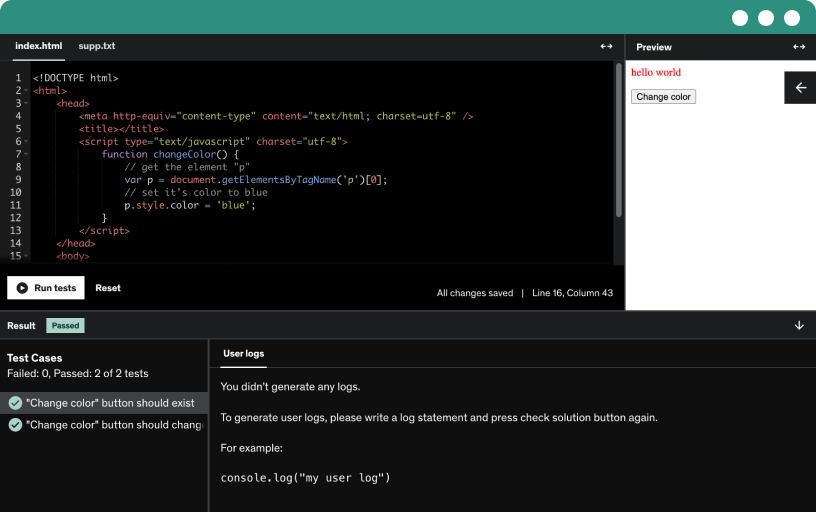
Course content
7 sections • 36 lectures • 7h 39m total length
Requirements
- Have access to internet and the willingness to learn computer programming
Description
Welcome to Java Puzzles to Eliminate Code Fear!
Are you frustrated by coding puzzles that even seasoned developers find challenging?
Do you wish to sharpen your logic skills and gain mastery over Java’s fundamental constructs?
Are you looking for a hands-on, practical approach that transforms theory into real coding expertise?
If you answered yes to any of these questions, you’re in the right place.
What Makes This Course Stand Out?
This course is built on the core principles of problem-solving in Java.
Inspired by insights from Jeff Atwood’s “Why Can't Programmers Program?”, it strips away unnecessary complexity to focus on what truly matters: mastering the building blocks of programming.
Every lesson zeroes in on method-level coding—covering string manipulation, loops, logic, recursion, and more—so you build a rock-solid foundation to tackle any coding challenge with confidence.
The motivation behind this course came from an article titled "Why Can't Programmers Program?" by Jeff Atwood. It talks about how poorly many candidates perform in coding interviews.
Why Java Puzzles and Problem Solving are Essential for your Career?
Surprisingly a large fraction of applicants, even those with masters’ degrees and phds in computer science, fail during interviews when asked to carry out basic programming tasks such as iterate over a loop and print numbers from 1 -10 . Or solve the common fizz buzz problem. And I’ve experienced this first hand when I interview candidates for software development positions.
They could have an impressive academic background as well as experience in various technologies and software projects, but when posed with an interesting programming problem, their code falls apart. The fact is, you don’t need a college education to become a good programmer. Simply there is a big divide between people who can program and those that can’t. It's my experience that the difference has to do with mastering the fundamental building blocks of programming.
And that’s basically method level coding and the mastery of topics like string manipulation, lists, loops, logic and recursion. These are fundamental granular components shared by all programming languages. Think of these as the tools a programmer can use to solve problems. And you really gotta know your tools well to be proficient at the craft!
You can’t learn programming by reading books. The fact is you just need a lot of practice. If you want to be a superb programmer, you have to program a lot and work on solving challenging problems that stretch your capabilities. This course offers a systematic and structured way for you to acquire that practice using only a subset of the java language without getting side tracked in other areas of software development. Every concept comes with a coding challenge. I ask you to try solving the challenge on your own before I go over the solution in detail. This approach has worked time and time again for my students.
KEY BENEFITS OF JAVA PUZZLES MASTERY
Mastering Java Puzzles will empower you to:
Enhance Critical Thinking: Transform your approach to problem-solving with hands-on coding challenges.
Boost Interview Confidence: Acquire the skills needed to ace coding interviews and excel in your career.
Solidify Core Concepts: Gain deep insights into Java’s essential tools, enabling you to write efficient, robust code.
Bridge Theory and Practice: Move seamlessly from learning concepts to applying them in real-world scenarios.
KEY TAKEAWAY
Java Puzzles isn’t just another programming course—it’s a transformative journey that empowers you to conquer coding challenges, master Java fundamentals, and evolve into a truly dangerous developer. Embrace the challenge and unlock your full potential!
Who this course is for:
- If you want to sharpen your programming skills by solving a bunch of programming problems to finally have a command over the programming profession, this course is for you!
- If you want to become a kick-ass problem solver using java, this course is definitely for you!
- If you want to just watch lectures passively while having popcorn without working on the programming puzzles, then this course is NOT for you!