
Your cart is empty.
Keep shopping
4-in-1 bundle: MySQL, PostgreSQL, Microsoft SQL & Oracle SQL
Role Play
18,917 students
4-in-1 bundle: MySQL, PostgreSQL, Microsoft SQL & Oracle SQL
Learn concepts & compare syntax of 4 popular SQL dialects- PostgreSQL, MySQL, Microsoft SQL & Oracle SQL | SQL Bundle
Created byStart-Tech Trainings, Start-Tech Academy
Last updated 4/2026
English
English [Auto],
What you'll learn
- How to write SELECT queries to fetch relevant data in 4 SQL dialects - PostgreSQl, MySQL, Oracle SQL and Microsoft SQL
- How to filter and sort the data using WHEN, logical operators and ORDER BY
- How to group and aggregate data in PostgreSQl, MySQL, Oracle SQL and Microsoft SQL
- How to apply joins and combining queries in 4 SQL dialects - PostgreSQl, MySQL, Oracle SQL and Microsoft SQL
- String, mathematical, date-time functions and pattern matching in 4 SQL dialects - PostgreSQl, MySQL, Oracle SQL and Microsoft SQL
- Understanding of VIEWS and INDEXES in 4 SQL dialects - PostgreSQl, MySQL, Oracle SQL and Microsoft SQL
- How to write subqueries in SQL
Explore related topics
Coding Exercises
This course includes our updated coding exercises so you can practice your skills as you learn.
See a demo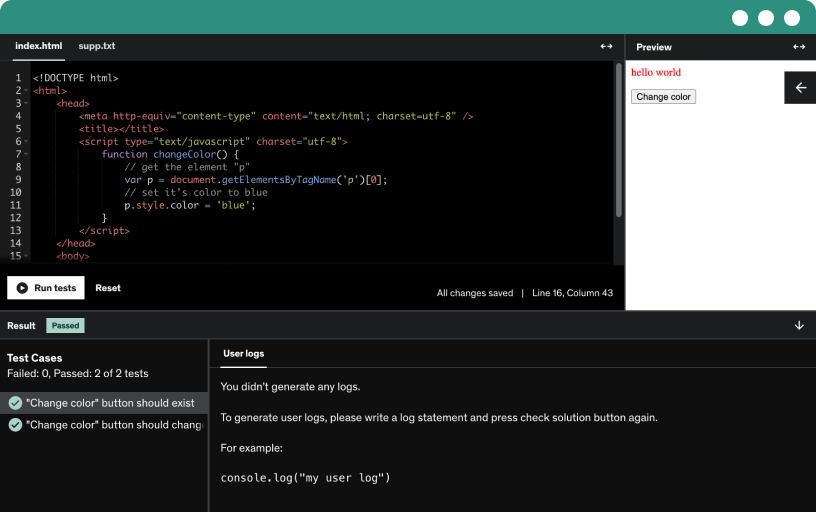
Course content
27 sections • 218 lectures • 15h 55m total length
Requirements
- Just a PC with any web browser
Description
4 Reasons why you should choose this SQL bundle
Carefully designed curriculum teaching you everything in SQL that you will need for Data analysis in businesses
Comprehensive - covers basic and advanced SQL statements in top 4 SQL dialects, MySQL, PostgreSQL, MS SQL and Oracle SQL
Downloadable resources covering essential topics on SQL
Your queries on SQL and anything covered in the Masterclass will be responded by the Instructor himself
A Verifiable Certificate of Completion is presented to all students who undertake this SQL course.
Why should you choose this course?
This is a complete tutorial on SQL which can be completed within a week. SQL is the most sought-after skill for Data analysis roles in all the companies. MySQL, PostgreSQL, MS SQL and Oracle SQL are highly desired skills for database management and data analysis roles. So whether you want to start a career as a data scientist or just grow you data analysis skills, this course will cover everything you need to know to do that.
What makes us qualified to teach you?
The course is taught by Abhishek, Pukhraj and Nadeem. Instructors of the course have been teaching Data Science and Machine Learning for over a decade. They have an in-depth knowledge in advanced SQL, PostgreSQL, Oracle SQL, database management, and various data analysis tools available in the market.
Our Promise
Teaching our students is our job and we are committed to it. If you have any questions about the course content, practice sheet or anything related to any topic, you can always post a question in the course or send us a direct message.
By the end of this course, your confidence in using SQL will soar. You'll have a thorough understanding of how to use SQL for Data analytics as a career opportunity.
Go ahead and click the enroll button, and I'll see you in lesson 1!
Cheers
Start-Tech Academy
FAQ's
Why learn SQL?
SQL is the most universal and commonly used database language. It powers the most commonly used database engines like MySQL, PostgreSQL, Oracle SQL, and Microsoft SQL. Simply put, If you want to access databases then yes, you need to know SQL.
It is not really difficult to learn SQL. SQL is not a programming language, it’s a query language. The primary objective where SQL was created was to give the possibility to common people to get interesting data from the database. It is also an English-like language so anyone who can use English at a basic level can write SQL queries easily.
SQL is one of the most sought-after skills by hiring employers.
You can earn good money
How much time does it take to learn SQL?
SQL is easy but no one can determine the learning time it takes. It totally depends on you. The method we adopted to help you learn SQL quickly starts from the basics and takes you to advanced level within hours. You can follow the same, but remember you can learn nothing without practicing it. Practice is the only way to learn SQL quickly.
What's the difference between SQL and PostgreSQL?
SQL is a language. Specifically, the "Structured Query Language"
PostgreSQL is one of several database systems, or RDMS (Relational Database Management System). PostgresSQL is one of several RDMS's, others of which are Oracle, Informix, MySQL, and MSQL.
All of these RDMSs use SQL as their language. Each of them has minor variations in the "dialect" of SQL that they use, but it's all still SQL.
Who uses these databases?
Here are a few examples of companies that use PostgreSQL: Apple, BioPharm, Etsy, IMDB, Macworld, Debian, Fujitsu, Red Hat, Sun Microsystem, Cisco, Skype.
Companies that use MySQL: Uber, Airbnb, Netflix, Udemy, Pinterest etc.
Companies that use Oracle SQL: Gartner, Nike, Costco, eBay etc.
Companies that use MS SQL: Accenture, Cognizant, Dell, Microsoft, ViaVarejo etc.
Who this course is for:
- Working Professionals beginning their Data journey
- Anyone curious to learn and compare syntax in 4 SQL dialects - PostgreSQl, MySQL, Oracle SQL and Microsoft SQL
- Students about to join their first corporate job