
This course includes our updated coding exercises so you can practice your skills as you learn.
See a demo
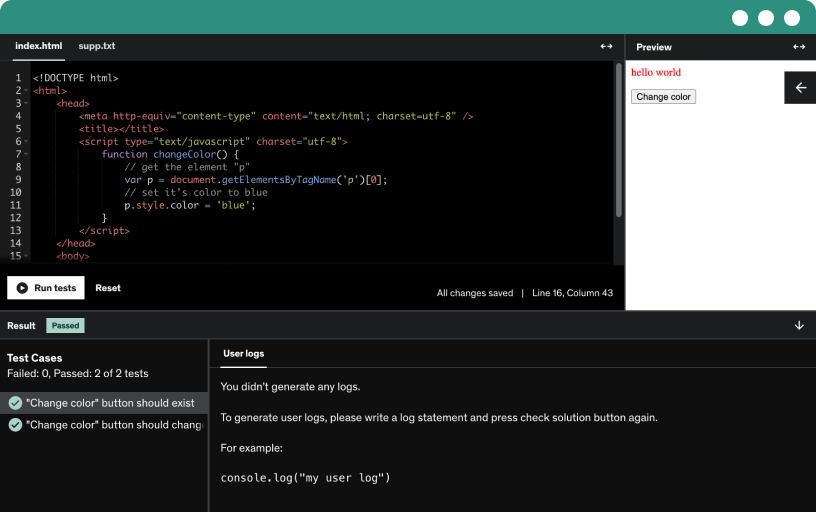
Explore why computers are fast but not smart, and show how programmers use Python to make machines smart, starting with an online platform that simulates coding before installation.
Learn how keywords and comments differ in Python, and how comments boost readability without changing code. See hash and triple inverted commas comments, and print statements with quotes.
Explore keywords in Python, the reserved words Python treats specially. Learn that Python 3 has 35 keywords, with examples like print not a keyword and uppercase false as reserved.
Master using variables to generalize square perimeter and area calculations, print outputs, and comment with hash; apply variables to a currency converter using a dynamic multiplier.
Explore Python data types, including integers, floats, strings, booleans, and None, and learn to inspect types, create well-named variables, and apply basic type concepts.
Master Python strings by exploring quotes, escape characters and backslashes, learn to print with variables, and practice string concatenation; preview Python 3.6+ string formatting.
Day 1 Video on Arithmetic Operator
Master relational operators in Python by comparing values with equals, not equals, greater than, greater than or equal to, less than, and less than or equal to, using booleans.
Explore how Python conditional operators use boolean logic and the ternary operator, with if, elif, and else to classify numbers as positive, zero, or negative.
Explore how indentation defines blocks of code in Python, using if statements and print statements, and the rule of using tabs or spaces to enhance readability.
Explore how to define and call functions in Python weekend bootcamp using def, pass parameters, and return values, with scope and practical examples like printing and multiplication.
Explore how Python lists can hold multiple data types, including strings, integers, and floats, unlike typed arrays in Java or C++, and see that mixing types does not raise errors.
Discover dictionaries, a key-value data type that contrasts with lists by using keys to access values. Learn to initialize, add entries, and handle missing keys with real-world examples like contacts.
This lecture explains handling user input in Python, showing how converting input to int prevents string-vs-integer errors when comparing x and y and checking double-digit numbers.
Learn how a while loop repeats actions while a condition is true, avoid infinite loops by updating variables, and stop execution with ctrl-c, illustrated by x and a clock example.
Explore while loops by printing numbers 1 to 5, including how to increment x, use a flag to stop the loop, and condition checks to prevent infinite loops.
In this fun project, the course teaches building a number guessing game with loops and if-else logic, using user input and integer conversion to print higher, lower, or correct messages.
Discover how to use for loops to iterate over strings and lists, traverse a sequence, and print letters or elements, contrasting with while loops.
Explore nested loops by using a for loop inside another for loop to print each fruit and its letters from a basket, illustrating the loop inside a loop concept.
Learn to control loops in Python with break, continue, and pass through concise examples of stopping a loop, skipping iterations, and using pass as a placeholder for unfinished code.
Install Python and add it to your path on your laptop. Choose a code editor and IDE such as VS Code, then install extensions.
Discover how to use f formatting in Python to create dynamic messages, format variables like name and seat number with curly braces, and avoid type errors from string concatenation.
Learn how Python modules split code into multiple files, import functions across files, and enable communication between files for maintainable, team-based, industry-grade development.
Explore how Python uses modules and libraries to build projects faster by reusing code, importing built-in and external libraries, and leveraging the math module for tasks like square roots.
Explore different module import methods in Python, including selective from import, importing multiple items, star imports, and aliasing, to improve readability and manage modules effectively.
Learn how to import and use external libraries with Python, install PyAutoGUI via pip, and explore its mouse control methods and practical examples from installation to executing movements.
Explore error handling in Python by creating buggy code, spotting syntax and name errors in an IDE, and learning how to handle inputs, outputs, and division by zero errors.
Explore Python error handling with division by zero, name errors, and index errors, and learn to prevent crashes using an if-else check before division.
Explains syntax versus logical errors, differentiates compile time and runtime errors, and introduces try and except for error handling, avoiding if-else by handling specific errors like division by zero.
Learn to control versioning with GitHub by creating a repository, uploading and editing files in VS Code, and committing changes with descriptive messages to manage collaborative development.
Explore how GitHub enables open source collaboration through issues, readmes, forks, and pull requests. Fork projects, submit pull requests, and become a contributor to improve and customize code.
Learn how GitHub and Git enable code backup, version control, and collaboration through issues and pull requests, while showcasing your projects and documentation to recruiters.
Learn to build a Tkinter gui in Python by creating a window, setting a title, and adding a label, input, output, and a button with a grid layout.
Build a square calculator GUI with input and output fields, a headline, and a grid with a compute button that squares the input and displays the result.
Learn to download YouTube videos with Python using pytube, install and import the library, create a YouTube object, inspect streams, and download the highest resolution video.
learn to convert a gui video downloader in Python by copying the gui from a calculator file, importing tinker, and adapting the inputs to accept a video URL for download.
Explore object oriented programming with Python through a cake shop example. Learn how classes serve as blueprints and objects as real world instances with attributes like name, color, and weight.
Explore Python object-oriented programming by building a cake shop data model with a cake class, attributes name, color, and weight, creating objects, and listing them with a for loop.
Most courses out there just teaches you the thing python in more than 30 hours of course. But this course is unique, in just about 5 hours and an estimation duration of 3 days you can comfortably start creating projects, design and code beautiful Graphical User Interface (GUI), create your own mini software easily. We will address all the though and important topics and will not shy away from them.
It was more than 6 months in the making of the course. There are hundreds of course on python on this platform. So to make this course unique I have spent almost 2 months just to read and understand all the negative feedbacks of those course. So this course shines out will all the goodness of all the top courses out there and with the errors rectified.
This course will be your entry point in to the world of Software Engineering.
Python is a very powerful language and it is widely used. After learning python you can easily start learning trends like Web Development, Machine Learning, Artificial Intelligence.
And I promise that this course will make you comfortable with python, logic building. But what I do not promise is that you will not be a Master of Python in 3 days, if you stumble upon something like this, stay away. Because to master a skill it takes you time and practice and it for sure cannot be done by watching videos in very short span of time.
Udemy provides a 30 Days money back guarantee with this course, so you can focus on learning.
See you in the course.