
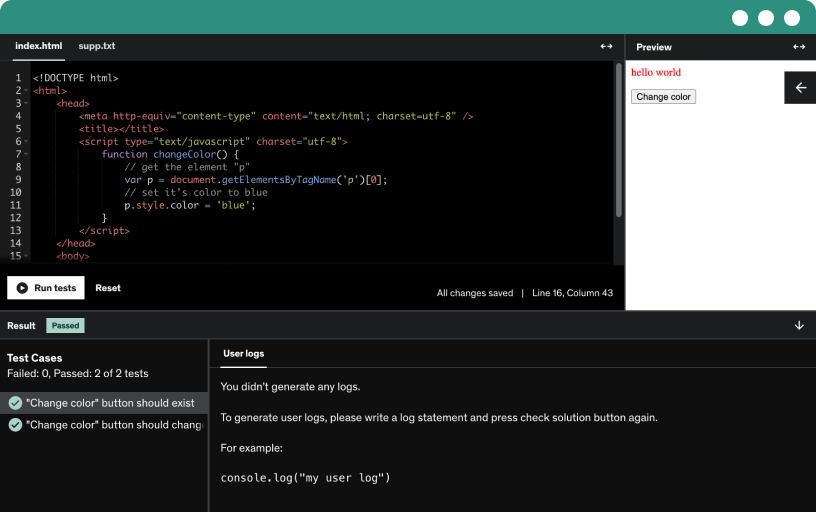
This course includes our updated coding exercises so you can practice your skills as you learn.
See a demo
Learn a step-by-step, hands-on approach to Python programming with MySQL for data science, using practical exercises, review videos, and independent practice to build coding skills.
Clarify prerequisites for Python programming with MySQL database for data science, including operating system skills and internet access, and explain that source code is shown in video with real-time examples.
you will learn file extension and source code notes
Generative artificial intelligence is artificial intelligence capable of generating text, images, videos, or other data using generative models, often in response to prompts. best ai tools are chatgpt, tabnine for developers, and more
You will learn how to learn online courses in a more productive way.
You will know the top AI tools every professional needs to boost productivity and achieve smarter results
Learn the basics of HTML, including what HTML stands for, opening and closing tags, and how to build interconnected web pages viewable in browsers, following W3C standards.
Learn how to choose a good code editor for python programming with MySQL data science, and explore popular options like Sublime Text, Visual Studio Code, and Notepad++.
Install Sublime Text editor by downloading from the Sublime Text website, choosing Windows or other OS, running the setup, and launching the editor to start coding.
Explore an overview of a web page, including domain names, hosting, publishing in the public domain, and how browsers load pages by typing a domain.
Explore the basic structure of a full HTML webpage, including the head and body sections, opening and closing tags, and how style tags shape the page’s presentation.
learn to use heading tags from h1 to h6 to control font size and weight for clear page structure, and save a file to preview in a browser.
Learn to format text with HTML tags such as bold, italic, strong, mark, and subscript or superscript, and preview paragraph styling in the browser for data science.
Learn to create unordered lists in html with ul and li, explore bullet styles, and compare to ordered lists, using examples like subjects and days of the week.
Learn to create and customize ordered lists in HTML by using the type attribute to switch between numbers, uppercase letters, lowercase letters, and Roman numerals, enabling clear grouping of items.
Learn how to define and apply css classes to html elements, style text with color and font properties, and reuse styles with a stylesheet to create visually appealing web pages.
Apply ids to HTML div elements and connect them to CSS styles. Practice setting background colors, padding, borders, and text spacing to build simple styled sections.
Master comment lines in python programming to document code, using opening and closing tags to hide or reveal text, write descriptive lines for design or changes, and selectively display paragraphs.
Learn how to display reserved characters in HTML using entities, including ampersand, less than, greater than, and common symbols like yen, pound, and the copyright or registered trademarks.
Explore how the div tag creates divisions or sections to group elements, apply CSS with classes and IDs, and control layout, alignment, borders, and backgrounds in web pages.
Build a basic HTML registration form with name, email, password, address, state, country, and pin code fields, using labels, input types, maxlength, and a submit or reset button.
Design a simple contact us form with name, mobile, country, subject fields and a submit button, styled with CSS for containers, labels, inputs, and a country select.
Participate in a coding exercise to build a simple student registration form with fields for name, father's name, email, password, address, country, and action buttons submit, cancel, and reset.
Designs a student registration form by implementing labels and input types for name, email, password, address, state, country, and pin code, with submit, reset, and cancel controls.
Explore Python as an interpreter and high-level language that emphasizes code reliability through indentation and object-oriented design. This design supports reusable code and saves time for large-scale projects.
Install python on Windows by downloading from the official site, choosing Python 3.10.2 64-bit, adding to PATH, and verifying with IDLE and a simple print command.
Learn to write a hello world program in Python for data science by creating a Python file in an IDE, writing a print statement, and running it to see output.
learn to capture user inputs in python with the input function, assign to variables, and convert strings to integers or floats for calculations, including name and age examples.
Learn how to use Python comments to explain code, document purpose, and improve readability, including single-line and multi-line comments, while understanding that comment lines are ignored by the compiler.
Learn string indexing in Python using zero-based, positive indices from left to right and negative indices from right to left. Practice retrieving single characters and previewing string slicing.
Explore arithmetic operators in Python by using integers and float values to perform addition, subtraction, multiplication, division, percent, and power, with examples and operator precedence.
Understand how the and operator in Python requires both conditions to be true, using x>3 and x<10, and apply this to loan eligibility with income and credit score.
Explore how the not operator negates booleans, influencing loan eligibility by flipping true and false, and combine with and/or for clear logical expressions.
Unlock the potential of Python and MySQL for data science with "Python Programming with MySQL Database: For Data Science." This course is designed to teach you how to leverage Python and MySQL to work with data, build insightful analytics, and develop data-driven applications. Whether you're a beginner or have some experience with programming, this course will provide the knowledge and hands-on experience needed to use these powerful tools in data science projects.
update: Learn the top AI tools every professional needs to boost productivity
You’ll begin by learning the basics of Python programming, including data types, control structures, and functions. As you progress, you’ll explore how to interact with MySQL databases using Python. Learn how to create, read, update, and delete data in MySQL, as well as how to write complex queries to extract meaningful insights from large datasets.
The course focuses on practical applications, guiding you through real-world examples where Python is used to analyze data and MySQL serves as the backend database. You'll also learn how to perform data cleaning, aggregation, and statistical analysis to make informed decisions. The course includes hands-on projects.
By the end of the course, you’ll be equipped with the skills to work with databases, analyze data, and create data science projects that use Python and MySQL efficiently.
Enroll today and take your data science skills to the next level with Python and MySQL!