
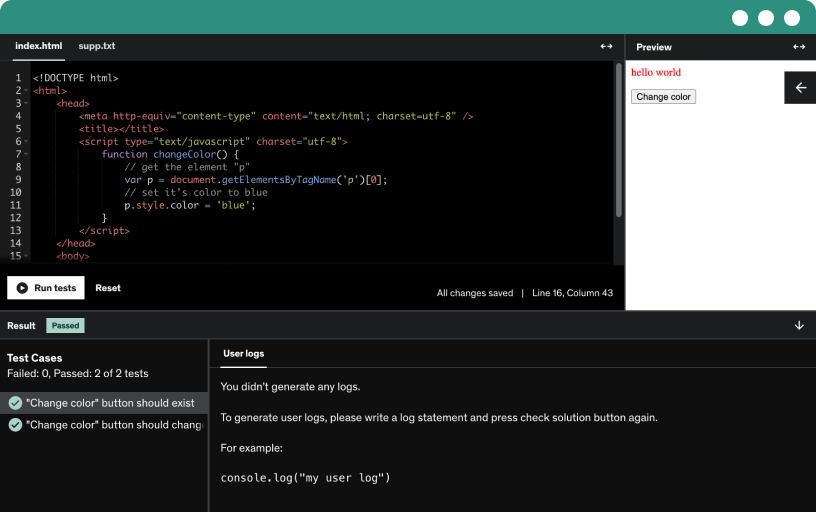
This course includes our updated coding exercises so you can practice your skills as you learn.
See a demo
Course help and welcome
Hello everyone and thank you so much for enrolling in this course.
I'm so excited to help you on your journey to becoming a Maya and Python Automation Specialist.
Before we start, I just wanted to let you know the best way to get help during the course if you
ever have a question.
First, you should check the FAQ lecture and see if your questions are answered there.
If it's not, you should search the Q & A forums using keywords pertaining to your question.
If you still can't find an answer. Feel free to post the new questions to the Q&A forums with explanations and as much context as you can, which allows everyone to fully understand what you're asking if you can add a picture that is useful too, basically, the more information you can give the better.
Thank you so much again for enrolling in the course I can't wait to get started.
This 'Frequently Asked Questions' page serves as a dynamic resource for you, answering the most common queries related to the course materials, content, technical issues, and feedback mechanisms. As the course evolves, so will this page, with new questions and answers added to continually enhance yo
Python Introduction
We'll embark on a fascinating journey into Python, a powerful, user-friendly language used worldwide. Learning Python can open a variety of opportunities in diverse fields such as data science, web development, and AI.
Python Syntax
Python's syntax is known for being clear and easy to understand. A solid understanding of Python syntax will help you to write clean, efficient code that's easy to read and maintain.
Python Variables
Python's variables are crucial for storing and manipulating information in your code. Mastering variables allows for effective data management and contributes to cleaner, more efficient code.
Python Data Types
Python handles various types of data, each with unique properties. Understanding these data types allows you to utilise Python's flexibility to the fullest, enhancing your coding abilities.
Python Numbers
Python's numerical data types are fundamental for calculations. Learning to work with these numbers will aid you in anything from simple arithmetic to complex mathematical operations.
Python Strings
Python strings are flexible and versatile, playing a crucial role in handling text data. Mastery of strings can help you manipulate, format, and analyse textual data efficiently.
Python Booleans
Booleans in Python, the true or false binary, are key for controlling program flow. Understanding Booleans enables effective decision-making in your code.
Python Lists
Lists are Python's flexible containers for storing collections of data. Mastering lists opens up an array of possibilities for data storage, manipulation, and operations.
Python Tuples
Tuples, Python's immutable sequences, are useful for grouping data. Learning about tuples will give you another tool for effective data management in Python.
Python Dictionaries
Dictionaries offer a unique way of storing data in key-value pairs. Mastering dictionaries can drastically improve the efficiency of data lookups and organisation in your code.
Python Sets
Sets in Python are an unordered collection of unique elements, invaluable for eliminating duplicates and performing common math operations. Understanding sets will expand your Python toolkit.
Control Flow
Control flow in Python allows for complex logic in your programs. Mastering this concept will let you build more intricate, intelligent, and interactive applications.
Python Operators
Operators in Python are essential for performing operations on variables. Understanding Python operators can make your code more concise and readable.
Python Conditional Statements
Conditional statements are Python's decision-making cornerstone. Mastering conditionals will enable you to write code that can respond differently to different situations.
Python Loops
Python loops automate repetitive tasks, increasing your code efficiency. Learning about loops will save you time and effort, making your programs more effective.
Python Break & Continue
The break and continue commands provide extra control over your loops. Understanding them helps you write more efficient and effective loop structures.
Python Exception Handling
Exception handling in Python helps you deal with potential errors and keep your program running smoothly. Mastering this skill can help you create more reliable, robust code.
Python Map & Filter
Map and filter are key for functional programming in Python. Mastering these functions will enable you to write cleaner, more efficient code.
Object-Oriented Programming (OOP)
Object-Oriented Programming (OOP) is a design principle that allows for cleaner and more organised code. Learning OOP can make your programming more effective and efficient.
Python Functions
Functions encapsulate blocks of code for reuse, promoting code efficiency. Understanding functions is fundamental to good coding practice and will make your programs more readable and maintainable.
Python Lambdas
Lambdas are Python's way of creating quick, anonymous functions for simple tasks. Understanding lambdas allows you to write concise, efficient code when a full function isn't necessary.
Python Classes
Classes, the backbone of OOP in Python, are used to create custom data structures. Learning to use classes effectively will expand your problem-solving capabilities and allow you to write more organised code.
Python Decorators
Decorators are a Python feature that allows the modification of functions or classes. Mastering decorators will provide you with powerful tools to make your functions more flexible and easier to maintain.
Python Modules
Modules help organise code into logical and manageable chunks. Understanding modules will help you keep your code base organised, reusable, and scalable as it grows.
Python Debugging and Testing
Debugging and testing are essential for writing reliable code. By learning these skills, you'll be able to ensure your code works as intended and catch and fix errors before they become problems.
Best Practices and PEP
Understanding Python's best practices and the Python Enhancement Proposals (PEPs) is essential for writing clean, professional code. It'll help you work effectively alone or on a team.
Welcome! We're embarking on an exciting journey into the captivating world of 3D modelling and animation with Autodesk Maya, one of the leading industry-standard software tools.
Dive into Maya's comprehensive documentation, a vast knowledge reservoir. It's your go-to guide, designed to navigate you through the labyrinth of this sophisticated software's many features.
The Maya User Interface (UI) is our control panel for creating and fine-tuning 3D content. Mastering this interface is pivotal in operating the software efficiently.
Learn the differences and similarities between Python 2 & 3, and their application in Maya scripting. This knowledge will bolster your scripting prowess and is essential for automation.
Nodes are the fundamental building blocks in Maya, driving everything from models, rigs to complex animation. Understanding nodes opens the door to the deeper workings of Maya.
Materials are the essence that give life and realism to 3D models. They govern how surfaces interact with light, creating visually appealing and realistic 3D scenes.
Step into the world of modelling in Maya. This process of crafting 3D objects is where our creations take shape, serving as the backbone of 3D projects.
Rigging is the puppetry behind 3D models. By learning to make models move in natural and realistic ways, you'll breathe life into your creations. (It's the best bit of Maya... and I am not biased...)
Animation in Maya is the art of bringing models to life. It's through animation that we can tell compelling stories, create dynamic simulations, and much more.
Sets in Maya are instrumental in organising your 3D scenes. By mastering sets, you'll be better equipped to manage complex 3D projects.
UI windows in Maya house a plethora of tools and features. Navigating these windows proficiently is key to streamlining your workflow.
Scripting automates tasks in Maya. By learning Python scripting, you can perform repetitive tasks quickly, drastically improving your efficiency.
VFX is the magic that adds spectacle to many visual mediums. By gaining a basic understanding of working in this industry, you'll open the door to exciting creative opportunities.
After this lecture, students will have a solid understanding of how to download and set up PyCharm, configure it with Maya commands (cmds), and ensure it is running Python 3. This provides the basis for seamless Python development in a Maya environment.
Welcome to this crucial section, where we'll establish a robust foundation for your Python development journey. Here, we'll tackle organising our code in a systematic way.
This lecture delves into the process of setting up a Python Dependency Node Class for Maya commands (cmds). It focuses on managing node dependencies efficiently in your scripts, a key aspect of developing complex scenes in Maya using Python.
Following on, we'll move from theory to practice and establish the initial code for our DAG Node. This key step lays the groundwork for more advanced manipulations in Maya.
Next, we put our code to the test. We'll run our Dependency Node Class in different scenarios to ensure it functions as expected, learning about the testing process along the way.
We will continue learning about the testing process in this lecture.
Following our testing lectures, we'll dive into troubleshooting and refining our code. We'll address any issues that arise, making necessary corrections to ensure our Dependency Node Class is robust and reliable.
To wrap up, we'll look at practical examples of how our Dependency Node Class can be used in real-world Maya Python scripting scenarios. This will solidify your understanding and show you the potential applications of this powerful tool.
We'll start with an overview of the Directed Acyclic Graph (DAG) Node setup. Understanding this construct is vital for getting to grips with Maya's scene hierarchy and node organisation.
Following on, we'll move from theory to practice and establish the initial code for our DAG Node. This key step lays the groundwork for more advanced manipulations in Maya.
Once our code is in place, we'll run it through its paces. We'll test our DAG Node under various conditions to ensure it performs as intended, learning about the testing process as we go.
To round off, we'll examine practical examples of how our DAG Node can be used in real-world Maya Python scripting scenarios. This will solidify your understanding and demonstrate the potential applications of this powerful tool.
Get acquainted with the Attributes Class: a core component in managing data within our nodes. Understand its role and significance in Maya Python scripting.
Dive into the code setup for the Attributes Class, focusing on identity operators and core functionality, essential for managing core attribute functionality with Python in Maya.
Continue the code setup journey, this time focusing on comparison operators. Grasp how to compare and contrast different attributes in Maya.
Complete the code setup by mastering arithmetic operators, a vital tool in manipulating attribute values within your Maya nodes.
Put the Attributes Class code to the test. Check its functionality and robustness, setting the stage for efficient and error-free scripting.
Round off with a practical example showcasing how the Attributes Class can be effectively utilised in real-world Maya Python scripting scenarios.
Familiarise yourself with the Object Dimension Class, a crucial component in creating and managing dimensions in your Maya projects.
Set up the Object Dimension Class, an important step for enabling efficient and effective creation of dimensions within your Maya nodes.
Test the Object Dimension Class, ensuring its robustness and reliability in handling dimension operations within your Maya scripts.
Visualise the practical application of the Object Dimension Class through a real-world example, solidifying your understanding of its potential use.
Begin with an introduction to the Mesh Class, a key component in handling mesh types, their deformation, manipulation and operations within Maya.
Set up the Mesh Class, the crucial step in enabling efficient manipulation of mesh types in your Maya projects, inheriting all our work from our DAG setup so far.
Test the Mesh Class, assessing its reliability and performance to ensure error-free manipulation of mesh types.
See the Mesh Class in action with a practical example, cementing your understanding of its use in real-world Maya scripting scenarios.
Your task is to design and implement the 'Curve' class to facilitate the creation and management of curves and controllers in Maya. Be sure to consider specific arguments such as 'type', 'shape', 'scale', 'colour', 'offset', and 'parentTo' to add depth to your class. Your functionalities should allow for interactions with curve points, scaling, and positioning of shapes as needed. For an added challenge, implement a path constraint functionality.
Make sure to incorporate functionalities that allow you to interact with the curve points and to scale and position the shape as needed. For added complexity, consider implementing a path constraint functionality. Next, remember to set up your testing folder and a test suite.
Write a series of assertions to ensure the correct functioning of your setup. Once you've completed your work, feel free to send it to me. I'll be more than happy to review it and provide constructive feedback.
Welcome to my course! 'Python for Maya: Beginner to Advanced Rigging Automation'
This course is your gateway to mastering Python scripting for Maya, providing an array of skills that will enable you to work faster and smarter, automating tasks that give you more time to engage in the work you love. These skills also add significant value to your employability, helping you progress in your career.
NOTE: Please make sure you first visit my website to check for any current coupons being offered as this might just save you some money.
Regardless of your experience with Python, this course offers something for everyone. From beginners to experienced coders, you will journey from basic Python syntax and Maya fundamentals to advanced Python methodologies for automating Maya rigging.
Here's a taste of what we'll cover:
Python Basics: Syntax, data types, loops, functions, classes, and conditions.
Advanced Python Techniques: Control flow, inheritance, testing, best practices.
Maya Pythonic Structures: Learn how to manage your codebase and the Maya API together.
Maya Rigging Automation: Use Python magic to simplify complex equations and make your code up to 20 times more functional.
As your course instructor, I'm a Senior Technical Director who's written tools saving hundreds of hours in productivity. The methodologies I use are the ones I'll be sharing with you here.
With each lecture, you'll have access to comprehensive code breakdowns and detailed explanations. Furthermore, our online community of fellow learners and myself are always here to help you out if you encounter difficulties.
I learnt Python and Maya through hands-on, project-driven methods, and it's these same techniques that I'll employ to teach you. So, are you ready to enhance your skills and begin your journey towards Python Mastery in Maya?
Let's get started!