Your cart is empty.
Keep shopping

Teach on Udemy
Turn what you know into an opportunity and reach millions around the world.
Learn MoreMastering C++ Programming - From Zero to Hero
Mastering C++ Programming - From Zero to Hero
Latest C++ with C++11, C++17, In-depth coverage of OOPs,Templates,STL,Basics to Advance C++ with Coding exercise
Created byHimayatullah Sharief
Last updated 9/2025
English
What you'll learn
- Gain in-depth knowledge in Object Oriented Programming using C++
- Complete understanding of C++ Language
- Create well indented Classes and Application programs
- Can able to understand complicated problems and solve using C++ Language
- Acquire skills that will be useful for understanding in-depth Object Oriented programming Concepts
- Get In-depth coverage of Strings and its functions in C++
- Fully Explore the Standard Template Library to maximum extent
- Learn Modern C++ concepts including C++ 11 to C++17
Explore related topics
Coding Exercises
This course includes our updated coding exercises so you can practice your skills as you learn.
See a demo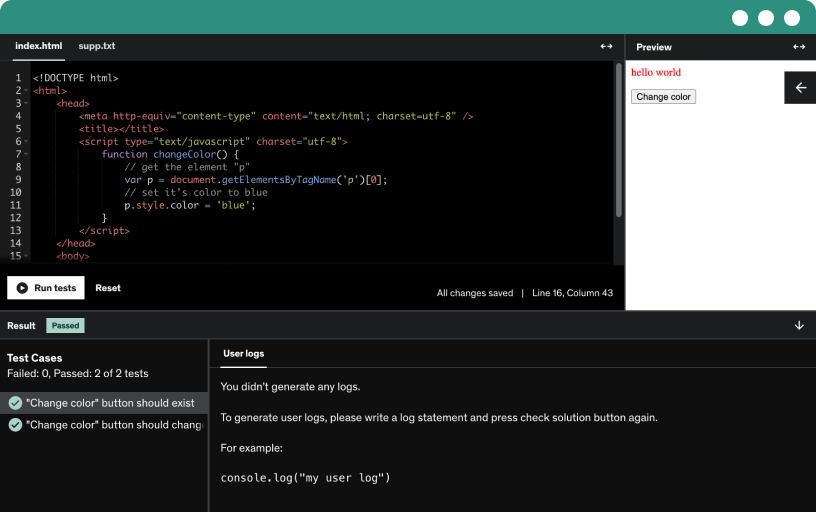
Course content
20 sections • 198 lectures • 31h 4m total length
- Course Introduction2:34
Mastering C++ programming from zero to hero introduces fundamentals, object-oriented concepts, and modern C++ features (11/14/17), with programming challenges to boost problem solving for all levels.
- Instructor's Note14:46
Navigate the C++ course overview that covers basics, object oriented concepts, and advanced topics, and explain IDE setup, practice programs, challenges, coding exercises, and how to access resources.
- Install, Setup and Settings of used IDE's5:32
Install, set up, and configure code blocks IDE on Windows or Mac, select mingw, associate C/C++ file types, create console project, adjust compiler and editor settings for build and run.
- First C++ Program10:25
demonstrates creating a new console project in code blocks, writing a first c++ program with iostream and cout, using namespace std, compiling, debugging, and viewing hello world output.
- Writing an Algorithm20:43
Define an algorithm as a step-by-step procedure that takes input, processes it, and outputs a result, and compare it with flowcharts and programs plus uses like google search and sorting.
- Drawing a Flow chart10:11
Learn how flow charts diagram algorithms using start/stop, read/write, process, and decision symbols; apply to simple tasks like finding the maximum of two numbers and summing natural numbers.
- Program Development and Execution15:54
Explore the full cycle of program development and execution in c++, from editing source code to preprocessing, compiling, linking, loading into memory, and runtime execution.
- Quiz # 1
- Basic Structure of a C++ Program9:58
Explore the basic structure of a C++ program, from the main function with an int return type to object instantiation, class components, and simple examples using iostream and std.
- Keywords and Identifiers in C++11:43
Explore the core tokens in C++ and learn how keywords and identifiers work, including naming rules, valid and invalid examples, and how to avoid using keywords as identifiers.
- Comments in C++6:20
Explore the role of comments in c++, learn single-line and multi-line comment syntax, and understand how clear documentation and proper indentation improve readability and debugging.
- Program Demonstrating Comments in C++4:20
Learn how C++ comments serve as encoded documentation and are ignored by the compiler. Discover two styles, multiline C style and single line C++ style, and how they enhance readability.
- Variables, Literals and Constants in C++17:08
Explore variables, literals, and constants in C++ by learning naming rules, data types, and how memory stores values; see cin, cout, and escape sequences for input and output.
- Why Data Types14:44
Understand why data types matter in programming by exploring how data and instructions form a program, and how memory stores numbers and characters with integers, floating point, and bytes.
- Data Types in C++9:04
Explore primitive data types in C++, their memory sizes, and ranges, then derive types like arrays, pointers, and references, plus user-defined types such as structures and classes.
- Expressions and Precedence10:50
Explore how to convert mathematical formulas into expressions in c++ and evaluate them using operator precedence, left-to-right evaluation, and parentheses, with examples like area, perimeter, and displacement.
- Practice Program - Expression10:24
Explore how to convert formulas into expressions in c++ through practical examples: area of a triangle and quadratic roots, using variables, double types, and discriminant computation.
- Input/Output(I/O) functions in C++5:46
Learn basic input and output in C++ using the iostream header, cout and cin, with insertion and extraction operators to read an age and display it.
- Introduction to Operators in C++6:52
Explore how C++ uses operators, from unary and binary to the ternary form, across seven categories: arithmetic, relational, logical, assignment, increment and decrement, bitwise, and conditional.
- Arithmetic Operators4:11
Explore arithmetic operators in c++, including addition, subtraction, multiplication, division, and remainder, with practical examples showing sums, differences, products, quotients, and memory updates.
- Increment / Decrement Operators10:27
This lecture explores increment and decrement operators in C++, covering pre and post forms, their differences in expressions, and practical examples that show how values change in memory.
- Assignment Operators6:17
Explore assignment operators in c++, including the equals operator and arithmetic forms like +=, -=, *=, /=, and %= with examples using x and y.
- Relational Operators4:34
Explore relational operators in C++ by comparing two operands with >, <, >=, <=, ==, and !=, and see how true and false results drive if, else, switch, and loops.
- Logical Operators5:45
Explore how logical operators in c++ combine relational expressions to drive decision making, using and, or, and not with true or false results for conditional statements.
- Practice Program - Operators12:03
Master arithmetic operators, including plus, minus, multiply, divide, and remainder, along with pre/post increment and decrement, and assignment operators in C/C++ demonstrations.
- Check if a given integer is both positive and even using Relational and Logical Operators
- Bit-wise Operators7:18
Explore bitwise operators in C++, including and, or, xor, not, and shift operations, to manipulate binary data at the bit level for faster processing.
- Practice Program - Bit-wise Operators14:00
Explore bitwise operators, including and, or, xor, not, and shift left/right, with binary examples using 4, 5, and 20 to show how these operations work and their effects on values.
- sizeof Operator6:08
Explore the size of operator, a unary operator that returns the memory size in bytes for variables, arrays, structures, and unions, guiding dynamic memory allocation in C and C++.
- Ternary operator7:19
Understand the ternary operator in C and C++, a three-operand conditional operator that replaces if else by evaluating expression one and selecting expression two or three.
- Operator Precedence and Associativity8:35
Explore operator precedence and associativity in C and C++ to understand how expression evaluation follows predefined rules, including left-to-right or right-to-left associativity and parentheses.
- Quiz # 2
- C++ Basics
- Flow Control Statements in C++7:29
Explore how C++ controls program flow, moving beyond sequential execution with decision and loop statements, including if, if-else, nested ifs, for, while, do-while, and switch.
- Decision Control Statements including if , if-else, nested-if and if-else Ladder16:04
Explore decision control statements in C++, including simple if, if-else, nested-if, and if-else ladder, and see how true or false conditions guide program flow.
- Practice Program- using Conditional statements4:19
Learn to implement conditional statements in C++, using if, if else, and nested if to determine if a user-entered number is even by checking the remainder with the modulo operator.
- Another Practice Program - using Conditional statements4:36
Apply conditional statements in c++ through practice programs that check age eligibility and working hours ranges, using if-else logic to display messages like minor or eligible.
- Practice Program - Finding Maximum of 2 numbers using if condition6:01
Learn to find the maximum of two numbers using an if statement in C++. Read two integers, compare them, and print which one is greater, with practical input examples.
- Programming Challenge and its Solution - Finding Max of 2 and 3 using Ternary op12:00
Learn to find the maximum of two and three numbers using the ternary operator, including nested expressions, with practical C++ examples.
- Programming Challenge - Validating number for negative or positive6:36
Read two numbers, M and N, validate that N is positive, and if not, display a message and terminate; otherwise divide M by N and show the result.
- Programming Challenge & Solution - Finding the Roots and Nature of Roots11:36
Determine the roots and nature for a quadratic equation by computing D = b^2 - 4ac, classifying as imaginary, real and equal, or real and unequal, and applying the quadratic formula.
- Programming Challenge - Generate Electricity Bill Charges4:33
Solve a C++ programming challenge to compute electricity bill charges using a slab-based tariff: 200 units at 0.5, 201-400 at 0.65, 401-600 at 0.8, above 600 at 0.9.
- Solution to Programming Challenge - Generate Electricity Bill Charges7:24
Compute electricity bill charges using a tiered rate system with unit ranges. Incorporate input validation and a C++ implementation to apply rates from 0–200, 201–400, 401–600, and above 600.
- Programming Challenge & Solution - Finding the Grade of a Student10:25
this lecture presents a programming challenge to compute a student's grade from three marks by calculating total and average, applying a fail condition, and assigning distinction, a, b, or c.
- Understanding Loops2:44
Mastering C++ programming explains loop control statements and the three types of loops—for, while, and do-while—highlighting iterations and when to use each for repeated tasks.
- Understanding While Loop in C++9:32
Explore how the while loop in C++ executes a factorial example, highlighting initialization, condition checks, and updating the loop body.
- Practice Program - Demonstrating working of while Loop6:14
demonstrates converting a for loop to a while loop by illustrating initialization, condition, and increment in a practice program, with a hands-on walkthrough of loop body execution.
- Understanding For Loop in C++10:18
Explore the for loop in C++ through initialization, condition, and update steps, with a demonstration and a range-based variant for iterating arrays, lists, and vectors.
- Practice Program - Demonstrating working of for Loop8:48
Explore the for loop in C++ through a hands-on practice program that sums the first n natural numbers, explains initialization, condition, and increment, and introduces a range for loop.
- Programming Challenge - To Find whether a given Number is Armstrong No. or not19:47
Explore how to determine if a number is an Armstrong number by summing each digit raised to the power of the digit count, with examples like 153 and 1634.
- Practice Program - Finding Maximum and Minimum Numbers from an Array9:13
learn to find the maximum and minimum numbers in an array by initializing max and min with the first element and updating them while iterating.
- Programming Challenge & Solution - Sum of Elements of an Array9:53
Compute the sum of array elements by traversing from index zero to the last, using a for loop and a sum variable, accessing each element as a[i].
- Programming Challenge & Solution - Finding the Factors of a Number9:31
Learn how to find a number's factors by looping from one to n/2 and printing divisors with zero remainder, illustrated with 10, 18, and 20.
- Programming Challenge & Solution - Find Whether a number is a PERFECT NUM or NOT13:27
Determine whether a given number is a perfect number by summing its factors up to half the value and comparing the sum to the number.
- Programming Challenge - Reverse a given Number7:11
Master the reverse of a given number in c++ by extracting the last digit with the modulo operator, updating the reversed value, and looping until the number becomes zero.
- Solution to Programming Challenge - Reverse a given Number5:50
Learn to reverse a given number in c++ for a programming challenge by extracting digits with modulo ten and a while loop, building the reversed value and displaying the result.
- Understanding do-while loop in C++9:46
Explore the do while loop in C++, compare its execution flow and syntax with the while loop, and learn its use in menu-driven programs.
- Programming Challenge - Finding GCD of 2 numbers using Iteration6:39
Find the greatest common deviser of two numbers using an iterative subtraction method with a for or while loop, subtracting the smaller from the larger until they are equal.
- Solution to Programming Challenge - Finding GCD of 2 numbers using Iteration7:08
find the gcd of two numbers using an iterative subtraction with a while loop, repeatedly replacing the larger by their difference, and handling negatives to return the gcd.
- Understanding Nested loops in C++17:30
Explore nested loops in C++ by embedding one loop inside another using for, while, and do-while loops. See inner and outer loop syntax and a prime-number example.
- Programming Challenge - Find whether a number is PALINDROME or NOT5:37
Tackle a programming challenge to determine whether a given number is a palindrome by reversing digits and comparing to the original, using a temporary variable and modulo division in C++.
- Solution to Programming Challenge - Find whether a number is PALINDROME or NOT6:40
Demonstrates solving the programming challenge of checking a number's palindrome status by reversing digits with remainder and a temporary copy of the original, then comparing.
- Programming Challenge - Printing Multiplication Table5:40
Practice two C++ programming tasks: print a fixed-format multiplication table for a given number using a single loop, and print tables from two up to n with nested loops.
- Solution to Programming Challenge - Printing Multiplication Table7:02
Learn to print multiplication tables in C++ using nested for loops, printing each row up to 10, and extend to generate multiple tables with an outer loop.
- Programming Challenge & Solution - Generate Pascal Triangle using Nested Loops9:09
Generate a Pascal triangle using nested loops and spaces to print a centered star pattern. Understand counting the maximum stars and aligning spaces with for loops to build the triangle.
- Infinite Loop6:53
Master infinite loops in C++ by using for and while variants that run endlessly, including while true. Discover their roles in embedded systems and hardware simulations.
- Goto and Labels in C++8:10
Explore goto and labels in C++, the unconditional jump syntax, and how control moves to a label, plus why debugging is harder and goto is discouraged, using break and continue.
- Understanding break and continue statements10:53
Master the break and continue statements in C++, learning how break exits loops and continue skips an iteration across while, do-while, and for constructs, with switch-case examples.
- Understanding Switch Case Statements in C++7:23
Explore how switch case statements in C++ implement case control flow by evaluating a test expression, matching a case, and using break or default to control execution.
- Practice Program - Switch Case Control Statements8:23
Learn to implement a switch case control statement by building a rating program from one to five, using cases and breaks and a default for invalid ratings.
- Programming Challenge & Solution - Build a Simple Calculator using Switch-Case9:02
Master a simple c++ calculator using a switch to handle plus, minus, star, and slash on two numbers, with an invalid operator default.
- Introduction to Arrays8:02
Learn how arrays store values in contiguous memory with zero-based indices and random access. Understand why elements must share a type and when to use arrays, such as storing marks.
- Basic Concepts of Arrays17:20
Declare and initialize one-dimensional arrays in c++, access elements by index or address, modify and read values, and use loops to process elements, base address, and zero-based indexing.
- Practice Program - To Display the Array Elements in Reverse order5:53
Learn to print array elements in reverse order in C++ by iterating from the last index to start, using a simple loop and user input.
- Programming challenge - Linear Search4:49
Apply the linear search to find a key element in an array by sequentially comparing from start and stopping at the first match, and analyze best, average, and worst-case time.
- Solution to Programming Challenge - Linear Search8:37
Explore linear (sequential) search by scanning a static or dynamic array from first to last, using a flag to mark a found key and breaking on a match.
- Programming Challenge - Binary Search9:37
Master binary search on sorted arrays by halving the search range with low, high, and mid, comparing the key at each step and noting best, average, and worst cases.
- Solution to Programming Challenge - Binary Search9:07
Implement binary search in C++ using loops or recursion on sorted input. Utilize dynamic arrays, low, high, and mid to locate keys.
- Range-Based for Loop13:27
Discover range-based for loops in C++, learn their syntax, compare them with regular for loops, and see how to iterate over containers with copies or references.
- Multi-Dimensional Arrays3:30
Explore multi-dimensional arrays in c++, including two-, three-, and four-dimensional forms, and how memory stores them as one-dimensional arrays using two types of mappings.
- 2 Dimensional Arrays11:10
Explore two dimensional arrays, learn how to initialize and access elements by row and column, and perform input and output with for loops in C++.
- Practice Program - Addition and Subtraction of 2 Matrices11:05
Demonstrates a two-dimensional array approach to add and subtract matrices, using nested loops to read, compute, and display results.
- Programming Challenge & Solution - Multiplication of 2 Matrices9:28
Learn to multiply two matrices in c++ by matching the first matrix's columns with the second's rows, yielding an m by s result with a triple-loop approach.
- 3 Dimensional Arrays8:33
Examine how to declare and initialize a three dimensional array in C++, compare row-major and column-major mapping, and see a demonstration program.
- Quiz # 5
- Introduction to Pointers in C++12:39
Learn what pointers are in C++, store addresses in pointer variables, and access data via dereferencing. Distinguish data variables from address variables and use ampersand and star to handle addresses.
- Why Pointers6:35
Explore why pointers matter in memory layout, covering code, heap, and stack, and learn how pointer variables access memory and enable resources like files, networks, and system programming.
- Pointer to a pointer10:20
Learn pointer to a pointer in c++, declare a double pointer with two asterisks, and dereference to access values, including command line arguments via argc and argv.
- Pointer Arithmetic6:57
Explore pointer arithmetic in C++, showing how base addresses and array names define memory locations, and how pointer plus or minus moves across memory using 4-byte ints and pre/post increments.
- Pointers and Arrays14:45
Explore the relationship between pointers and arrays in C++, where the array name is the base address, and pointers access elements via dereferencing and pointer arithmetic.
- Dynamic Memory Allocation7:19
Explore dynamic memory allocation in C++, comparing static, automatic, and dynamic allocation; learn heap allocation with new and delete, and identify the memory leak problem.
- Reference in C++8:20
Explore how C++ references act as aliases, letting X and Y share the same memory and propagate updates through reference parameters across functions.
- Problems with Pointers8:19
Explore how pointers can crash software and identify three problems: initialized pointers, memory leaks, and dangling pointers, and learn to prevent them with proper initialization and memory deallocation.
- Programming Challenge - Compute the Sum and Absolute difference using Pointers9:53
Compute the sum and the absolute difference of two integers by passing their addresses to a function via pointers, using pointers as the parameters, and output the results.
- Quiz # 6
- Introduction to Strings16:31
Explore how strings work in C++, including character arrays, pointers, and the string class, covering initialization, memory layout, and reading and writing with getline and output operators.
- Reading and Writing a String6:38
Explore reading and writing strings in C++, comparing character arrays, pointers, and string objects, and use the extraction operator, getline, and get to handle spaces correctly.
- String Functions in C++20:49
Explore common c string functions such as strcat, strcmp, strcpy, and strlen, including count-limited variants, and compare and copy c style strings versus the C++ string class.
- String Class - An introduction7:18
Explore the C++ string class, an object oriented representation of sequences of characters, with constructors, assignment operators, iterators, and capacity controls such as size, length, and reserve.
- String Class Member Functions - Constructors, Destructors and operator =13:51
Explore the string class in C++ by examining constructors, destructors, and the assignment operator, with overloaded constructors, copy construction, memory management, and operations like find and substring.
- String Iterators with Program - begin, end, rbegin, rend, crbegin, crend12:31
Master string iterators in C++, using begin and end to traverse forward, and rbegin and rend to traverse backward. Understand dereferencing and constant iterators like cbegin, cend, crbegin, and crend.
- String Capacity Functions with Program- Size, Length, Capacity, Max_size14:43
Explore C++ string capacity functions, including size, length, capacity, and max_size, and learn how resize, clear, empty, shrink_to_fit, and reverse affect string length and storage.
- String Modifier Functions with Program - append, replace, insert, swap15:31
Master string manipulation in C++ by applying append, insert, replace, and swap to modify existing text with clear, example-driven explanations.
- String Element Access Functions with Program - [], at, back, front12:52
Master the string element access functions in c++ by using the subscript operator, at, back, and front to access characters, loop through the string using length, and understand bounds.
- String Class Operations - Copy, find, rfind, substr, compare23:50
Explore string operations in the c++ string class, including copy, find, rfind, substr, and compare, with hands-on examples that demonstrate copying substrings, locating occurrences, extracting substrings, and comparing strings.
- Programming Challenge - Change the case for a String7:03
Master string case conversion in c++ by implementing a transform that flips uppercase to lowercase and vice versa, using ascii values and a for loop with range checks.
- Solution to Programming Challenge - Change the case for a String5:54
Learn to convert string letter cases using ASCII values, loops, and range checks: add 32 to go from upper to lower, or subtract 32 to go from lower to upper.
- Programming Challenge - Check whether a string is PALINDROME or NOT3:04
Examine how to determine whether a string is a palindrome by comparing it with its reverse, noting case sensitivity and the role of lowercase versus uppercase.
- Solution to Programming Challenge - Check whether a string is PALINDROME or NOT5:09
Explore the solution to a programming challenge: check whether a string is palindrome in C++ by constructing a reverse string, measuring length, and comparing results.
- Programming Challenge - Count the # of Vowels, consonants and words from a Strin4:23
Master the programming challenge by counting vowels, consonants, and words in a string. Learn to use spaces for word counts and the string length for total characters.
- Solution to Programming Challenge - Count the Vowels, consonants and words4:50
Count vowels, consonants, and words in a string by iterating characters, identifying vowels (uppercase or lowercase), recognizing spaces for word boundaries, and handling end-of-string word counting.
- Programming Challenge - Validate Username from given email address4:50
Extract the user name from a given email address and validate it to contain only letters, digits, underscores, or dots.
- Solution to Programming Challenge - Validate Username from given email address7:10
Extracts the username from an email by locating the @ symbol and slicing before it, then validates characters as letters, digits, underscores, or dots.
- Introduction to Functions14:03
Discover how functions enable structured programming by breaking a monolithic program into named tasks with parameters and return types, and learn memory layout concepts like code, stack, and heap.
- Function Overloading10:03
Learn how function overloading in C++ enables the same function name to support different parameter lists and types, illustrating valid and invalid overloads and its role in compile-time polymorphism.
- User define functions9:21
Learn how to create and use user defined functions in C++, including function prototypes, definitions, and calling conventions, with emphasis on return types, parameters, and value vs reference passing.
- Parameter Passing Mechanism with Program14:25
Explore the three parameter passing mechanisms in C++, by value, by address, and by reference, through a program that swaps values and demonstrates memory behavior.
- Storage Classes in C++8:28
Explore C++ storage classes: automatic, external, static, register, and mutable, and examine their scope, lifetime, initial values, and memory layout across stack, heap, and data sections.
- Recursive functions12:54
Explore how recursive functions call themselves, establish base conditions to prevent infinite loops, avoid stack overflow, and trace examples like factorial and sum of natural numbers using the stack.
- Programming challenge - GCD of 2 given numbers4:27
Explore a recursive approach to computing the greatest common divisor (GCD) of two numbers, using base cases, differences, and parameter updates to solve the problem.
- Solution to Programming challenge - GCD of 2 given numbers6:09
Apply recursion to compute the gcd of two numbers by replacing the larger pair with their difference until equality, illustrating base condition, parameter changes, and recursive function calls.
- Programming challenge - Fibonacci Series6:35
Explore a c++ programming challenge that builds the Fibonacci series by defining each term as the sum of the two preceding numbers, starting with 0 and 1, using recursion.
- Solution to Programming Challenge - Fibonacci Series5:34
Explain a C++ recursive solution to the Fibonacci series, using base cases for zero and one and exploring zero-based vs one-based starts and their n=5 outputs.
- Introduction to OOPs8:50
Explore object oriented programming concepts in C++, including abstraction, encapsulation, inheritance, and polymorphism. See how classes, objects, data hiding, and public interface enable reusable, secure, and easier to maintain code.
- Objects and Classes13:13
Learn how classes encapsulate private data with public member functions, and how objects represent class instances, demonstrated by a simple object with set and display data.
- More...on Classes15:07
Explore how classes serve as blueprints for objects with data members and member functions, compare them with structures, and learn how access control and invariants enforce validity in C++.
- Practice Program - Classes in C++10:44
Learn to build a rectangle class in C++ with private weight and height and public set values and area functions, implementing them inside or outside the class with scope resolution.
- Practice Program #2 on Classes in C++4:55
Create multiple objects from the rectangle class in C++, set values, and compute areas for different dimensions. Recognize the class as a blueprint and use its member functions across objects.
- Constructors and Destructors7:46
Learn how constructors initialize data members and objects, with default, parameterized, copy, and move constructors introduced in C++11. Explore destructors as special memory functions that automatically release resources at termination.
- Different Types of Constructors18:08
Explore the four types of constructors in C++, including default, parametrized, copy, and move constructors, with syntax, usage, and a demonstration program.
- Practice Program using Constructors11:11
Explore c++ constructors, including default, parametrized, copy, and move constructors, and see how they initialize a rectangle’s weight and height during object instantiation.
- Uniform Initialization using Constructors6:43
Explore uniform initialization in C++ by using overloaded constructors in a rectangle class, demonstrating default, parameterized, copy, and single-parameter constructors and various initialization styles.
- Programming Challenge - To Create Universal and Standard Time (Use Constructors)4:33
Create a time class in C++ that uses default, parameterized, and copy constructors to read hours, minutes, seconds and display them in universal and standard formats.
- Solution to Programming Challenge - To Create Universal and Standard Time12:17
Demonstrates solving a time display challenge by implementing default, parameterized, and copy constructors, plus set and get methods to print universal and standard time with leading zero and am/pm formatting.
- Introduction to Templates3:55
Explore templates in C++, understand why they are needed, and identify function templates and class templates as the core generic programming tools for any data type.
- Function Template in C++9:09
Explore function templates in C++, enabling generic types to implement reusable max functions without duplicating code. Learn how templates and overloading handle integers, characters, and other types.
- Class Templates in C++ with Practice Program13:31
Master class templates in C++ declaring generic classes with template parameters and exploring practical examples like a max function and a calculator that supports add, subtract, multiply, and divide.
- Template Specialization in C++ with Practice Program9:21
Explore template specialization in C++, implementing a my container class that stores any type and uses a specialized form for characters to change case, while integers and floats increment normally.
Requirements
- Some/No Basics of C Programming Knowledge Required
Description
This course fully covers from classical C++ to Modern C++ style of creating object Oriented Programs from scratch to advance level in a step-by-step approach. The course teaches in detail the latest concepts introduced in C++11, C++14 and C++17. The object oriented programming concepts are covered in detail such that you will learn all the concepts including classes, objects, Data Abstraction, Data Encapsulation, Inheritance, polymorphism (including Operator overloading and Function Overloading). The main focus of the course apart from Fundamentals of programming and Object Oriented Programming is on Templates(including Function and Class Templates) , which is a building block to understand STL implementation. And standard template library is explored to maximum extent in detail along with the almost all the concepts from the latest versions of C++
The Course entirely covers all String Functions included in the latest version of C++ along with the basic programming concepts like operators, variables, Conditional statements and looping structures, functions(User-Defined and Recursive Functions), reference parameters, Arrays,File I/O and vectors in C++.has been discussed in details.
The step by step approach of first learning concepts, then followed by practice programs and then solving programming challenges will definitely benefit you to get more confidence with C++ programming.
Not only as a Instructor, but I will be available through out the course, as mentor and as guide, to assist and guide you alongside doing the programs in C++ and that will be best way to complete the programs and programming challenges.
So, If you have any doubt in any topic then you can,
1. Message me
2. Ask Question using Q&A option under the same section
3. paste the program source code to debug and remove errors, your errors will be removed instantly( in less than 24 hours).
4. paste the screenshot of the problem
Happy Learning and Coding in C++
Who this course is for:
- Graduates and Undergraduates who want to Learn Object Oriented Programming through C++ Language
- Any aspirant with Basic knowledge of C programming
- Fresher Students to Crack Campus interviews in OOPS using C++ Language
- Students with C++ in their Curriculum want to Learn beyond their syllabus and gain extra knowledge of Object Orientation
- Students with no prior Programming knowledge and fears programming