
Your cart is empty.
Keep shopping
Learn Statistics & Biostatistics Data Analysis From Scratch
Bestseller
1,555 students
Learn Statistics & Biostatistics Data Analysis From Scratch
Learn fundamentals of statistics and bio statistics from very basic to upward with R-Programming (Coding Exercise)
Created byNaeem Mahmood Ashraf, Arslan Hamid
Last updated 2/2025
English
English [Auto],
What you'll learn
- Basics Concepts Related to Data and Its Types
- Different Types of Sampling Stratagies and Their Applications to Collect Data
- Installation of R and R-Studio in Operating System
- Core Functionalities of R and R-Studio & Fundamentals of R-Programming
- Installation of R-Packages and Use of Their Functions in Coding
- Core Concepts of Discriptive Statistics and Visulization of Data
- Use of R ProgrammingTo Calculation Discriptive Statistics and Data Visulization
- Concept of Probability, Types and Their Application in Daily Life
- Use of R Programming to Calculate Probabilities
- Concept of Correlation and Its Types
- Use of R Programming to Calculate Pearson, Kendalls and Spearman Correlation
- Detailed Concept of Regression and Its Types
- Use of R Programming To Build Linear and Logistic Regression
- Detailed Concept of Hypothesis Testing and Different Types of Hypothesis Tests (Z-Test, T-Test, F-Test, ANOVA, Chi-Sq))
- Use of R Programming to Calculate Different Test Statistics
Explore related topics
Coding Exercises
This course includes our updated coding exercises so you can practice your skills as you learn.
See a demo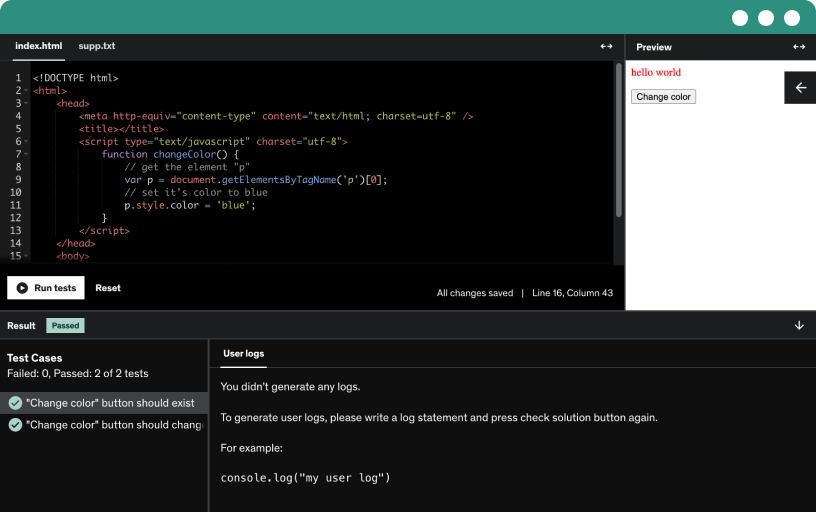
Course content
8 sections • 139 lectures • 10h 23m total length
Requirements
- This course is tailored for beginners, with no prerequisites required. Even if you're new to statistics and R programming, there's no need to worry. We'll start from the very basics and gradually build your understanding step-by-step, ensuring you grasp each concept clearly and can easily follow along with the content.
Description
Welcome to our fourth course "Learn Statistics & Biostatistics Data Analysis From Scratch". In this course, you will start from the very fundamentals of Data and slowly move forward to the analysis of the data using different statistical tools. In an era dominated by big data and machine learning, statistics is the cornerstone that allows us to make sense of the vast amounts of information we collect. It provides the methodologies for the collection, analysis, interpretation, and presentation of data. This course not only makes you literate in the language of data but also empowers you to make informed decisions in business, science, and technology.
In this course, you will also learn the R-Programming to calculate different statistics on your data. R programming is one of the most sought-after skills in the fields of statistics, biostatistics and data analysis. With its extensive libraries and frameworks, R provides an unparalleled platform for analyzing and visualizing data, making it an indispensable tool for statisticians and data scientists for statistics. This course provides hands-on experience with R, ensuring you can apply statistical methods effectively in real-world scenarios.
This course is divided into Eight Modules
What is Data? - Understand the basics of data, its types, and how it's collected and organized.
Introduction to R Programming - Dive into R and R-studio, a powerful tool for statistical computing and graphics, essential for modern data analysis.
Descriptive Statistics - Learn to summarize and describe the essential features of numerical data, crucial for initial data exploration. You will also learn how to build their visualization.
Handling Categorical Data - Explore techniques for effectively managing and analyzing categorical variables.
Probabilities - Gain insights into the concepts of probability, a foundational pillar for statistical inference. You will understand the subjective, classical, conditional, etc probabilities concepts at the end of this module.
Correlation - Discover the methods to measure the strength and direction of a relationship between two variables. We will explain to you the Pearson, Kendall and Spearman correlations.
Regression - Understand how to model relationships between variables and make predictions. We will teach you about Simple linear Regression, Multiple Linear Regression, and Logistic Regression.
Hypothesis Testing - Develop the ability to test assumptions and make decisions based on data. You will learn the Z-test, T-test and its types, F-test, ANOVA and its types, and Chi-Sq test and its types.
This course is a unique blend of theory and practical. You will learn the theory of statistical concepts and along with it you will learn the R-programming to apply those statistical concepts to your data. We hope this journey will be enlightening for you. After having this course, you will be confident to analyze your data by your own.
Who this course is for:
- This course is for broad audiance.
- Students from basic sciences, particularly those in life sciences, will find this course especially beneficial, as it is designed to cater to their needs and enhance their understanding of R programming in scientific contexts.
- Computer science students aiming for a career in data science will greatly benefit from this course, as it provides foundational skills in R programming that are essential for data analysis and interpretation in the field.
- Sociologists who collect population data and wish to analyze and visualize it independently will find this course highly beneficial, as it equips them with the skills to effectively manage, analyze, and present data using R programming.
- Not highly recommended but economics and finance students who analyze market trends and financial data will benefit from this course, as it provides the tools to independently conduct statistical analysis and create impactful data visualizations.