

Your cart is empty.
Keep shoppingLearn Python Programming From A-Z: Beginner To Expert Course
108,503 students
Learn Python Programming From A-Z: Beginner To Expert Course
Become a professional Python programmer and learn how to easily create programs, apps, scripts, games and so much more!
Created byJuan E. Galvan, Ahmed Wael
Last updated 2/2022
English
English [Auto],
What you'll learn
- How to become a professional Python Developer
- How to land your first job as a Python Developer
- How to use the basic Python structures: strings, lists, and dictionaries
- How to write Python scripts to perform automated actions
- How to use Python Object-Oriented Programming (OOP)
- How to create your own Python programs from scratch
- How to use core programming tools such as functions and loops
- How to use variables to store, retrieve and calculate information
Explore related topics
Coding Exercises
This course includes our updated coding exercises so you can practice your skills as you learn.
See a demo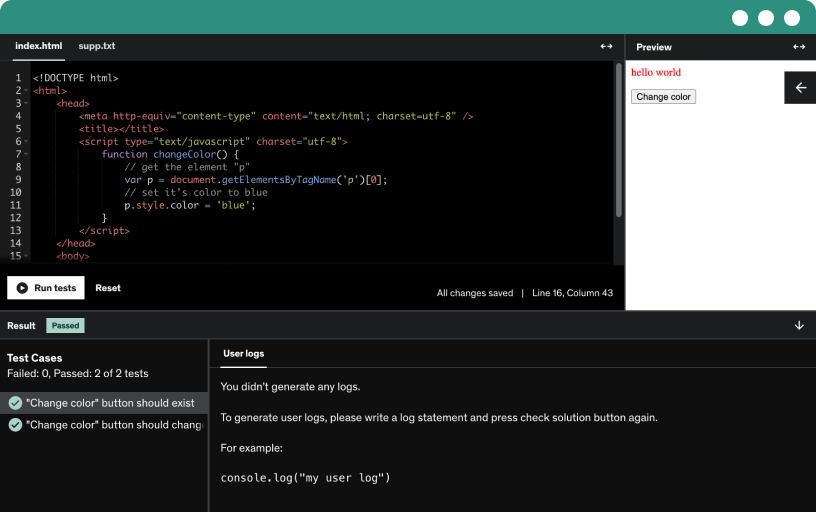
Course content
16 sections • 156 lectures • 15h 51m total length
Requirements
- Access to a computer with an internet connection.
Description
Welcome to the Learn Python Programming From A-Z: Beginner To Expert Course
Where you’re going to learn how to become a professional Python Developer and create programs, apps, scripts, games and so much more...
In this practical, hands-on course our main objective is to give you the education not just to understand the ins and outs of Python Programming, but also to learn exactly how the software development industry works, the different roles within a team, and how to land a Python Programming job without a degree.
Blending practical work with solid theoretical training, we take you from the basics of Python Programming to mastery, giving you the training you need not just to create software programs, scrape websites, and build automations, but also the foundational understanding of data science and visualization so you can become a well-rounded Python Programmer.
We understand that theory is important to build a solid foundation, we understand that theory alone isn’t going to get the job done so that’s why this course is packed with practical hands-on examples that you can follow step by step.
Even if you already have some coding experience, or want to learn about the advanced features of Python, this course is for you! In this course, you’ll learn Python 3.
Python is the number one programming language choice for machine learning, data science, and artificial intelligence. In order to get those high paying programming jobs, you need the skills and knowledge of how to become an expert Python Programmer, and that’s exactly what you’ll learn in this course.
Together we’re going to give you the foundational education that you need to know not just on how to write code in Python, create various scripts and softwares but also how to get paid for your newly developed programming skills. The course covers 6 main areas:
1: PYTHON COURSE INTRO
This intro section gives you a full introduction to the Python industry and marketplace, job opportunities and salaries, and the various Python job roles.
- Python Industry and Marketplace
- Python Job Opportunities
- Landing a Job w/o a Degree
2: BASIC/ADVANCED DATA TYPES
This section gives you a full introduction to the Python basic and advanced data types with hands-on step by step training.
- Python Variables
- Integers, Floats, and Complex Numbers
- Strings
- Operators
- Lists, Tuples, Sets & Dictionary
3: PYTHON CONTROL FLOW
This section gives you a full introduction to the Python Control Flow with hands-on step by step training.
- Basic/Complex Conditional Statements
- For Loops, While Loops
- Break/Continue Statements
- Zip/Enumerate Keywords
4: BASIC/ADVANCED FUNCTIONS
This section gives you a full introduction to the Python basic and advanced functions with hands-on step by step training.
- Help/Defining Function
- Error Handling
- Variable Scope
- Doc Strings
- Lambda Functions
- Iterators + Generators
- Map/Filter Functions
5: SCRIPTING & LIBRARIES (includes numpy, pandas)
This section gives you a full introduction to the scripting and libraries with hands-on step by step training.
- Scripting Basics
- Python IDEs
- Python Text Editors
- Third Party Libraries
- Numpy + Pandas
- Data Visualization
- Webscraping
6: STARTING A CAREER IN PYTHON
This section gives you a full introduction to starting a career as a Python Programmer with hands-on step by step training.
- Building a Brand
- Personal Branding
- Freelancing + Freelance websites
- Importance of Having a website
- Networking
- Creating a Resume
By the end of the course you’ll be a professional Python Programmer and confidently apply for jobs and feel good knowing that you have the skills and knowledge to back it up.
Who this course is for:
- Students who want to learn Python Programming from A-Z