Udemy
    •  
    •  
    •  
    •  
    •  
    •  
    •  
    •  
Turn what you know into an opportunity and reach millions around the world.
Learn More
Your cart is empty.
Keep shopping
Java Programming with Java 8 and OCA OCP Java Exam Prep
Rating: 4.4 out of 5(320 ratings)
1,848 students

Java Programming with Java 8 and OCA OCP Java Exam Prep

Full syllabus of a classroom-based Java 8 training and exam prep with theory, exercises and lab sections.
Created byTalha Ocakçı
Last updated 9/2018
English

What you'll learn

  • Create a Java desktop application
  • Use even the smallest control structure in practical examples
  • Leverage the object oriented programming in best way
  • Use encapsulation to keep your data safe
  • Use encapsulation and abstraction for reusable module development
  • Using data collections professionally
  • Interacting with binary and text files
  • Create binary or text files after processing data
  • Using Java 8 streams and functional programming
  • Using databases with Java applications
  • Create a user interface by using swing

Coding Exercises

This course includes our updated coding exercises so you can practice your skills as you learn.

See a demo
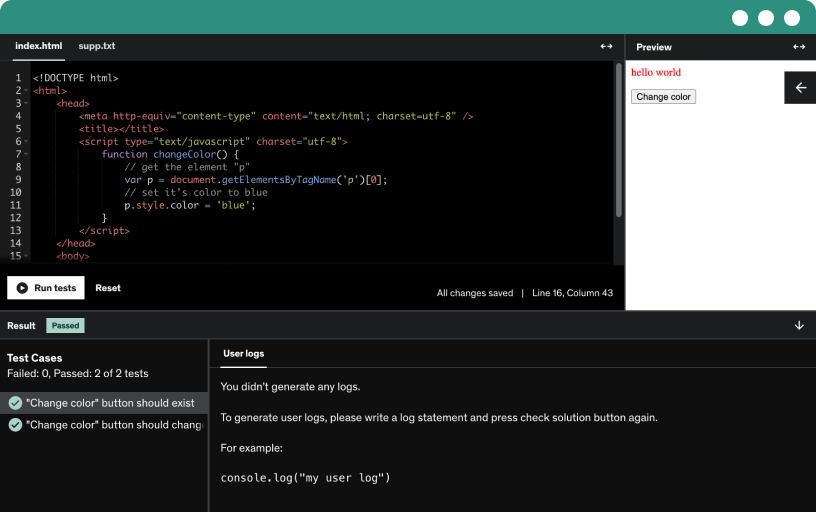
Image of coding exercise example

Course content

21 sections208 lectures26h 12m total length
  • Course Introduction3:46

    The tools we will use will be explained.

    Using the exercises and checking the solutions, source codes will be explained.

  • Platform Independency, JDK and JRE terms8:35

    Java became popular by its platform independent architecture.

    When you write an application for Windows, you may port it to Mac or any Linux distribution without any further effort. This is amazing.

    You will learn how platform independency works.

    All new students confuse what is JDK and JRE. JDK is used by only developers and contains development tools like compiler but JRE is used by anyone.

  • Introduction to Java
  • Preparing development environment8:53
  • Syntax rules13:37

    Some basic syntax rules explained.

    What is statement in Java?

    How to separate statements?

    How to define variables and assign values to variables?

    How to allocate memory for an object with new keyword.

  • Method Invocation 17:03
  • A method MUST be inside a class.
  • A method (mostly) MUST be invoked from an instance of a class.

  • Method Invocation 2 - Invoke on object instances8:17

    Class is a meta-data (definition) of a real world object and the heart of object oriented programming. It is above all methods, behaviors contrary to functional programming or declarative programming. Thus, before coding some code flow, you need to design a class to store some state inside an object (instance). That is why no code may exist outside of a class. So does it make sense to put main method into a class? It should from now on. You can create a class with class keyword in a separate file and define some attributes and methods inside it. You can create concrete objects with new keyword. As soon as you create an instance and allocate some memory for it, you will be able to store state of this object. State is the snapshot of an object at current time and can be modified either directly or via methods indirectly. Both methods and attributes can be accessed by dot notation on any object. (instance)

  • Exercise - Using classes, instances and invoking methods2:00
    • Design and create a class.
    • Create an instance by new keyword.
    • Accessing / modifying attributes and methods of an instance.
  • Exercise - Code Correction - Return value on all flow paths1:00

    A method mostly returns a value.

    (If return value is void, there is no need to return a value) return keyword completes the execution of the current method so that none of the below lines inside the method are executed.

    If the return type of the method is not void, than all of the execution flows must return a value.

  • Method Overloading4:29

    Methods with same name may exist in the same class if their argument lists are different.

    These methods are called as overloaded versions of each other.

    int sum(int v1, int v2)

    int sum(int v1, int v2, int v3)

    int sum(int v1, int v2, int v3, int v4)

  • Limitless arguments - Array and Vararg arguments10:27
    • If we need to process an unbound number of arguments with same type we may put them into an array and then pass to the method

    String concatanateStrings(String[] values);

    • We use variable arguments to pass any number of variables to a method without using an explicit array

    String concatanateStrings(String… values)

  • Constructors11:03

    Constructor is a special method that

    • has no return value
    • executed just after memory allocation for an instance is completed.
    • When you create a class with new keyword, constructor is called internally.

    Constructor eases to set instance variables without writing explicit lines to set them.

  • Static context7:03
  • Using static variables and methods9:59

    So far, we have dealt with readdressable (variable) values that created at run-time (while the execution of the program). They are called as «Dynamic variables» When you create a new instance of a class, a brand new memory is allocated in heap space. Instance context isolates different instance’s values and method executions from each other.

    Java has another context called «static».

    Static context: Before the execution of the program (on class loading phase), variables are stored into class space and the address does not change throughout the execution

  • Requirements

    Description

    NEW: ONLINE CODE PRACTICES ARE ADDED. YOU STUMBLED UPON THE FIRST JAVA COURSE WITH UDEMY ONLINE CODE PRACTICES.

    Read the problem, write your code and get the feedback automatically. That's it!

    [ALL SOURCE CODE IN THE FIRST LECTURE. JUST IMPORT AND TEST!!!]

    [FIRST STEP TO PREPARATION FOR THE ORACLE CERTIFICATION EXAMS: OCJA and OCJP]

    [MOST CHAPTERS HAVE A GREAT EXERCISE AND ITS SOLUTION IN DETAILS]

    This course is for those want to be a Java programmer by following a proven methodology and one-to-one online version of the lectures I gave to hundreds of students in several classrooms in several high-quality training center.

    The biggest missing part for programming students is the exercises that they may work on. This class has high-quality exercises and their solutions right after the video explanations.

    Here is our agenda:

    0- Why java? What is platform independency? Why it is the most used programming language in professional software development?

    1- Learn programming basics:

    Using variables, primitive types, mathematical and logical operators.

    Control structures, loops and really high-quality exercises to have hands-on experience.

    2- Learn one dimensional and multidimensional arrays:

    Use this basic data collection and use them inside real-world, fun practices. Find the longest lost series of an NBA team for instance :)

    3- Learn object oriented programming:

    Learn encapsulation, inheritance, abstraction with great examples and exercises. Possibly you wasted lots of time by watching similar unclear explanations so far. It is time to polish the dust of these concepts.

    4- Learn core types and great utility classes of Java.

    How a professional programmer leverages built-in types and utility classes in real life? StringBuilder, StringBuffer, Date type, String - Date conversions with SimpleDateFormat, Math class, Collections and Arrays class the topics you will learn.

    5- Learn regular expressions.

    Extracting useful data from a string by regular expressions is the greatest feature of all programming languages. But it is the most overlooked one. We don't overlook it. With two great explanation you will learn how to extract data from a URL and you will validate an email address ( by not Googling and copying of course!!!)

    6- Learn data collections.

    Everyone teaches you what is a list, set and map. How to put data and retrieve it. But this is the top of the iceberg. You MUST know where to use them, when to leverage the collections. Included exercises are asked in job interviews!!! Hold tight!!!

    7- Learn file operations

    How java communicates with files, read text files, binary files or write to them? How the content of the file is processed with data collections? You will learn by great exercises.

    At this point you may move on Java EE course for further understanding.

    8- Functional programming in Java 8

    Using ASM interfaces, Function, Predicate, Consumer, Supplier interfaces, lambda expressions.

    Using streams to process collections in functional style.

    Leveraging multi-cpu cores easily by using parallel streams

    9- Java 8 Date and Time API

    10- Generics

    11- Java and Database Interaction with MySQL 

    Have a great experience!!!


    Who this course is for:

    • Even with no experience in programming
    • Programmers with even no experience in object oriented programming
    • Programmers that already know an object oriented programming language

    Report abuse