
Your cart is empty.
Keep shopping
Dynamic Programming Made Easy: A Step-by-Step Beginner Guide
Highest Rated
New
13 students
Dynamic Programming Made Easy: A Step-by-Step Beginner Guide
The Hidden Logic for Solving Any Dynamic Programming Problem
Created byRajshree Umarekar
Last updated 9/2026
English
What you'll learn
- What is Dynamic Programming?
- What is Memoization?
- How Many Types of Dynamic Programming Actually Exist?
- What is Linear DP?
- How to solve Fibonacci Numbers?
- How to solve Climbing Stairs?
- How to solve House Robber?
- How to solve Jump Game?
- What is Kadane's Algorithm?
- How to solve Maximum Subarray?
- How to solve Maximum Circular Subarray Sum?
- How to solve Maximum Product Subarray?
- How to find Best Time to Buy and Sell Stock?
- What is 0/1 Knapsack?
- How to solve Classic 0/1 Knapsack?
- How to solve Subset Sum?
- How to solve Partition Equal Subset Sum?
- How to solve Target Sum?
- What is Unbounded Knapsack?
- How to solve Classic Unbounded Knapsack?
- How to solve Coin Change?
- How to solve Coin Change II?
- How to solve Rod Cutting?
- What is Subsequence?
- How to solve Longest Common Subsequence?
- How to solve Edit Distance?
- How to solve Longest Palindromic Subsequence?
- How to solve Distinct Subsequences?
Explore related topics
Coding Exercises
This course includes our updated coding exercises so you can practice your skills as you learn.
See a demo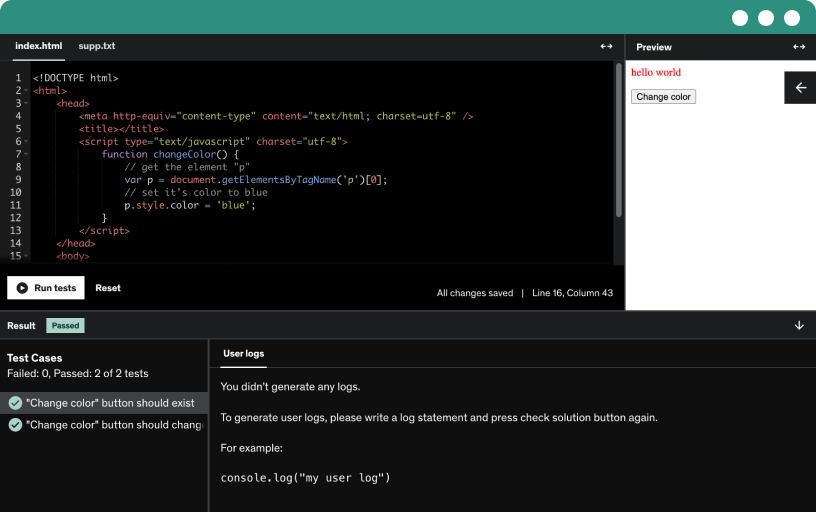
Course content
6 sections • 27 lectures • 5h 4m total length
Requirements
- You should have an IDE (Eclipse, Intellij, etc) for coding
- You should know the basics of Java Programming
Description
Ready to conquer complex problems? This comprehensive Dynamic Programming course is your ultimate guide! We're diving deep into one of computer science's most powerful techniques.
Let's start with a fundamental question: Why should you care about dynamic programming? The answer lies in efficiency. On one side, we have *Dynamic Programming* — a smart approach that significantly reduces redundant calculations. It optimizes both performance and feasibility by breaking down complex problems into simpler subproblems. On the other side, we have *Brute Force* methods, which can lead to exponential time complexity. This makes them impractical for larger problem instances because they involve exhaustive searching and lead to redundant calculations.
Think of it this way: Would you rather solve a puzzle by trying every possible combination, or by remembering which pieces you've already tried? Dynamic programming is like having a perfect memory for problem-solving.
By the end of this course, you'll not only understand *why* Dynamic Programming is a game-changer but also how to implement it effectively, step-by-step, with ease.
What you'll learn in this series:
Introduction to Dynamic Programming & Memoization
Common DP types with real-world examples:
Linear DP
Fibonacci Numbers
Climbing Stairs
House Robber
Jump Game
Kadane's Algorithm
Maximum Subarray
Maximum Circular Subarray Sum
Maximum Product Subarray
Best Time to Buy and Sell Stock
0/1 Knapsack
Classic 0/1 Knapsack
Subset Sum
Partition Equal Subset Sum
Target Sum
Unbounded Knapsack
Classic Unbounded Knapsack
Coin Change
Coin Change II
Rod Cutting
Subsequence
Longest Common Subsequence
Edit Distance
Longest Palindromic Subsequence
Distinct Subsequences
Whether you're a beginner or looking to solidify your knowledge, this series is for YOU!
Who this course is for:
- Developers curious to learn about Dynamic Programming
- Java developers willing to learn how to solve DP problems
- Anyone pursuing career in backend development
- Beginners looking forward to understand the different types of Dynamic Programming
- Anyone pursing a high paying job in IT Industry
- Anyone targeting for the FAANG companies
- Developers willing to clear job interviews with ease