Your cart is empty.
Keep shopping

Teach on Udemy
Turn what you know into an opportunity and reach millions around the world.
Learn MoreData Structures & Algorithms, Level-up for Coding Interviews
Rating: 4.7 out of 54.7(3,456 ratings)
29,870 students
Data Structures & Algorithms, Level-up for Coding Interviews
Master problem solving for Coding Interviews, ace Data Structures and Algorithms with over 150 challenges!
Last updated 7/2022
English
EnglishFrench [Auto],
What you'll learn
- Accelerate your algorithmic thinking
- Learn to optimise brute force solutions
- Learn to apply data structures
- Learn to write complex codes
- 150+ carefully curated problems
- Analysis of space-time complexity
- Using C++ Standard Template Library
- Become a 10x Problem Solver
- Sliding Window, Hashing, Maps & Sets
- Master Dynamic Programming & Graphs
- BONUS : Build a LRU Cache
- Practice Questions on all important topics
Explore related topics
Coding Exercises
This course includes our updated coding exercises so you can practice your skills as you learn.
See a demo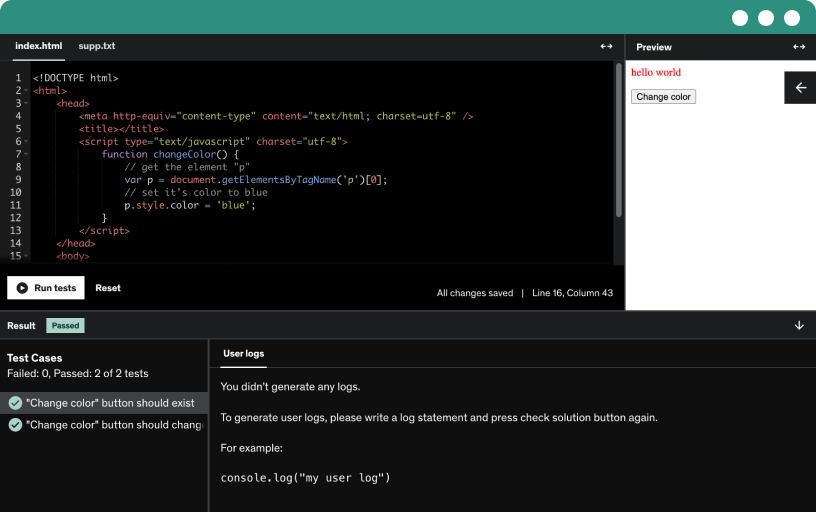
Course content
19 sections • 255 lectures • 30h 43m total length
- Course Orientation!5:23
Data structures and algorithms level-up course equips you with essential problem-solving through curated problems across arrays, stacks, trees, graphs, and dynamic programming, plus practice and C++ STL guidance.
- How to do this course?2:58
Structure your learning with modular sections on arrays, videos that discuss problems and solutions, and coding lectures with hands-on implementation. Think before solving, and implement in C++ for assignments.
- C++/Java Code Repository!0:09
- TA Hours/ Doubt Support Guidelines1:15
- Exercise Solutions!0:08
- Q/A Section0:09
- Introduction4:16
Explore arrays and vectors as dynamic, contiguous data structures in c++, with doubling growth, o(1) access, and passing by value versus by reference.
- Vector STL - Demo5:24
Learn to use the C++ vector STL with a hands on demo: create vectors, inspect size and capacity, push back elements, print them, and initialize with a fill constructor.
- Vector of Vector - Demo3:04
Explore 2d vectors as an alternative to 2d arrays, construct a vector of vectors with varying row lengths, and learn iteration, printing, and updating techniques using for and foreach loops.
- How to submit coding exercises?5:04
Learn to submit coding exercises on Udemy, implement the given fizzbuzz function inside the template, and see how your solution is judged against tests.
- FizzBuzz Test
- A Note on Sorting!0:30
- Helpful Webinars [Optional]0:11
- Pairs9:40
Find two distinct numbers in an array that sum to a target S, using brute force, sorting with binary search, or a hash set for linear time.
- Pairs Code4:14
implement the pair sum problem using an unordered set and a vector to return the matching pairs; check the complement before inserting the current element to avoid duplicates.
- Triplets8:32
Solve the triplets problem by finding all distinct triplets that sum to a target sum, with internal and overall sorting in ascending order, using sorting and two-pointer techniques.
- Triplets Code6:46
Sort the array, then use a two-pointer approach to find triplets that sum to the target, collecting and printing all valid triples.
- Mountain7:26
Identify peaks in an array of distinct integers and calculate the longest mountain width by expanding left and right from each peak, achieving linear time.
- Mountain Code7:32
Implement the highest mountain function by identifying peaks and counting contiguous elements to the left and right, updating the largest peak length while avoiding segmentation faults.
- Longest Band10:50
Uncover how to find the longest band in an array by forming the longest sequence of consecutive numbers after reordering, using sorting or an O(n) hash set approach.
- Longest Band Code7:18
Explore solving the longest band problem with an unordered set, starting chains from elements lacking a left neighbor and extending right to achieve O(N) time.
- Rains10:17
Compute trapped rain water on an elevation map using the min of left max and right max minus the bar height, with left and right max arrays in linear time.
- Rains Code6:55
Implement the rainwater trapping solution by computing left max and right max arrays from the heights, then accumulate water using the minimum of these bounds.
- Subarray Sort10:24
Identify smallest subarray to sort so the whole array becomes sorted; if already sorted, return -1 -1; use linear time to find the out-of-order min and max and their positions.
- Subarray Sort Code8:22
Implement the subarray sort solution by locating the smallest and largest out-of-order elements, then determine their left and right indices to sort the subarray.
- Minimum Swaps9:18
Learn how to compute the minimum number of swaps to sort an array by building a value-to-position mapping, identifying disjoint cycles, and summing cycle lengths minus one.
- Minimum Swaps Code13:12
Learn cycle-based solution to the minimum swaps problem: pair each element with its original index, sort by value, and count swaps as cycle length minus one using a visited array.
- Maximum Subarray Sum
- Minimum Difference
- Array Products
- Busy Life
- Arrays & Vectors Quiz!
- Strings Introduction6:11
Compare character arrays and the string class in C++ and learn dynamic storage. Use getline for input, vector of strings for multiple inputs, and loop over each character.
- Searching Inside String!5:15
Use the string class to search for a word inside a paragraph with the find function and obtain the first occurrence index, then locate subsequent occurrences.
- Warm Up - Search All!
- Space203:18
Master space replacement by converting spaces to %20 using an in-place, right-to-left single-pass approach, counting spaces and shifting characters to accommodate extra space.
- Space20 Implementation6:21
Execute an in-place space replacement by counting spaces, computing the final index, and performing a reverse pass to shift characters and insert %20, ensuring null termination.
- Tokenisation (using sstream)4:43
Learn how tokenization splits a string by delimiters using a C++ stringstream and getline to extract tokens into a vector.
- Tokenisation (using strtok)4:44
Strtok tokenizes a string by returning one token per call, starting at the input and using a static variable; call it first with the string, then null on subsequent calls.
- Designing our own String Tokeniser!8:01
Design a custom string tokeniser that scans left to right, uses a static state to track input, and builds tokens in a dynamic array until delimiters are reached.
- String Key Sort9:06
We learn to sort strings by column keys formed from space-separated fields, using numeric or lexical comparisons, with an optional reverse and precomputed key pairs.
- String Key Sort Implementation16:13
This lecture presents a string key sort implementation that reads lines, tokenizes input, builds a vector of string pairs, and sorts by numeric or lexicographic keys with optional reversal.
- Check Subsets4:09
Learn to check whether the second string is a subsequence of the first using a two-pointer approach, achieving linear time O(m+n) instead of the exponential subset generation.
- Check Subsets Implementation2:34
Implement the isSubset function using a two-pointer approach to determine whether the second string is a subset of the first by matching characters from the end.
- Sort Subsequences5:11
Learn to generate all subsequences of a string using recursion, with a note on bit masking, then sort the results by length and, if tied, by lexicographic order.
- Sort Subsequences Code5:13
Write a recursive solution to generate all subsequences of a string, using base and recursive cases, including or excluding each letter, building outputs, and sorting by length and lexicography.
- Digital Clock
- Biggest Number String
- Run Length Encoding
- Palindrome Break
- String Normalisation
- Solution : String Normalisation0:15
- Strings Quiz!
- Bitwise Operators9:54
Explore bit manipulation with bitwise operators like and, or, xor, and not, and learn how binary representations and two's complement enable fast operations such as 5, 7, and 8.
- Left Shift & Right Shift4:21
Explore binary left shift, which multiplies a number by 2^B, and right shift, which divides by 2^B, with concrete examples from five and ten.
- Check Odd/Even3:16
Learn to check odd or even using a bitwise operator. Use the last bit (x and 1) to determine parity, with an example showing odd and even results.
- Get ith Bit3:55
Get the i-th bit of a number using bitwise operations. Create a mask by left shifting 1 i times and use it with the number to yield 1 or 0.
- Set ith Bit2:30
Set the i-th bit of a number using a left-shifted mask and bitwise OR. Update n by reference or return the new value, illustrated with five becoming seven.
- Clear ith Bit2:42
Learn to clear the i-th bit by creating a mask with 1 << i, negating it, and using bitwise AND to zero only that bit in a number.
- Update ith Bit4:48
Learn to update the i-th bit by clearing it, then applying a mask from value left shifted by i to set or clear the bit.
- Clear last i Bits3:54
Clear the last i bits of a number by left-shifting minus one to form a mask and applying a bitwise and with the original number.
- Replace Bits Challenge4:57
Learn to replace bits between indices i and j in a 32-bit number with bits from m by clearing the range, creating a mask, left-shifting m, and or-ing with n.
- Two Power2:52
Learn to determine if a number is a power of two using a bitwise and with n minus one, a fast order one check.
- Counting Set Bits4:18
Count set bits in a number using bitwise operations, tracking the last bit with n & 1 and removing it by right shifting, with a loop running in O(log n).
- Counting Bits Hack3:15
Count set bits efficiently with the n and n minus one hack, removing one set bit each iteration. The loop runs once per set bit, as illustrated by examples.
- Fast Exponentiation8:11
Explore fast exponentiation using binary representation and bit masking. Learn to compute powers in O(log n) by iteratively squaring and multiplying when bits are set.
- Problem - Decimal to Binary6:58
Convert a decimal number to binary using repeated division by two, capturing remainders and assembling the binary digits via powers of two.
- Earth Levels
- Sliding Window Introduction2:50
Master sliding window techniques, reducing complexity from O(n^2) to O(n). Explore fixed windows of length k and variable windows with two pointers, using deques to maintain state.
- Housing (Two Pointer)12:27
Explore the housing problem by finding all continuous subarrays whose sum equals k using a sliding window two-pointer approach, achieving linear time and constant space.
- Housing Implementation7:41
Explore the window approach to find subarrays summing to k by expanding and contracting the window, tracking the current sum, and printing the i to j-1 window.
- Unique Substring (Hashing)9:20
Explore the unique substring problem by applying a sliding window approach with two pointers and a hash map to track last occurrences, expanding or restarting windows to maximize length.
- Unique Substring Implementation12:24
Implement the unique substring problem using a sliding window and hash map to track last occurrences, update start and max length, and return the corresponding substring.
- String Window8:46
Discover how to find the smallest window in a big string that contains all characters (including duplicates) of a small string, using a sliding window with frequency maps.
- String Window Implementation15:34
Learn a sliding window algorithm that uses frequency maps for the pattern and string, expands and contracts the window, and returns the smallest valid substring.
- Smallest Distinct Window
- Sliding Window Maximum
- Count Subarrays with Target Sum
- Sliding Window Quiz
- Merge Sort4:28
learn how merge sort uses divide and conquer to recursively sort an unsorted array's left and right subarrays. then merge them with two pointers into a single sorted array.
- Merge Sort Code12:41
Learn to implement merge sort with a recursive approach that splits at the midpoint into left and right parts, merges with a temporary vector, and copies back.
- Inversion Count13:45
Explore the inversion count problem on arrays, moving from brute force to a divide-and-conquer merge-sort approach that counts left, right, and cross inversions for an O(n log n) solution.
- Inversion Count Code4:05
Learn a merge-based inversion count algorithm that tallies left inversions, right inversions, and cross inversions to produce the total, updating the count as elements are copied during merge.
- Quick Sort10:11
Learn quicksort, a divide-and-conquer sorting algorithm that uses a pivot to partition an array into elements less than and greater than the pivot, then recursively sorts each part.
- Quick Sort Code6:27
Implement the quicksort algorithm by writing the partition function and the recursive quicksort calls. Manage base cases and pivot placement for left and right partitions.
- Quick Select4:33
Learn to find the kth smallest element with quickselect using partition and pivot, building on quicksort with an array of distinct integers.
- Quick Select Code3:04
quick select code uses a partition from quicksort to find the k-th smallest element by pivot index, recursing left or right based on k, with zero-based indexing.
- Smallest String6:42
Learn to form the lexicographically smallest concatenation of strings by sorting with a custom comparator that compares x+y and y+x, guided by merge sort to build the final result.
- Smallest String Code1:09
Implement the smallest string traversing problem by sorting strings with a custom comparator that compares x+y and y+x, then concatenate the sorted array to produce the output like aabaab.
- Sparse Search6:22
Explore the sparse search problem on a sorted array with empty strings, and learn a modified binary search that uses nearest non-empty strings to efficiently locate a key.
- Sparse Search Code6:33
Implement sparse search by performing a modified binary search over an array with empty strings, adjusting mid to the nearest non-empty, and returning the index of the key or -1.
- Staircase Search
- ICPC Standings
- Juggling Balls
- Sorting Subarray
- Sorting & Searching Quiz
- Binary Search - Recap!3:58
Discover how binary search, a divide and conquer technique, solves multiple problems with logarithmic time complexity. Apply its simple code patterns to efficiently locate a key and explore practical applications.
- Frequency Count7:07
Learn to count frequency of a target in a sorted array using binary search by finding the first and last occurrences and computing frequency as last minus first plus one.
- Frequency Count Code-I3:04
Find the lower bound of a key using a binary search, updating the answer whenever a match is found and searching the left part to locate the smallest index.
- Frequency Count Code-II3:43
Learn to count frequency efficiently in C++ by using lower_bound and upper_bound from the standard template library; compute frequency as upper_bound minus lower_bound in one line of code.
- Rotated Search8:38
Discover how to search a rotated sorted array with a modified binary search, using pivot-based halves and conditional decisions to locate an element's index efficiently.
- Rotated Search Code6:08
Explore the rotated search implementation using a modified binary search, splitting the array around the pivot and narrowing the search by comparing against the left and right sorted parts.
- Finding Roots9:49
Find the square root of a number to p decimal places using binary search on a monotonic search space, without library functions, refining digits with a linear search.
- Square Roots Code6:25
Implement the square root using binary search from 0 to n, then refine with a linear search for decimals to achieve the floating-point result.
- Aggressive Cows [Spoj]11:21
Explains solving the aggressive cows problem by binary searching the maximum minimum distance between birds placed in nests along a line, using a monotonic feasibility check.
- Aggressive Cows Code10:01
Sort nest positions, apply a binary search on the minimum separation, and use a canPlace feasibility check to maximize the distance between birds in nests.
- Min Pairs5:42
Learn to find a pair with minimum absolute difference between two arrays using sorting and lower bound, yielding an efficient O(m log m + n log m) approach.
- Min Pairs Code5:25
Sort one array, then for each element in the first array find the closest element in the second array using lower_bound, evaluating left and right neighbors to minimize the difference.
- Game of Greed
- Game of Greed Concept8:20
Explore the game of greed by partitioning an array into k subarrays to maximize the minimum sum each friend receives, using binary search on a monotonic feasibility predicate.
- Solution - Game of Greed10:02
Learn to solve the game of greed by partitioning an array into k parts to maximize the minimum sum, using binary search to check if such partitioning is possible.
- Solution : Game of Greed0:36
- Reading Books
- Binary Search Quiz
- Recursion Recap5:39
Recap recursion by showing how to break a problem into its smallest case. Define base and recursive cases, and follow a depth-first, left-to-right call tree managed by a stack.
- Ladders Concept8:02
Explore the ladder problem with steps of 1, 2, or 3, derive f(n)=f(n-1)+f(n-2)+f(n-3), and examine base cases and overlapping subproblems leading to dynamic programming.
- Ladders Code4:43
Learn to count ways with a recursive approach: base case n equals 0 returns 1, recursive calls n-1 and n-2, and negative n returns 0; dynamic programming handles overlapping subproblems.
- Subsequence Based Problems5:12
Explore how to generate all subsequences of a given string using a recursive brute-force approach, by including or excluding each character and forming subsets.
- Subset Sum to X6:07
Learn to solve subset sum problems for non-negative integers by counting how many subsets sum to a target X. Use a recursive include-or-exclude approach with clear base cases.
- Subset Sum to X Code2:43
Count subsets that sum to x in an array using a recursive include/exclude approach, with base cases, and hint at dynamic programming for optimization.
- Generate Brackets6:55
Learn to generate all balanced parentheses strings for n pairs using recursive backtracking, enforcing opening before closing and pruning invalid branches to produce valid expressions.
- Generate Brackets Code6:50
Explore a recursive generate brackets solution that builds valid bracket strings by tracking open and close counts, uses backtracking and a base case to avoid mutating the output array.
- Smart Keypad3:44
Learn to generate all possible strings from a digit sequence using the keypad mapping, by reading input digit by digit and using recursion with backtracking.
- Smart Keypad Code7:09
Build a recursive print keypad output function that converts a numeric string into all possible letter combinations using keypad mappings, skipping 0 and 1, and printing results.
- Permutations10:51
Learn to generate all permutations of a string using recursion and backtracking with character swaps. Restore the original array after each recursive call and print permutation at the base case.
- Sorted Permutations
- N-Queen Problem11:53
Explore the n-queen problem and backtracking approach to place one queen per row on an n by n board so that no queens attack each other, printing a valid configuration.
- N-Queen Code15:58
Implement an n-queen solver with backtracking. Build a board, place one queen per row, use can_place to check column and diagonals, print on success, and backtrack otherwise.
- N-Queen Code15:58
Explore the n queen problem with a backtracking solution that builds a board, places queens row by row, checks the column and diagonals, backtracks when needed, and prints valid configurations.
- Sudoku10:40
Explore solving Sudoku on a 9x9 grid by backtracking and recursion, filling empty cells (zeros) with valid digits 1-9 while enforcing row, column, and subgrid constraints.
- Sudoku Code18:29
Learn to implement a sudoku solver using backtracking on a 9x9 grid, replacing zeros with valid numbers while enforcing row, column, and 3x3 subgrid constraints.
- Modulo Exponentiation
- Sudoku Solver
- N-Queen
- Game of Coins
- Game of coins - Advanced
- Rat in a Maze
- Longest Possible Route
- Recursion Quiz!
- Linked List Section Introduction7:56
Explore the linked list concept, including non-contiguous memory, nodes with next pointers, head, and dynamic allocation, and outline basic operations like insertion, deletion, searching, and printing.
- Warm Up - Search!
- Warm Up - Creating a Linked List7:00
Learn how to implement a linked list with insertion at head and print operations, using a node class with data and next, managing the head pointer, and pass-by-reference concepts.
- Practice - Insertion in the Middle4:19
Practice inserting a node in the middle of a linked list by traversing to the prior position, creating a new node, and updating next pointers; handle head insertion.
- Recursive Reverse a Linked List6:10
Explore reversing a linked list with recursive and iterative approaches. Learn how to flip pointers, update head and tail, and handle base cases and null termination.
- Recursively Reverse a Linked List Code3:03
Implement a recursive reverse of a linked list by handling base cases for null or single-node lists, then recursively reverse the rest and reconnect the nodes.
- Iterative Reverse4:43
Explore reversing a linked list using an iterative approach. Track current, previous, and temp nodes to safely update links and return the new head.
- Iteratively Reverse a Linked List Code2:16
Iteratively reverse a linked list using previous, current, and a temp pointer to store next, update links, and set head to previous for order n time and order one space.
- K-Reverse a Linked List3:49
Reverse every k nodes in a linked list by reversing the first k nodes, recursively solving the remainder, and connecting the parts to build the final list.
- K-Reverse Code6:35
Apply a recursive approach to the k-reverse problem by reversing the first k nodes of a linked list, using a base case, and reconnecting the reversed segment to the remainder.
- Merge Two Sorted Linked Lists4:07
merge two sorted linked lists by adjusting pointers without creating new nodes, compare a.data and b.data with a two-pointer approach and recursion, handling null end cases to return merged list.
- Merge Two Sorted Linked Lists Code5:06
Implement the merge function for two sorted linked lists using base cases and a recursive step with a temporary head pointer, merging by smaller value and returning the merged list.
- Runner Technique1:32
Learn the runner technique in linked lists by using two pointers, fast and slow, to find the midpoint efficiently and apply this logic to other problems.
- Middle Element
- K-th Last
- Merge Sort on Linked List4:35
Learn to sort a linked list with merge sort by modifying pointers without creating a new list, dividing at midpoint, recursively sorting parts, and merging for O(n log n) time.
- Merge Sort Linked List Code5:07
Implement merge sort on a linked list by handling zero or one node, splitting at the midpoint with slow and fast pointers, and merging the sorted halves.
- Detect Cycle in a Linked List
- Stacks, Queue, Deque Recap6:14
Review stacks, queues, and deques, detailing their LIFO and FIFO behavior, push and pop operations, and how they enable BFS, level-order traversal, and iterative solutions for recursion.
- Balanced Paranthesis4:01
Apply a stack-based approach to check balanced parentheses. Push opening brackets and pop on matching closings, ignoring operands and operators, and verify the stack is empty.
- Balanced Paranthesis Code5:57
Implement a balanced parentheses check using a stack that pushes opening brackets and pops on matching closings. Return true if the stack is empty at the end.
- Redundant Paranthesis8:38
Identify redundant parentheses in a balanced expression by using a stack to track operands and operators; if no operator exists inside brackets, mark them as redundant.
- Redundant Paranthesis Code5:42
Use a stack-based approach to detect redundant parentheses in expressions. The method pops until the opening bracket and checks for an operator, returning true when no operator exists inside.
- First Non-Repeating Letter7:07
Learn to find the first non-repeating letter in a running stream using a frequency map and a queue. The method outputs the current non-repeating character or -1 if none.
- First Non-Repeating Character
- First Non-Repeating Code4:33
Implement a streaming solution to find the first non-repeating character using a queue and a frequency map, reading input until a dot and outputting the result or -1.
- Max Subarray (Sliding Window + Deque)24:51
Solve the sliding window maximum problem using a deque to maintain a monotonic queue, producing the maximum for every window in linear time.
- Simplify Path
- Simplify Path9:05
Build a function to simplify a file path by normalizing absolute and relative paths, collapsing multiple slashes and dot-dot segments, and preserving root constraints to produce an equivalent path.
- Simplify Path Code21:12
Tokenize the path by slashes, filter out dot and dot-dot tokens, and use a stack to resolve absolute and relative paths into a simplified result such as x, y, z.
- Stock Span Problem
- Solution : Stock Span0:05
Requirements
- Ability to write & understand code
- Understanding of data structures
- Time & space complexity analysis
Description
Do you find yourself feeling like you get "stuck" every time you get a coding question?
Welcome to Data Structures & Algorithms, Level up Course the only course that provides you an ultimate practice on problem solving process and helping you to take your data structures & algorithms to the next level. The course is taught by an expert instructor Prateek Narang from Google, who is not just a software engineer but also has mentored thousands of students in becoming great programmers & developers.
The Course contains 25+ hours of interactive video content & dozens of coding exercises, teaching you the right tips & tricks in problem solving in a most concise way. Every problem discussion starts with a brute force approach, optimisations and ends with hands-on-coding video in C++ as well.
Here is what you will learn -
Problems on Data Structures
* Arrays, Strings, Vectors
* Hashing (Unordered Maps, Maps, Sets)
* Stacks, Queues, Linked Lists
* Binary Trees, BSTs, Heaps
* Graphs, Tries
Problems on Algorithms
* Brute force, Backtracking
* Sliding Window Algorithms
* Sorting, Searching, Binary Search
* Dynamic Programming Fundamentals
* Important Graph Algorithms
* BFS & DFS, Shortest Paths
Course exercises are in C++ but programmers having experience in one or more languages (C++/Java/Python/JavaScript) can definitely do this course, provided they have fundamental understanding of data structures. The course covers both breadth & depth of topics, diving deep where-ever needed. You will also learn how to apply techniques involving like - sorting & searching algorithms, sliding window, binary search, hashing which are very important for problem solving. For advanced topics like Dynamic Programming & Graphs, the course starts from the basics & helps you master these topics from the very fundamentals.
Unlike most instructors, I am not a salesperson or a marketer. My job is to help you build strong fundamentals in programming & be a successful developer. Through Udemy, I am providing this course to you at a fraction of cost of its original cost, so that anyone who is interested to learn can take their skills to the next level. So I hope you sign up today, and I will see you in the course.
Who this course is for:
- Students pursuing Computer Science or related fields
- Beginner-Intermediate level programmers with basic knowledge of data structures
- Developers who want to excel in problem solving skills & competitive coding
- Students who know theory of data structures, but find hard to implement in problems