
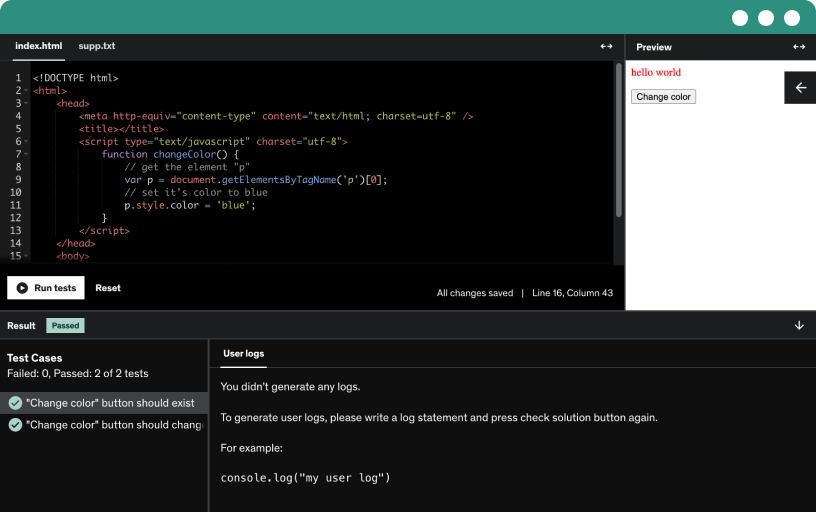
This course includes our updated coding exercises so you can practice your skills as you learn.
See a demo
Learn Java step by step through practical programming examples, from console input/output to control structures, arrays, methods, and object oriented concepts like classes and inheritance.
Demonstration on how to download and install Open JDK on Windows 10 operating system.
Learn how to compile and execute Java program from within Windows command prompt.
How to download and install Eclipse on Windows and then how to create a Java project and execute on Eclipse.
Learn the basics of a Java program by exploring a hello world example, writing classes and methods, and understanding main and static methods, and command line arguments.
Learn to declare variables in Java using primitive data types—byte, char, short, int, long, float, double, and boolean—initialize values, understand memory allocation, and print results to the console.
Learn how Java identifiers are named: avoid keywords, spaces, and leading digits, and forbid special characters. Follow camelCase for variables and methods, and PascalCase for classes.
Learn the string type in Java as an explicit class, create string objects, use length and the plus operator to print concatenated names.
Learn to format console output in Java using System.out.printf, with format specifiers for strings, integers, and doubles, including alignment, width, and zero padding.
Learn how the java.lang package is imported by default, why string and system classes don’t need imports, and how to access the scanner class using imports or fully qualified names.
Explore shortcut assignment operators in Java, including plus equals, times equals, and minus equals, to update a variable efficiently by applying operations like x += 10 or x *= 6.
Learn how to read a Celsius temperature in Java using a Scanner, convert it to Fahrenheit with the formula F = C * 9/5 + 32, and print the result.
Master branching with if-else statements in Java, selecting code blocks based on conditions using relational and logical operators to find the maximum of two numbers.
Develop a Java program that calculates income tax using if-else ranges. Apply 0% up to 30,000, 5% from 30,000 to 50,000, and compute primary tax with surcharge for higher incomes.
Learn to compute the factorial of a number using a while loop, validate negative and zero inputs, and print the result with a step-by-step explanation.
Extend Java tutorial to test if a given number is a perfect number by summing its factors and comparing sum to twice the number, with 6 and 28 as examples.
Master nested loops in Java by printing multiple patterns using i and j, including numbers and asterisks, with spacing and parity-based logic.
Understand the do-while loop in Java, its syntax and end-of-iteration condition, why it runs at least once, and a sum of user inputs example until the user enters zero.
Use the break keyword to exit the loop when a factor is found while testing if a number is prime. See Java with a boolean prime flag and square-root checks.
Use the continue keyword inside loops to skip the rest of an iteration and move to the next one. It works in for, while, and do-while loops.
Generate random numbers with thread local random, useful when multiple threads avoid contention. Use current and nextInt overloads to produce 10 inclusive to 100 exclusive bounds, and explore next methods.
Learn how method overloading lets you define multiple add methods with different signatures under one name. The compiler binds the best match at compile time, enabling compile-time polymorphism.
Learn how to traverse a one-dimensional array using the for-in loop, including syntax with a variable p, traversing any collection, deducing types with val, and printing each value.
Explore how Java's dynamic array-like collection, ArrayList, stores integers with generics, demonstrates index-based insertion, appending elements, retrieving size and elements with get, and iterative printing.
Learn how to pass a list of strings to a method in Java, print all names with a for in loop, and display total elements using the list size method.
This course will help you to learn Java from grounds up, starting from the basic up to advance level, step-by-step. Not only video tutorials but the course contains lots of coding exercises that you will do to test your acquired knowledge practically side by side of watching video tutorials.
This course will help you to prepare for Job Interviews on Core Java language, also you will gain confidence in doing programs using Java.
Each and every section of the course contains coding exercises that students will need to do practically while following the course lectures. These coding exercises are developed according to the corresponding section topic.
Also, there are quizzes in each section to test the acquired knowledge of the students.
Students will get all the required information to download, install and configure Java in their system, be it Mac or Windows.
Should they need any further information they can always use the Q/A forum.
At the beginning, students will learn the basics of Java programming, including control structures, methods, classes and objects, Java String and all other fundamental Java classes including use of Arrays and Lists. Then the course will move to the advance sections which includes Inheritance, dynamic polymorphism , exception handling, Generics.