
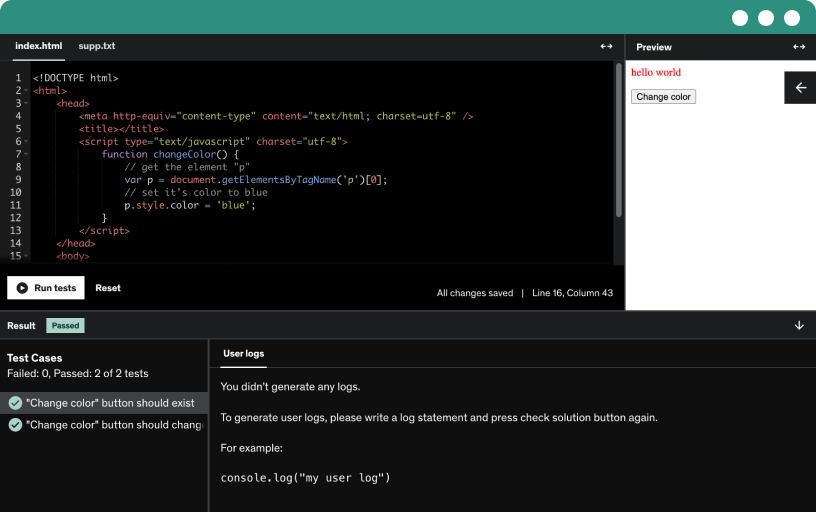
This course includes our updated coding exercises so you can practice your skills as you learn.
See a demo
In Lecture 1 of Section 1, we will be covering an introduction to Convolutional Neural Networks (CNNs) in Python for computer vision applications. We will start by discussing the basics of CNNs, including what they are and how they are used in image recognition tasks. We will also explore the architecture of a typical CNN, including layers such as convolutional layers, pooling layers, and fully connected layers.
Additionally, we will delve into the importance of CNNs in computer vision, highlighting their ability to automatically learn features from raw data and their effectiveness in image classification tasks. Throughout the lecture, we will provide examples and practical demonstrations to help you understand how CNNs work and how they can be implemented using Python libraries such as TensorFlow and Keras. By the end of this lecture, you will have a foundational understanding of CNNs and be prepared to dive deeper into more advanced topics in the following sections.
In Lecture 3 of Section 2, we will cover the installation process for Python and Anaconda, which are essential tools for setting up and running Convolutional Neural Networks in Python. We will walk through step-by-step instructions on how to download and install Python, a popular programming language for machine learning, as well as Anaconda, a data science platform that includes various tools and libraries for data analysis and visualization.
By the end of this lecture, you will have a better understanding of how to set up your Python environment and Jupyter Notebook, a web-based interactive computing environment, to begin working with CNNs for computer vision projects. We will discuss the importance of using Python and Anaconda for developing deep learning models, and how to effectively use these tools to build and train CNNs for image classification and object detection tasks. Overall, this lecture will provide you with the foundational knowledge needed to start exploring the world of Convolutional Neural Networks and computer vision using Python.
In Lecture 5 of Section 2, we will be focusing on opening Jupyter Notebook to start working on our Convolutional Neural Networks in Python project. We will cover the steps to install Python and Jupyter Notebook on your system, ensuring that you have all the necessary tools to begin coding. We will also discuss how to launch Jupyter Notebook and create a new notebook to start writing and running Python code for our CNN project.
Additionally, we will provide a brief overview of the Jupyter Notebook interface, including how to navigate through the different sections and cells within a notebook. We will introduce you to the basics of using Markdown for text formatting and code execution within Jupyter Notebook. By the end of this lecture, you will have a solid understanding of how to set up Python and Jupyter Notebook for your CNN Computer Vision project and be ready to move on to the next steps in building and training your CNN model.
Welcome to Lecture 6 of Section 2: Setting up Python and Jupyter Notebook in our Convolutional Neural Networks in Python course. In this lecture, we will be diving into the basics of Jupyter Notebook, a popular tool used by data scientists and machine learning engineers for interactive computing and data visualization. We will discuss how to install Jupyter Notebook, launch the application, create new notebooks, and run code cells.
We will also cover the different types of cells in Jupyter Notebook, such as code cells, markdown cells, and raw cells. Additionally, we will explore various keyboard shortcuts and other useful features that will help streamline your workflow and enhance your coding experience. By the end of this lecture, you will have a solid understanding of Jupyter Notebook and be ready to start coding your own Convolutional Neural Networks in Python for computer vision tasks.
In Lecture 7 of Section 2 on setting up Python and Jupyter Notebook, we will be covering the basics of arithmetic operators in Python. We will discuss how to perform mathematical operations such as addition, subtraction, multiplication, and division in Python. We will also learn about other operators such as modulus, exponential, and floor division. Understanding these arithmetic operators is essential for any programming task, including working with Convolutional Neural Networks in Python.
By the end of this lecture, you will have a solid understanding of how to use arithmetic operators in Python for basic mathematical calculations. This knowledge will serve as a foundation for more advanced concepts in the upcoming lectures on Convolutional Neural Networks. Make sure to follow along with the coding examples provided in Jupyter Notebook to practice applying these arithmetic operators in Python.
In this lecture, we will cover the basics of working with strings in Python. We will discuss how to create strings, manipulate them, and concatenate them together. Understanding how to work with strings is essential for data processing and analysis in Python, and we will explore various string methods and functions that can be used to manipulate and extract information from strings. Additionally, we will talk about the importance of string formatting and how it can be used to present data in a clear and visually appealing manner.
In the second part of the lecture, we will delve into the fundamentals of Python, including its syntax and basic programming concepts. We will explore variables, loops, and conditional statements, which are essential building blocks of any program in Python. By understanding these fundamental concepts, you will be better equipped to write efficient and effective code in Python, which will be critical for successfully implementing Convolutional Neural Networks in Python for computer vision tasks.
In Lecture 9 of Section 2 of the course "Convolutional Neural Networks in Python: CNN Computer Vision," we will be covering the basics of Python including lists, tuples, and dictionaries. We will dive into how to create and manipulate lists, which are ordered collections of items that can be of different data types. We will also explore tuples, which are similar to lists but are immutable once created. Finally, we will discuss dictionaries, which are key-value pairs that allow for easy and efficient data retrieval and manipulation.
By the end of this lecture, you will have a solid understanding of how to work with lists, tuples, and dictionaries in Python. We will also discuss how these data structures can be useful for storing and organizing data in a variety of applications, making them essential tools for any Python programmer. Additionally, we will demonstrate how to effectively use these data structures in conjunction with Jupyter Notebook, the interactive coding environment that we will be using throughout this course.
In Lecture 10 of Section 2 on "Setting up Python and Jupyter Notebook" in the course "Convolutional Neural Networks in Python", we will be diving into the powerful Numpy library in Python. Numpy is a fundamental package for scientific computing with Python, particularly in the field of data manipulation and analysis. We will start by exploring how to install Numpy in Python and import it into our Jupyter Notebook environment.
Next, we will delve into the various functionalities and capabilities of Numpy, such as creating arrays, reshaping arrays, and performing basic arithmetic operations on arrays. We will also cover more advanced topics like broadcasting, array indexing, and slicing. By the end of this lecture, you will have a solid understanding of how to leverage the Numpy library in your CNN computer vision projects, enabling you to efficiently manipulate and process large datasets to train your neural networks.
In this lecture, we will focus on setting up Python and Jupyter Notebook for working with Convolutional Neural Networks in Python. We will begin by discussing the importance of having a properly configured Python environment to run CNN models efficiently. We will also talk about the benefits of using Jupyter Notebook for coding and visualization of CNN algorithms.
Next, we will delve into the Pandas library of Python and how it can be used to handle data manipulation and analysis tasks in CNN projects. We will cover basic Pandas functions, such as reading and writing data files, filtering and sorting data, and performing descriptive statistics. Additionally, we will explore how Pandas can be integrated seamlessly with CNN models to preprocess and analyze image data effectively. By the end of this lecture, you will have a solid understanding of how to set up your Python environment and utilize the Pandas library for CNN computer vision projects.
In Lecture 12 of Section 2: Setting up Python and Jupyter Notebook, we will be focusing on working with the Seaborn library in Python. Seaborn is a popular data visualization library built on top of Matplotlib that provides a high-level interface for creating attractive and informative statistical graphics. We will explore how to install the Seaborn library using pip and how to import it into Jupyter Notebook for data visualization tasks.
We will learn how to use Seaborn to create different types of plots such as scatter plots, line plots, bar plots, and histograms. We will also discuss how to customize the appearance of these plots using various styling options provided by Seaborn. By the end of this lecture, students will have a better understanding of how to leverage the power of Seaborn to create visually appealing and insightful plots for their data analysis projects.
In Lecture 14 of Section 4 on Single Cells in the course "Convolutional Neural Networks in Python: CNN Computer Vision," we will be delving into the concept of the Perceptron. The Perceptron is a fundamental building block in neural network models, and we will explore its role in classifying data by learning from example pairs of inputs and outputs. Through a series of examples and exercises, we will learn how the Perceptron can be trained to make accurate predictions based on input data.
Furthermore, we will also be covering the Sigmoid Neuron in this lecture. The Sigmoid Neuron is another type of artificial neuron commonly used in neural networks, particularly in the context of binary classification problems. We will examine how the Sigmoid Neuron computes its output based on a weighted sum of inputs, and how it applies a non-linear activation function to the result. By the end of this lecture, you will have a solid understanding of both the Perceptron and the Sigmoid Neuron, and how they are used in building more complex neural network models for solving computer vision tasks.
In Lecture 15 of the Convolutional Neural Networks in Python course, we will dive deeper into the topic of activation functions, focusing specifically on the Perceptron and Sigmoid Neuron models. We will discuss how these functions are used in the context of single cell processing, and their significance in the realm of computer vision. We will explore the mathematical formulations of these functions, as well as their practical applications in training CNN models for image classification tasks.
Furthermore, we will examine the role of activation functions in the overall architecture of CNNs, and how they contribute to the non-linearity and feature extraction capabilities of these networks. Through hands-on examples and demonstrations, we will illustrate how the Perceptron and Sigmoid Neuron activation functions can be implemented in Python using popular deep learning libraries such as TensorFlow and Keras. By the end of this lecture, students will have a solid understanding of how activation functions shape the behavior of neural networks, and how they can be leveraged to enhance the performance of CNN models in computer vision applications.
In Lecture 16 of the "Convolutional Neural Networks in Python" course, we will be diving into the topic of creating a Perceptron model using Python. We will start by discussing the basics of a Perceptron and how it functions as a simple neural network model. We will cover the concept of input features, weights, and the activation function used in a Perceptron model. Additionally, we will go through the mathematical formula for updating weights during the training process.
Furthermore, in this lecture, we will be exploring the Sigmoid Neuron, which is a type of activation function commonly used in neural networks. We will discuss the properties of the Sigmoid function and how it helps in making predictions by mapping the output between 0 and 1. We will also cover the differences between the Sigmoid Neuron and the Perceptron model, and how they can be applied in various machine learning tasks. Finally, we will provide hands-on examples in Python to demonstrate how to implement a Perceptron model and incorporate the Sigmoid Neuron in a neural network.
In Lecture 17 of the "Convolutional Neural Networks in Python: CNN Computer Vision" course, we will delve into the basic terminologies related to Neural Networks. This lecture will focus on explaining concepts such as neurons, layers, weights, biases, activations, and loss functions. We will also explore the role of activation functions like ReLU, Sigmoid, and Tanh in shaping the behavior of neural networks.
Furthermore, we will discuss the importance of stacking cells to create a network in neural networks. By understanding how to combine multiple layers of neurons, we can create complex models that can learn from data and make accurate predictions. This lecture will lay the foundation for building more advanced convolutional neural networks for computer vision tasks.
In Lecture 18 of our course on Convolutional Neural Networks in Python, we will delve into the concept of gradient descent. Gradient descent is a crucial optimization algorithm that is used in training neural networks. We will explore how gradient descent works, including the steps involved in updating the weights of a neural network to minimize the loss function.
Furthermore, we will discuss the importance of gradient descent in the context of training convolutional neural networks for computer vision tasks. Understanding how gradient descent can be applied to optimize the performance of CNNs is essential for achieving better results in image classification, object detection, and image segmentation. By the end of this lecture, you will have a solid understanding of how gradient descent can be used to improve the performance of neural networks in computer vision applications.
In Lecture 19 of the course "Convolutional Neural Networks in Python: CNN Computer Vision," we will delve into the concept of back propagation in neural networks. Back propagation is a crucial algorithm that allows us to iteratively adjust the weights of our neural network to minimize the error between the predicted and actual outputs. Through this lecture, we will explore the mathematical foundations of back propagation and discuss how it helps optimize the performance of our convolutional neural network.
Moreover, we will also cover the technique of stacking cells to create a more complex neural network. By stacking multiple layers of neurons, we can create deep neural networks that can learn complex patterns and structures in our data. We will discuss the challenges and benefits of building deep neural networks, and how we can effectively train them using techniques such as back propagation. This lecture will provide a comprehensive understanding of how neural networks are constructed and trained, offering valuable insights into the world of computer vision and artificial intelligence.
In Lecture 20 of Section 6, we will be discussing some important concepts related to Convolutional Neural Networks. Specifically, we will be focusing on common interview questions that may be asked in job interviews or technical discussions related to CNNs. Understanding these concepts is crucial for anyone looking to excel in the field of computer vision and machine learning.
Some of the key topics we will cover include the differences between CNNs and traditional neural networks, the importance of pooling layers in CNNs, the role of activation functions such as ReLU, and the concept of data augmentation. By gaining a thorough understanding of these concepts, students will be well-equipped to answer common interview questions and showcase their knowledge and expertise in the field of Convolutional Neural Networks.
In this lecture, we will be focusing on the standard model parameters for Convolutional Neural Networks in Python. Specifically, we will discuss how hyperparameters play a crucial role in the performance of CNN models. Hyperparameters such as learning rate, batch size, and momentum will be covered in detail, along with their impact on the training process and overall accuracy of the model.
We will also delve into the process of tuning hyperparameters to optimize the performance of a CNN model. By understanding how each hyperparameter affects the training process and model accuracy, we can make informed decisions when selecting values for these parameters. Through practical examples and demonstrations, we will explore best practices for choosing hyperparameters to ensure our CNN models are effectively trained and perform at their best.
In Lecture 22 of Section 8 on Tensorflow and Keras, we will be diving into the relationship between Keras and Tensorflow in the context of convolutional neural networks. We will explore how Keras serves as a high-level neural networks API that can run on top of Tensorflow, making it easier for developers to build and train deep learning models. We will discuss the advantages of using Keras for its simplicity and user-friendly interface, as well as its compatibility with Tensorflow for optimized performance.
During this lecture, we will also cover how to leverage the power of Tensorflow within Keras to streamline the process of building CNN models for computer vision applications. We will walk through practical examples of using both libraries together to create efficient and effective neural networks. By the end of this lecture, students will have a solid understanding of how Keras and Tensorflow can be integrated to enhance the development of CNNs and improve their performance for computer vision tasks.
In this lecture, we will cover the process of installing Tensorflow and Keras, two popular deep learning libraries, on your system. We will walk through the steps required to set up these frameworks, including instructions for installing them via pip or conda. Additionally, we will discuss the importance of having the correct versions of Python and other dependencies installed to ensure compatibility with Tensorflow and Keras.
Furthermore, we will explore how to verify that Tensorflow and Keras have been successfully installed by running some sample code. We will demonstrate how to import the libraries into your Python scripts and execute basic operations, such as defining neural network architectures and training models. By the end of this lecture, you will have a solid understanding of how to install and begin using Tensorflow and Keras for your deep learning projects.
In Lecture 24 of the "Convolutional Neural Networks in Python" course, we will be diving into the topic of datasets for classification problems in Python. We will explore how to properly structure and prepare datasets for use in training convolutional neural networks for computer vision tasks. This lecture will cover the importance of high-quality datasets, data preprocessing techniques, and the common pitfalls to avoid when working with image classification datasets.
Furthermore, we will discuss the different types of datasets commonly used in classification problems, such as the CIFAR-10 and MNIST datasets. We will walk through the process of loading and exploring these datasets using Python libraries like NumPy and Pandas. By the end of this lecture, students will have a solid understanding of how to work with datasets for classification problems, setting them up for success in applying convolutional neural networks to real-world computer vision tasks.
In Lecture 25 of Convolutional Neural Networks in Python, we will be covering the importance of normalization and test-train split in computer vision. Normalization helps standardize the input data, making it easier for the model to learn and improve its performance. We will discuss the different techniques for normalization such as min-max scaling, z-score normalization, and batch normalization. Additionally, we will explore the concept of test-train split, which involves dividing the dataset into a training set and a testing set to evaluate the performance of the model.
Furthermore, in this lecture, we will dive into the Python code implementation of normalization and test-train split using popular libraries such as NumPy and scikit-learn. We will demonstrate how to preprocess the dataset for a classification problem, ensuring that the data is appropriately normalized and split for training and testing. By the end of this lecture, students will have a clear understanding of the importance of normalization and test-train split in building effective convolutional neural networks for computer vision tasks.
In Lecture 26 of the "Convolutional Neural Networks in Python" course, we will delve deeper into the concept of test-train split when working with convolutional neural networks for computer vision tasks. We will discuss the importance of splitting your dataset into training and testing sets to evaluate the performance of your model accurately. We will also explore different techniques for splitting the data, including random sampling and stratified sampling, and learn how to implement these techniques in Python using popular libraries such as scikit-learn.
Additionally, we will cover the best practices for splitting your dataset for a classification problem and discuss the potential pitfalls to avoid when performing a test-train split. By the end of this lecture, you will have a clear understanding of how to properly split your data for training and evaluation purposes, ensuring that your convolutional neural network produces reliable and accurate results for computer vision applications.
In Lecture 27 of Section 10 on Python - Building and training the Model, we will be focusing on different ways to create Artificial Neural Networks using Keras. We will explore how to build and train neural networks for image recognition using convolutional layers and pooling layers to extract features from images. This lecture will provide a comprehensive understanding of how to design and implement convolutional neural networks in Python using Keras for computer vision tasks.
Additionally, we will delve into the process of tuning hyperparameters, such as learning rates and batch sizes, to optimize the performance of our neural networks. By the end of this lecture, you will have the knowledge and skills to create and train convolutional neural networks using Keras for computer vision applications. This will equip you with the tools necessary to build powerful image recognition models that can classify and detect objects with high accuracy.
In Lecture 28 of our course on Convolutional Neural Networks in Python, we will be diving into the process of building the neural network using Keras. Keras is a popular deep learning framework that provides a user-friendly and flexible way to build and train neural networks. We will start by discussing the structure of the neural network, including the number of layers, activation functions, and optimization algorithms that will be used.
Next, we will walk through the steps to build and train the model using Keras. This will include defining the layers of the network, compiling the model with an appropriate loss function and optimizer, and fitting the model to the training data. We will also cover techniques for monitoring the model's performance during training, such as using callbacks to save the best model and early stopping to prevent overfitting. By the end of this lecture, you will have a solid understanding of how to build and train a convolutional neural network using Keras for computer vision tasks.
In Lecture 29 of our course on Convolutional Neural Networks in Python, we will delve into the important process of compiling and training the neural network model. We will discuss the various parameters and options that are available when compiling a CNN model, such as choosing the optimizer, the loss function, and setting performance metrics for evaluation. We will also explore how to fine-tune these parameters to achieve optimal performance and efficiency in training our neural network.
Additionally, we will cover the process of training the neural network model using the compiled configuration. We will discuss the concept of epochs and batch size, as well as techniques for monitoring the training process and evaluating the performance of our model. By the end of this lecture, you will have a solid foundation in building and training CNN models in Python, equipping you with the skills needed to tackle real-world computer vision tasks.
In Lecture 30 of the course "Convolutional Neural Networks in Python: CNN Computer Vision," we will be focusing on evaluating the performance of our trained model and making predictions using Keras. We will discuss various evaluation metrics such as accuracy, precision, recall, and F1 score that are commonly used to assess the performance of a convolutional neural network. Additionally, we will explore how to use these metrics to interpret the results of our model and fine-tune it for better performance.
Furthermore, we will delve into the process of making predictions using Keras and how to interpret the output of the model. We will demonstrate how to use our trained model to classify new images and analyze the predictions made by the network. By the end of this lecture, students will have a solid understanding of how to evaluate the performance of their convolutional neural network model and how to use Keras for making accurate predictions in computer vision tasks.
In this lecture, we will focus on building a neural network for solving a regression problem using Python. Specifically, we will cover the concepts of artificial neural networks (ANN) and how they can be applied to regression tasks. We will discuss the architecture of a basic neural network, including the input layer, hidden layers, and output layer, and how each layer contributes to the overall regression model.
Furthermore, we will delve into the implementation of the neural network using Python. We will walk through the process of loading and preprocessing the dataset, defining the architecture of the neural network using the Keras library, compiling the model, and training it on the data. By the end of this lecture, you will have gained a solid understanding of how to use neural networks to solve regression problems in Python, and be equipped with the knowledge to build your own regression models.
You're looking for a complete Convolutional Neural Network (CNN) course that teaches you everything you need to create a Image Recognition model in Python, right?
You've found the right Convolutional Neural Networks course!
After completing this course you will be able to:
Identify the Image Recognition problems which can be solved using CNN Models.
Create CNN models in Python using Keras and Tensorflow libraries and analyze their results.
Confidently practice, discuss and understand Deep Learning concepts
Have a clear understanding of Advanced Image Recognition models such as LeNet, GoogleNet, VGG16 etc.
How this course will help you?
A Verifiable Certificate of Completion is presented to all students who undertake this Convolutional Neural networks course.
If you are an Analyst or an ML scientist, or a student who wants to learn and apply Deep learning in Real world image recognition problems, this course will give you a solid base for that by teaching you some of the most advanced concepts of Deep Learning and their implementation in Python without getting too Mathematical.
Why should you choose this course?
This course covers all the steps that one should take to create an image recognition model using Convolutional Neural Networks.
Most courses only focus on teaching how to run the analysis but we believe that having a strong theoretical understanding of the concepts enables us to create a good model . And after running the analysis, one should be able to judge how good the model is and interpret the results to actually be able to help the business.
What makes us qualified to teach you?
The course is taught by Abhishek and Pukhraj. As managers in Global Analytics Consulting firm, we have helped businesses solve their business problem using Deep learning techniques and we have used our experience to include the practical aspects of data analysis in this course
We are also the creators of some of the most popular online courses - with over 1,300,000 enrollments and thousands of 5-star reviews like these ones:
This is very good, i love the fact the all explanation given can be understood by a layman - Joshua
Thank you Author for this wonderful course. You are the best and this course is worth any price. - Daisy
Our Promise
Teaching our students is our job and we are committed to it. If you have any questions about the course content, practice sheet or anything related to any topic, you can always post a question in the course or send us a direct message.
Download Practice files, take Practice test, and complete Assignments
With each lecture, there are class notes attached for you to follow along. You can also take practice test to check your understanding of concepts. There is a final practical assignment for you to practically implement your learning.
What is covered in this course?
This course teaches you all the steps of creating a Neural network based model i.e. a Deep Learning model, to solve business problems.
Below are the course contents of this course on ANN:
Part 1 (Section 2)- Python basics
This part gets you started with Python.
This part will help you set up the python and Jupyter environment on your system and it'll teach you how to perform some basic operations in Python. We will understand the importance of different libraries such as Numpy, Pandas & Seaborn.
Part 2 (Section 3-6) - ANN Theoretical Concepts
This part will give you a solid understanding of concepts involved in Neural Networks.
In this section you will learn about the single cells or Perceptrons and how Perceptrons are stacked to create a network architecture. Once architecture is set, we understand the Gradient descent algorithm to find the minima of a function and learn how this is used to optimize our network model.
Part 3 (Section 7-11) - Creating ANN model in Python
In this part you will learn how to create ANN models in Python.
We will start this section by creating an ANN model using Sequential API to solve a classification problem. We learn how to define network architecture, configure the model and train the model. Then we evaluate the performance of our trained model and use it to predict on new data. Lastly we learn how to save and restore models.
We also understand the importance of libraries such as Keras and TensorFlow in this part.
Part 4 (Section 12) - CNN Theoretical Concepts
In this part you will learn about convolutional and pooling layers which are the building blocks of CNN models.
In this section, we will start with the basic theory of convolutional layer, stride, filters and feature maps. We also explain how gray-scale images are different from colored images. Lastly we discuss pooling layer which bring computational efficiency in our model.
Part 5 (Section 13-14) - Creating CNN model in Python
In this part you will learn how to create CNN models in Python.
We will take the same problem of recognizing fashion objects and apply CNN model to it. We will compare the performance of our CNN model with our ANN model and notice that the accuracy increases by 9-10% when we use CNN. However, this is not the end of it. We can further improve accuracy by using certain techniques which we explore in the next part.
Part 6 (Section 15-18) - End-to-End Image Recognition project in Python
In this section we build a complete image recognition project on colored images.
We take a Kaggle image recognition competition and build CNN model to solve it. With a simple model we achieve nearly 70% accuracy on test set. Then we learn concepts like Data Augmentation and Transfer Learning which help us improve accuracy level from 70% to nearly 97% (as good as the winners of that competition).
By the end of this course, your confidence in creating a Convolutional Neural Network model in Python will soar. You'll have a thorough understanding of how to use CNN to create predictive models and solve image recognition problems.
Go ahead and click the enroll button, and I'll see you in lesson 1!
Cheers
Start-Tech Academy
------------
Below are some popular FAQs of students who want to start their Deep learning journey-
Why use Python for Deep Learning?
Understanding Python is one of the valuable skills needed for a career in Deep Learning.
Though it hasn’t always been, Python is the programming language of choice for data science. Here’s a brief history:
In 2016, it overtook R on Kaggle, the premier platform for data science competitions.
In 2017, it overtook R on KDNuggets’s annual poll of data scientists’ most used tools.
In 2018, 66% of data scientists reported using Python daily, making it the number one tool for analytics professionals.
Deep Learning experts expect this trend to continue with increasing development in the Python ecosystem. And while your journey to learn Python programming may be just beginning, it’s nice to know that employment opportunities are abundant (and growing) as well.
What is the difference between Data Mining, Machine Learning, and Deep Learning?
Put simply, machine learning and data mining use the same algorithms and techniques as data mining, except the kinds of predictions vary. While data mining discovers previously unknown patterns and knowledge, machine learning reproduces known patterns and knowledge—and further automatically applies that information to data, decision-making, and actions.
Deep learning, on the other hand, uses advanced computing power and special types of neural networks and applies them to large amounts of data to learn, understand, and identify complicated patterns. Automatic language translation and medical diagnoses are examples of deep learning.