
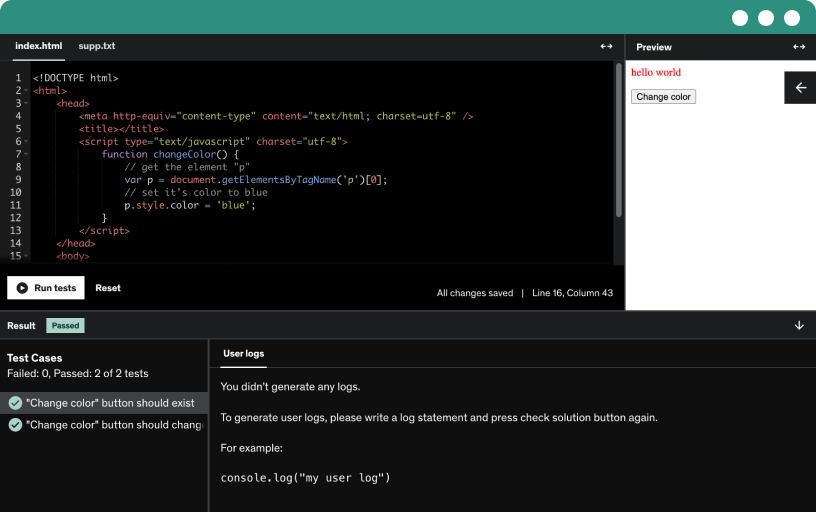
This course includes our updated coding exercises so you can practice your skills as you learn.
See a demo
Explore the definition, purpose, and evolution of ChatGPT, and how the transformer core enables human-like text generation.
The transformer is a powerful language model that models relationships between words using self-attention and word order, with an encoder and a decoder to process input and produce output.
Explore how a transformer learns language by tokenizing sentences, representing words as colored tokens, and using attention to respect word order for coherent generation.
Explore the transformer architecture built on self-attention to capture long-range dependencies, featuring multi-head attention, positional encoding, feed-forward layers, and layer normalization in an encoder-decoder framework.
Demonstrate how a transformer processes a sentence using self-attention to relate words, encodes their positions, and decodes a representation to translate or answer questions.
Discover the wide range of ChatGPT applications, from content generation and summarization to translation, customer support, chat bots, and sentiment analysis, and understand its capabilities and limitations.
Discover how ChatGPT generates contextually relevant text in a conversational style, processing vast textual data. Track its evolution from GPT-1 to GPT-4, reaching about 1 trillion parameters.
Explore ChatGPT, its purpose and evolution, and how prompt engineering uses transformer models with attention to craft clear prompts and enable data personalization and domain-specific adaptations.
Define a prompt as a text input to an ai language model like ChatGPT that initiates a response, guides context and scope, and enables effective prompt engineering and dynamic conversations.
Learn to craft specific, clear prompts and experiment systematically to improve ChatGPT outputs. Explore contextual and conversational prompts, step-by-step and debate-style answers, and length-format controls for more accurate, engaging content.
Refine open-ended prompts to yield targeted, comprehensive AI responses by specifying structure and focus, as shown through a global warming example with causes, effects, and three mitigations.
Master specificity and clarity to heighten relevance of ai generated content, by refining prompts to the top five science fiction books published in the last decade for targeted recommendations.
Explore how contextual and conversational prompts improve ChatGPT responses by providing context, clarifying intent, and producing more accurate, relevant answers.
Learn to craft step-by-step and debate-style prompts with contextual, conversational prompts. Use a chocolate cake recipe from scratch to generate detailed, organized, easy-to-follow responses.
Learn to control the length and format of ChatGPT responses by giving explicit constraints in prompts. Use word limits to produce concise explanations, such as a 100-word description of photosynthesis.
Incorporate user data and personalization to tailor prompts, generating more targeted, engaging, and useful ChatGPT responses, such as a 30-minute beginner workout focused on strength and flexibility.
Craft neutral prompts to manage biases and pitfalls in prompt engineering, emphasizing balanced factors such as governance, infrastructure, health, education, and inequality.
Adapt prompts for specific industries and applications to yield targeted, actionable insights. Focus on the technology sector to identify risks and mitigation strategies, including diversification and a long-term horizon.
Explore the building blocks of ChatGPT-4, including input representation, self-attention, positional encoding, and output generation, and see how tokenization, vocabulary, and embeddings convert text to model-ready vectors.
Demonstrate how positional encoding preserves token order by adding unique position vectors to token embeddings, created with different frequencies, so the transformer understands tokenization and context.
Explore self-attention in transformers, focusing on relevant tokens via attention scores for accurate outputs. Understand scaled dot-product attention and multi-head attention, which process tokens in parallel to capture diverse relationships.
Explore layer normalization, residual connections, and feedforward networks inside the transformer to improve training stability and performance, enabling token-by-token output generation from self-attention outputs.
Compare greedy decoding and beam search for token selection in conversational AI, contrast grid decoding, and explain how fine tuning GPT-4 on conversational data improves chatbot responses.
Master prompt engineering to design effective prompts that guide ChatGPT responses and tailor output by adjusting temperature and top K sampling, balancing diversity, relevance, and determinism.
Recognize ChatGPT's strengths in generating contextual text and processing large data, and its limitations like biases and the risk of misleading or incorrect information, grounded in the transformer architecture.
Explore the fundamentals of natural language processing and how NLP enables computers to understand, interpret, and generate human language, powering text analysis and natural human-computer interactions.
Explore how natural language processing enables applications like sentiment analysis, translation, and text summarization for businesses and researchers. Learn tokenization as a fundamental pre-processing step that breaks text into tokens.
Compare stemming and lemmatization, where stemming trims affixes to root forms and lemmatization uses context to yield base forms, with examples like running, run, and runner.
Learn how part of speech tagging assigns categories to tokens, tagging nouns, verbs, adjectives, and adverbs to reveal sentence structure and support nlp tasks like parsing and named entity recognition.
Explore dependency parsing to map grammatical relationships into a dependency tree that clarifies sentence meaning. Learn named entity recognition (NER) to identify people, locations, and dates for information extraction.
Develop coreference resolution to identify when different words refer to the same entity, enabling coherent summaries and translations. This technique supports summarization, question answering, and text analysis by clarifying entities.
Explore sentiment analysis, also known as opinion mining, to identify emotion in text and classify as positive, negative, or neutral, with applications in social media monitoring and market research.
Explore machine translation using NLP techniques to enable seamless cross-language communication. Master text summarization to generate concise, information-rich summaries of lengthy texts.
Learn how language modeling builds statistical models to predict likelihood of word or character sequences, enabling next-word predictions that power translation, speech recognition, and text generation, including ChatGPT and Bert.
Explore how rule-based and statistical nlp address ambiguity, idiomatic expressions, and language variations to build robust language understanding.
Deep learning reshapes NLP with RNNs and transformers, improving machine translation and sentiment analysis. The lecture demonstrates a feedforward neural network using tokenization, word embeddings, and labeled training data.
ChatGPT uses NLP techniques and transformers to understand and generate coherent, engaging responses in conversational settings, illustrating the fundamentals that enable and limit intelligent language systems.
Explore retrieval augmented generation (rag) to keep AI up to date by retrieving new information before answering, reducing errors and outperforming traditional llms like ChatGPT by avoiding hallucinations.
Explore retrieval augmented generation (rag) and combination of retrieval from external sources with generation via a large language model to enhance accuracy, reduce hallucinations, and enable knowledge for prompt engineers.
Explore rag-powered AI that retrieves live research papers and news articles to verify facts and stay up to date, boosting accuracy and reliability beyond standard LLMs.
Unpack how RAG works: convert queries to vectors, retrieve data from vector databases like Astra DB or Pinecone, and generate accurate, up-to-date responses with an LLM.
Load high quality data into a rag system, chunk text, create embeddings, and store them in a vector database to enable meaningful contextual matches and llm responses via the retriever.
Explore LangChain and LangFlow to build efficient retrieval-augmented generation pipelines, leveraging document loaders, retrievers, and memory to fetch relevant data from vector databases and generate informed responses.
Rag delivers accurate, up-to-date responses by retrieving external data, reducing hallucinations, and enabling domain-specific customization. However, it adds complexity, slower searches, and data security concerns, best for accuracy-critical use.
Install and run LangFlow and LM Studio to set up a RAG environment. Learn to install Python, add to path, pip install LangFlow, and explore the GUI and RAG features.
Orchestrate a local rag workflow by pairing Langflow with LM Studio, loading a llama 3.2 model, importing PDFs, creating embeddings, storing in chroma db, and building a context-based prompt template.
Demonstrates building a simple rag workflow with Gemini and Langflow, using Google Generative AI, embeddings, Chroma DB, and PDFs to power a retriever-based question-and-answer flow.
Unlock the Full Power of ChatGPT with Expert Prompt Engineering, RAG, and Next-Level AI Tools
Discover the exciting world of ChatGPT and harness the power of AI-driven conversation technology with this comprehensive, hands-on course on mastering GPT-4o and GPT-5 —the most advanced language model from OpenAI. Whether you're a beginner or an experienced user, this course will guide you through both the fundamentals and advanced capabilities of ChatGPT, now including powerful tools like Retrieval-Augmented Generation (RAG), LangChain, and Langflow.
Learn to create smarter, context-aware AI solutions by combining GPT-4o and GPT-5 with external knowledge sources, build RAG pipelines, and deploy practical LLM-based apps—all without needing a deep programming background. Perfect for entrepreneurs, professionals, students, and curious minds looking to stay ahead in the evolving AI landscape.
In this course, you’ll explore:
How ChatGPT and GPT-4o and GPT-5 work behind the scenes, including architecture and real-world applications.
Expert-level prompt engineering techniques to improve response quality, precision, and control.
Productivity hacks using ChatGPT: manage tasks, generate content, create daily schedules, and more.
Hands-on tutorials to build and deploy RAG pipelines with GPT-4o and GPT-5 using LangChain, Langflow, and vector databases.
Installation and setup guides for local development using LM Studio, Langflow, and Gemini.
Real-world projects where you integrate GPT-4o and GPT-5 with your own data sources for dynamic, smart AI apps.
Templates and frameworks to accelerate your chatbot or AI-powered application development.
Ethical AI usage best practices to ensure responsible implementation of generative tools.
No programming experience? No problem. This course is accessible, engaging, and full of practical examples designed to empower you—whether you're launching a business, upgrading your workflows, or building your first AI-powered tool.
By the end of this course, you'll not only master ChatGPT and expert prompt engineering but also gain the practical skills to build and deploy powerful RAG-based AI solutions that interact with real-time, domain-specific information.