

Your cart is empty.
Keep shoppingBeginning C++ Programming - From Beginner to Beyond
Bestseller
372,323 students
Beginning C++ Programming - From Beginner to Beyond
Obtain Modern C++ Object-Oriented Programming (OOP) and STL skills. C++14 and C++17 covered. C++20 info see below.
Last updated 4/2025
English
Arabic [Auto],Bulgarian [Auto],
What you'll learn
- Learn to program with one of the most powerful programming languages that exists today, C++.
- Obtain the key concepts of programming that will also apply to other programming languages
- Learn Modern C++ rather than an obsolete version of C++ that most other courses teach
- Learn C++ features from basic to more advanced such as inheritance and polymorphic functions
- Learn C++ using a proven curriculum that covers more material than most C++ university courses
- Learn C++ from an experienced university full professor who has been using and teaching C++ for more than 25 years
- Includes Quizzes, Live Coding Exercises, Challenge Coding Exercises and Assignments
- New Section: Learn to use Visual Studio Code with C++
- New Section: Learn all about using C++ Lambda Expressions
Explore related topics
Coding Exercises
This course includes our updated coding exercises so you can practice your skills as you learn.
See a demo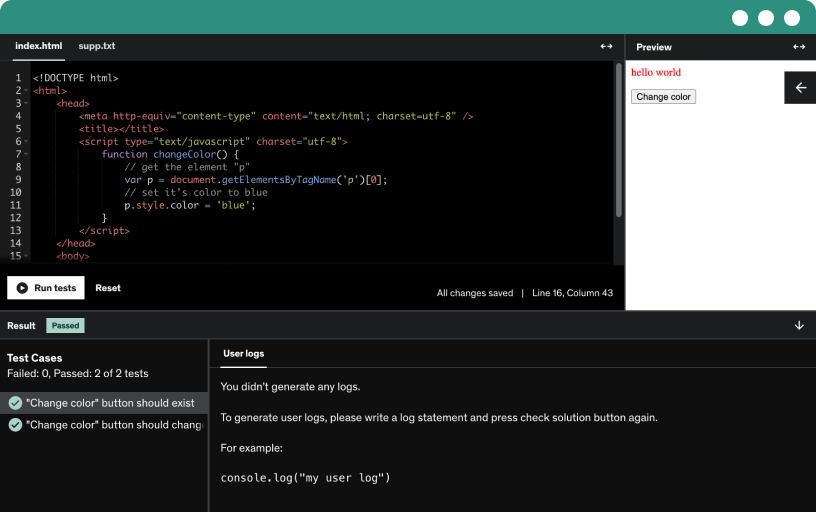
Course content
25 sections • 305 lectures • 45h 51m total length
Requirements
- Access to a computer running Windows, Mac OS X or Linux
Description
Which programming language is often seen as a badge of honor among software developers? C++
Which programming language can you learn that when added to your resume, will often get you a job interview? C++
Which programming language is routinely ranked in the top 5 programming languages by popularity, and been consistently in the top 10 for close to 20 years? C++
Why you should learn C++
Much, if not most of the software written today is still written in C++ and this has been the case for many, many years.
Not only is C++ popular, but it is also a very relevant language. If you go to GitHub you will see that there are a huge number of active C++ repositories and C++ is also extremely active on stack overflow.
There are many, many leading software titles written entirely or partly in C++. These include the Windows, Linux, and Mac OSX operating systems!
Many of the Adobe products such as Photoshop and Illustrator, the MySQL and MongoDB database engines, and many many more are written in C++.
Leading tech companies use C++ for many of their products and internal research and development. These include Amazon, Apple, Microsoft, PayPal, Google, Facebook, Oracle, and many more.
Can you see how learning C++ will open up more career opportunities for you?
If more professional companies are using C++, it stands to reason that there is going to be more of a demand for C++ programmers.
But the main reason programmers should probably learn C++ is because it is so powerful!
What do I mean by powerful?
C++ is super fast and is a general-purpose programming language that supports both procedure and object-oriented programming making it very flexible.
It can scale easily. And it can be portable as well.
C++ can do many things that other languages just can't.
That's why nearly every major language has a way to interface with code written in C++.
Since C++ has influenced so many languages, if you know C++ you'll likely see elements from C++ in new languages you learn.
How can a beginner learn C++?
Find a good course, taught by an instructor with many years of experience in C++ is critical, as is the need for the instructor to have the necessary skills to be able to teach you the language.
Frank Mitropolous, the instructor in this course has been using C++ for over 2 decades and has taught students in both university courses and industry training courses. He even worked on a C++ compiler development project while he was in the industry.
So not only will you be learning C++ from an expert C++ programmer, but you'll also be taught by an instructor who has successfully taught at university level for many years.
As a result, you can take this course with confidence, knowing that you will learn C++ the right way, and in the shortest possible timeframe.
Which version of C++ should I learn?
C++ has had many version releases and updates over the years. It's a sad fact that most C++ courses do not teach Modern C++, but focus on old, obsolete versions of C++.
Frank teaches you Modern C++ (specifically C++ 14 and C++17).
Learn C++ the right way, with Modern C++, as taught by Frank in this course.
What about C++20? Don't I need to learn about that as well?
This course currently covers C++14 and C++17 but is still valid if you ultimately want to learn C++20.
C++20 is new and the reality is that C++20 compilers and tools are not yet ready for prime time and the industry is using mainly C++14. So it's not really of any benefit for you to learn C++20 right now when the industry is not using it.
It's going to take many, many years for the industry to migrate to C++20 and that means jobs for C++20 are not going to be around for quite some time.
What is available right now, are tons of jobs for Modern C++ developers, and you will obtain those skills in this course.
It's our sincere advice to focus on learning Modern C++ and not get too hung up on the latest and greatest versions of C++.
And even if you really do want to learn C++20, the new features in C++20 are mostly advanced features that require understanding the foundations of Modern C++.
If you don't learn the basics, you won't master any version of C++.
Learning the foundations of Modern C++ should be your priority, which you will learn in this course!
Is C++ difficult to learn?
With all the power and flexibility of C++ comes complexity.
There is no question that C++ is one of the most complex programming languages out there.
But with the right instructor and the right training, you really can get up to speed with C++ quickly, and that's what this course is all about.
What will I learn in this course?
The course assumes no previous experience with C++ (or even programming in general), and you will end up with the skills to create your own programs in C++.
Key topics covered include.
* Looping with while, do/while for, range-based for statements and recursion
* Performing calculations and displaying results
* Functions
* Pointers
* Using existing classes and creating objects
* Creating your own classes
* Using Basic Standard Template Library classes such as Vector
* Constructors and Destructors
* Copy and Move semantics including Copy constructors, Move constructors, and copy and move assignment
* How to overload operators
* Using inheritance and class hierarchies
* Using Polymorphic functions and dynamic binding
* Using smart pointers
* Using stream I/O
* An introduction to the C++ STL
* An introduction to Exception Handling
* And much more.
How is this C++ course different from other courses?
You will learn Modern C++, for one. Many, perhaps most other courses on Udemy teach you old, obsolete versions of C++. If you are going to learn C++, it's imperative that you learn the Modern version to maximize your career opportunities and to ensure your skills are up to date.
The course format includes theory and concepts which are then reinforced with live code examples. Often the C++ debugger is used to step through code and analyze variables to better understand the behavior of C++. The instructor also uses a pen tablet to write on the screen and provide even more visual explanations.
You won't find better C++ training anywhere, and you will struggle to find someone with as much industry and training experience as your instructor Frank has.
What do I get out of learning C++?
More career options for one! C++ is one of the most popular programming languages used in games development. It's also heavily used in embedded applications. Your investment in time in learning C++ will reward you time and time again with more pay, and more opportunities, and frankly, more fun!
Are you ready to get started?
If you are ready to get that first paid programming job or to move up to a more senior programming position, then this course is for you!
Your new job or consulting opportunity awaits!
Why not get started today?
Click the Signup button to sign up for the course!
Who this course is for:
- This course is perfect for absolute beginners with no previous coding experience, or anyone wanting to add C++ to their existing skillset.
- Anyone looking to increase career options by learning one the most in-demand programming languages.