
This course includes our updated coding exercises so you can practice your skills as you learn.
See a demo
Define AI and general AI as subfields of computer science that mimic human vision, language, sentiment, and actions. Explore agents, reinforcement learning, and audio generation and speech driving intelligent behavior.
Define artificial intelligence and generative AI as a subfield of computer science. Learn how AI imitates human vision, language, sentiment, and action through agents in reinforcement learning and audio generation.
Generative ai learns patterns from data to generate content from prompts, enabling conversations and documentation automation; it is probabilistic, costly to train, and carries risks like alignment and data leakage.
Understand what large-language models (LLMs) are and compare open-source and closed-source options, then learn to choose the right model by considering size, data source, ownership, privacy, and deployment hardware.
This lecture defines plant engineering as designing optimal inputs for ai tools, with four parts: instruction, context, input data, and output indicator, and surveys zero-shot, full-shot, and triangle-shot CLT prompting.
Define api as an application programming interface that enables predefined functions to interact with models, databases, and external systems via a three-tier architecture for presentation front end and back end.
Explore LangChain, a software framework that speeds building AI apps with components like prompts, output parsers, retrievers, document loaders, and feature stores, plus tools for agents and retrieval strategies.
Install and configure Python to build the back end and front end of a generative AI application, using Python.org downloads across Windows, Mac, and Linux.
Set up VSCode for AI development, edit code, debug, and manage repositories with essential extensions. Log in with GitHub, explore file manager, source control, copilot chat, testing, and Docker extensions.
Explore how GitHub hosts a git-based version control system, enables code collaboration and social coding through a web interface, and demonstrates signing up, signing in, and navigating repositories.
Explore Hugging Face as a machine learning model repository and deployment platform, learn to sign up, generate an access token, and leverage models, datasets, spaces, and docs.
Sign up for the OpenAI platform, log in with email, Gmail, or Microsoft account, and access organization, dashboards, and API keys to interact with models and fine-tune via the playground.
Explore HTTP and RESTful API concepts, including the client-server model, HTTP methods (get, post, put, delete), and how RESTful design maps to HTTP for simple, scalable, stateless APIs.
Explore the six-step API development and deployment workflow, from requirement analysis to deployment, covering API design, development, unit and functional testing, documentation, and container-based deployment.
Architect your Python API backend with FastAPI using an object oriented, modular approach that encapsulates components into modules for structured unit tested deployment and ci/cd powered development.
Demonstrates architecting a FastAPI back-end for an AI chatbot, including project setup with git, a dockerized API, middleware, componentized GPT chatbot, and environment-based API keys.
Discover fastapi as a python api backend with openapi docs and type checking for ai application development. The session covers credentials, calls to openai and hugging face, and response formatting.
Containerize your API with Docker to create a lightweight, isolated runtime that unifies development and deployment. Build images from a Dockerfile, install dependencies, and run the API.
Deploy your api on Hugging Face spaces by creating a public space with a docker-based template. Clone the repository, add app and dockerfile, push updates, and launch a public endpoint.
gradio, an open-source python library, lets you build user interfaces for machine learning models and prototype chatbots and image demos; learn to wire api calls and manage tokens for deployment.
Demonstrates deploying a Gradio application on Hugging Face spaces, setting up a front-end space, uploading files, debugging back-end and front-end, and testing a chatbot with llama and GPT versions.
DevOps unites development and operations through practices, culture, and people, enabling faster delivery and reliability via continuous integration and continuous deployment pipelines.
Explore software testing as a critical development phase, evaluating performance, functionality, and security to identify bugs and flaws. Define levels from unit and integration tests to system and end-to-end testing.
Explore software testing frameworks and pytest as an easy way to write unit tests in Python and validate applications.
Demonstrates writing Python code for a generative AI app, using VS Code, testing with FastAPI test client and pytest, validating a running server, endpoints, and model token generation.
Demonstrates building an automated test workflow with GitHub Actions for your app, including CI/CD tests on an Ubuntu runner with Python 3.9 and a Docker image, using Hugging Face tokens.
Discover domain annotations to provide context when data falls outside pre-trained data set. Compare three annotation approaches: in-context learning, RAC retrieval algorithm generation, and supervised fine-tuning on your own data.
Architect a fast api backend in Python for rapid development and production performance. Structure code with a modular, object-oriented design, supported by unit tests and ci/cd pipelines.
Set up the development environment, deploy a backend API to Hugging Face Space with a chat interface, and automate tests and pipelines with GitHub Actions.
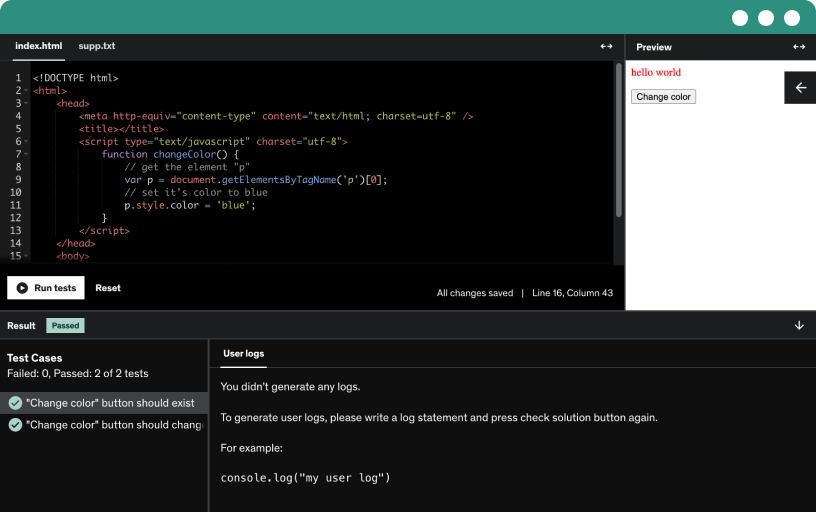
Apply skills from this course by working backwards from real problems to ChatGPT-like solutions, while doing hands-on projects to test and learn from feedback.
Becoming an AI Engineer with LLM Application Development
| A concise guide for AI engineers to develop and deploy generative AI applications |
What is generative AI? Why you should be a part of this revolution?
Generative AI is a truly transformative technology that allows us to engineer and deploy various AI applications like chatbots and other automation workflows without costly upfront investments. Therefore, there is an emerging trend that many companies, even if not within the technology domains like finance and health care, are trying to adopt AI applications like ChatGPT. Here is what an AI engineer could do to help these organizations develop and deploy a valuable and cost-effective AI application using various open or closed-source models. If you want to be a part of this revolution, this course is right for you to learn the fundamental concepts and practical skills to become an AI engineer nowadays.
What can I learn from this course?
- Chapter 1 - Introduction to Generative AI
- Chapter 2 - Environment Set-up / Generative AI Platform Tours
- Chapter 3 - Develop your API endpoint for your generative AI applications
- Chapter 4 - Develop and Deploy with your Front-end Interface
- Chapter 5 - Streamline API Delivery with Automated Test and Deployment Pipeline
- Chapter 6 - Course Summary / Final Exam
What can I gain from this course?
This course has a wide range of materials to help you become familiar with the concepts and skills to design, develop, and deploy an AI application; those resources include:
1. On-demand lecture videos
2. Supplement learning resources to keep up to date with the latest trend
3. Open-source codebase to help you kick-start your AI engineer journey
4. Various online quizzes to help you familiarize yourself with the contents and the skills
5. Q&A with the instructor
6. Programming test with hands-on online practice
Who is my instructor?
Mark is an entrepreneur and computer science student at the University of London who lives in Taiwan. He founded Mindify AI, a company aimed at helping software engineers learn new codebases faster with its flagship product, Mindify Chat. Mark is also involved in AI and quantum AI research, working on innovative projects, including utility-scale quantum generative AI models for the Google Quantum Application XPRIZE. In addition to his business ventures, Mark creates Notion templates and Udemy courses, generating side income. Mark's recent achievements include developing algorithms, leading research projects, starting a new company, and gaining traction for Mindify AI. He is dedicated to making his products profitable and advancing his research and business efforts.